Air Freight Volumetric Weight: How Chargeable Weight Is Calculated
You packed 35 kg of goods, your freight forwarder quoted a price, and then the invoice arrived charging you for 62 kg. Before you call it a billing error, check the tape measure — because in air freight, the price is not set by what your cargo weighs. It is set by how much space it occupies.
This is the volumetric weight rule, and it is the single most common source of surprise air freight bills for importers buying from China. A pallet of plush toys that weighs almost nothing can be charged as if it weighed half a ton. A carton of folded T-shirts can cost more to fly than a solid steel part of the same box size. None of this is arbitrary — airlines sell space, not weight, and dimensional weight (also called volumetric weight or DIM weight) is how that space gets priced.
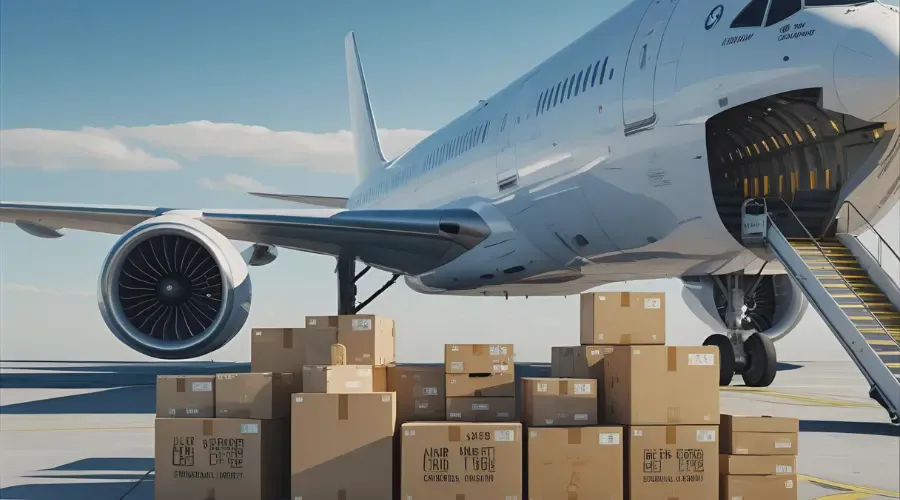
This guide explains exactly how chargeable weight works in 2026: the formula, the DIM factors used by air cargo lines versus express couriers, worked examples you can copy, and seven practical ways to reduce your volumetric weight so your next shipment from China costs less. If you want the short version first: chargeable weight = the larger of your actual weight and your volumetric weight, and volumetric weight = (length × width × height) ÷ a DIM factor that depends on who carries your freight.
1. What Is Volumetric Weight and Why Does Air Freight Use It?
Volumetric weight is a theoretical weight calculated from your shipment's dimensions rather than its physical mass. It exists because an aircraft's cargo hold is a fixed volume, and a plane that is "full" by space can still be far under its maximum payload by weight. A Boeing 777 freighter can lift about 100 tonnes, but its hold can only physically fit a finite number of cubic meters. If you filled that hold entirely with feather pillows, the plane would be space-full while carrying a fraction of its weight capacity — and the airline would lose money on every flight.
To price fairly across both scenarios, the industry converts volume into an equivalent weight using a DIM factor (dimensional weight divisor). If your cargo's volume-equivalent weight exceeds its actual weight, you pay for the volume. If your cargo is genuinely heavy, you pay for the actual weight. Either way, the airline recovers the cost of the space your shipment occupies.
This logic is worth keeping in mind: volumetric weight is not a surcharge or a trick. It is the standard commercial mechanism that keeps lightweight, bulky cargo from being subsidized by heavy cargo. Every airline and every express courier on the planet applies it — the only difference is the divisor they use (Section 3).
Key Terms You Will See on Every Air Freight Quote
| Term | What It Means |
|---|---|
| Gross weight / actual weight | The total physical weight of your cargo, including packaging, usually in kg. |
| Volumetric weight / DIM weight | The "theoretical" weight calculated from your shipment's dimensions using a DIM factor. |
| Chargeable weight | The number your invoice is based on — always the larger of gross weight and volumetric weight. |
| DIM factor / divisor | The number used to convert volume into weight (e.g., 6,000 for international air cargo). |
| Light cargo / low-density cargo | Cargo whose volumetric weight exceeds its actual weight — billed on volume. |
| Heavy cargo / high-density cargo | Cargo whose actual weight exceeds its volumetric weight — billed on weight. |
2. The Formula: How to Calculate Volumetric Weight
The metric formula used for international air freight is simple:
Volumetric weight (kg) = Length (cm) × Width (cm) × Height (cm) ÷ 6,000
For international express couriers (DHL, FedEx, UPS international air services), the most common divisor is 5,000:
Volumetric weight (kg) = Length (cm) × Width (cm) × Height (cm) ÷ 5,000
For US domestic air freight using imperial units, you will often see 166 in³/lb:
Volumetric weight (lb) = Length (in) × Width (in) × Height (in) ÷ 166
Whichever formula applies, the final step is identical:
Chargeable weight = max (gross weight, volumetric weight)
Worked Example 1: A Genuinely Light Shipment (Billed on Volume)
You are shipping 40 cartons of children's plush toys from Shenzhen to Los Angeles. Each carton measures 60 × 40 × 40 cm and weighs 8 kg.
- Actual weight: 40 × 8 = 320 kg
- Volume per carton: 60 × 40 × 40 = 96,000 cm³
- Volumetric weight per carton: 96,000 ÷ 6,000 = 16 kg
- Total volumetric weight: 40 × 16 = 640 kg
Your chargeable weight is 640 kg — double your actual weight. Your $7/kg air freight rate suddenly becomes an effective $14/kg on the invoice. This is the exact scenario that generates "why is my bill twice my scale weight?" phone calls.
Worked Example 2: A Genuinely Heavy Shipment (Billed on Weight)
You are shipping 10 cartons of stainless steel kitchen equipment from Guangzhou to Dubai. Each carton measures 50 × 40 × 30 cm and weighs 45 kg.
- Actual weight: 10 × 45 = 450 kg
- Volume per carton: 50 × 40 × 30 = 60,000 cm³
- Volumetric weight per carton: 60,000 ÷ 6,000 = 10 kg
- Total volumetric weight: 10 × 10 = 100 kg
Chargeable weight = max(450, 100) = 450 kg. You pay for actual weight. Dense, heavy goods are priced on weight — which is exactly why freight forwarders love mixing heavy and light cargo on the same pallet (Section 7).
Worked Example 3: The Express Courier Difference (÷ 5,000)
The same plush toy cartons above, shipped via DHL or FedEx express from Shenzhen to New York:
- Volumetric weight per carton: 96,000 ÷ 5,000 = 19.2 kg (vs. 16 kg under the air cargo divisor)
- Total volumetric weight: 40 × 19.2 = 768 kg vs. actual 320 kg
The stricter 5,000 divisor means express couriers charge you 20% more volumetric weight than standard air cargo for identical dimensions. This is one reason your express quote can look shockingly high for bulky goods — and why standard air freight via a forwarder is often far cheaper for anything larger than a few small cartons.
3. DIM Factors: Which Divisor Applies to Your Shipment?
The divisor is the variable that most importers never think to ask about — and it changes your bill by 20% or more. Here is the landscape in 2026:
| Channel | Typical DIM Factor | Notes |
|---|---|---|
| International air cargo (IATA standard) | 1 kg = 6,000 cm³ | The default for freight-forwarder air shipments; most airline tariffs use 6,000. |
| International express (DHL, FedEx, UPS) | 1 kg = 5,000 cm³ | Stricter divisor; applied per-piece on most courier services. |
| US domestic air freight | 166 in³ per lb | Equivalent to ~6,000 cm³/kg; used on US domestic lanes. |
| China–US / China–EU express lanes | Often 5,000 | Many China-based express and "专线" (dedicated line) carriers apply 5,000 to be safe. |
| Sea freight LCL | 1 CBM = 1,000 kg | A completely different benchmark — see Section 6. |
Two practical consequences follow.
First, always confirm the divisor before you book. A quote based on 6,000 and an invoice based on 5,000 differ by 20% on a volume-billed shipment. Reputable forwarders state the divisor on the quotation; if yours does not, ask in writing.
Second, know that DIM factors are not sacred constants. Carriers occasionally revise them, and during peak seasons (September–November, and the weeks before Chinese New Year) some airlines and couriers apply stricter divisors or add volume-related surcharges. The figures above are the long-standing industry norms as of 2026, but the operative number is always the one on your carrier's current tariff sheet.
4. Why Chargeable Weight Trips Up First-Time China Importers
Volumetric weight is taught once and forgotten, which is why it generates so much friction between importers and forwarders. The most common misunderstandings we see at AllBestShipping, in no particular order:
"My goods weigh 200 kg — why am I billed for 400?" Because your 40 cartons of inflatable pool floats occupy 400 kg of space. The plane cares about the space.
"The courier weighed my parcel and it matched my invoice, so it's fair." Express couriers weigh and measure. If your parcel's volume-equivalent exceeds its scale weight, you are billed on volume — check the DIM line on your courier invoice.
"I'll just declare smaller dimensions." Do not. Airlines and couriers re-measure randomly and on suspicion; a mismatch between declared and actual dimensions triggers re-invoicing, penalties, and in repeat cases account suspension. Honest dimensions are the only safe dimensions.
"Air freight is always more expensive than sea freight." Not necessarily — see Section 6. For low-density cargo, air freight can actually be the cheaper and faster option, because you are paying less "space" than you think.
"My forwarder's quote included volumetric weight, so I'm being scammed." No — the quote was correct; the surprise is usually that nobody explained the calculation up front. A good forwarder flags volume-billed shipments before quoting so there are no surprises.
5. Seven Proven Ways to Reduce Your Volumetric Weight
Because chargeable weight is driven by volume, packaging decisions directly change your freight bill. These are the strategies our team uses to cut clients' air freight costs from China by 15–40% on light cargo:
1. Vacuum-compress soft goods
Textiles, plush toys, bedding, pillows, and apparel can be vacuum-packed, shrinking their volume by 50–70%. This is the single biggest win for garment and toy importers. Ask your supplier whether your goods are compressible — most are.
2. Redesign or downsize your export carton
Oversized packaging is the quiet killer of freight budgets. A carton with 10 cm of empty space around its contents wastes hundreds of cm³ per box. Standard export carton sizes (e.g., 60 × 40 × 40 cm) are convenient, but a bespoke size that hugs your product can cut volumetric weight by 15–25% across a full shipment. Suppliers in China routinely customize cartons cheaply.
3. Ship flat-packed or knock-down where possible
Furniture, shelving, and machinery can often ship knocked-down: legs removed, frames disassembled, nested parts stacked. A flat-packed table can occupy one-fifth of the volume of an assembled one. Confirm the buyer can assemble on arrival, and check that the product's import duties don't penalize knocked-down forms (they usually don't).
4. Remove excess internal packaging
Filler foam, oversized bubble wrap, and double-boxing inflate both volume and weight. Right-size the protective packaging to the product's fragility instead of defaulting to generous padding.
5. Consolidate into mixed-density pallets
Forwarders can co-load your light cargo with heavy cargo from other shippers on the same pallet or ULD (unit load device). Because the airline charges the pallet as a whole, mixing densities balances the bill — a well-known practice that can cut effective rates on volume-heavy shipments. This is where using an experienced air freight forwarder pays for itself.
6. Choose the right transport mode for the density
If your cargo's volumetric weight is more than ~2.5× its actual weight, it is genuinely "light," and you should question whether air freight is the right mode at all. Sea freight LCL, rail, or door-to-door consolidated services may undercut air on cost even after transit-time trade-offs (Section 6).
7. Measure everything before you book
Get carton dimensions and weights from your supplier in advance, run the formula yourself, and ask your forwarder to confirm the expected chargeable weight in the quotation. Ten minutes of math before booking beats a two-week dispute after invoicing.
6. Air vs. Sea vs. Express: How Volumetric Weight Changes the Math
The most useful mental model for choosing a shipping mode from China is this: air freight prices space aggressively; sea freight prices space generously; express couriers price space most aggressively of all.
- Air cargo (÷ 6,000): 1 CBM of cargo = 167 kg of chargeable weight.
- Express courier (÷ 5,000): 1 CBM = 200 kg of chargeable weight.
- Sea freight LCL: 1 CBM = 1,000 kg maximum chargeable — but LCL billing compares your volume against 1 CBM per 1,000 kg and bills on whichever is larger, with rates per CBM that are a tiny fraction of air rates per kg.
Concretely: a 1-CBM, 150-kg shipment of soft goods would be charged at 167 kg by air, 200 kg by express, and 1 CBM by sea — and the sea rate for that CBM will be a small fraction of the air rate for 167 kg. That is why bulky, low-value cargo overwhelmingly moves by sea or rail, while urgent, high-value, or genuinely dense cargo justifies air.
The decision framework we give our clients:
| Your cargo profile | Recommended mode | Why |
|---|---|---|
| Urgent, high value, small volume (samples, spare parts, electronics) | Air or express | Speed justifies the price; small volume keeps volumetric weight low. |
| Dense and heavy (machinery parts, tools, hardware) | Air often competitive | Billed on actual weight, so no volume penalty. |
| Bulky and light (toys, textiles, inflatables) | Sea LCL or rail | Volume penalty makes air disproportionately expensive. |
| Full containerloads (any density) | Sea FCL | Flat container price; no per-CBM volume math. |
| E-commerce parcels to consumers | Express or dedicated line | Door-to-door tracking; accept the 5,000 divisor as the cost of speed. |
For a fuller breakdown of how LCL and consolidation pricing works on the sea side, our LCL shipping guide walks through the comparison. And if you are shipping products destined for Amazon warehouses, the volumetric-weight math interacts with FBA's own size tiers — our Amazon FBA shipping from China guide covers the freight side of that decision.
7. FAQ: Air Freight Volumetric Weight Questions, Answered
Q1: Is volumetric weight the same as chargeable weight?
Not exactly. Volumetric weight is the calculated value; chargeable weight is what you are billed on — always the larger of actual weight and volumetric weight. When people say "I was charged by volumetric weight," they mean their volumetric weight exceeded their actual weight and became the chargeable weight.
Q2: Why do express couriers use 5,000 and air cargo uses 6,000?
Each carrier sets its divisor commercially. The 6,000 figure is the long-standing IATA air-cargo norm; couriers' 5,000 divisor reflects the higher cost structure of door-to-door express networks (more handling, more trucking legs, more sorting). The practical effect: for identical dimensions, express charges ~20% more volumetric weight than standard air cargo.
Q3: My carton is half empty — do I still pay for the full box?
Yes. Airlines measure the outer carton, not the contents. Empty space inside packaging is billed as if it were cargo. This is precisely why right-sizing your cartons (Section 5) is the cheapest cost-saving lever available.
Q4: Can I reduce chargeable weight by compressing goods?
Absolutely — if the goods survive compression. Vacuum packing soft goods, nesting hollow items, and knock-down assembly all reduce outer dimensions, which directly reduces volumetric weight. Your forwarder can advise which products in your range are compressible.
Q5: Do airlines actually re-measure my cargo?
Yes. Random and targeted re-measurement is routine at airline warehouses, particularly for consistently "suspicious" shippers. If re-measured dimensions exceed the declared ones, you are re-invoiced at the corrected chargeable weight — and repeat discrepancies can flag your account for 100% inspection. Accurate declarations protect both you and your forwarder.
Q6: I'm shipping a 2 kg sample in a big box — why is it billed at 5 kg?
Because the courier measures the box. A 40 × 30 × 30 cm box has a volumetric weight of 7.2 kg under the 5,000 divisor (40×30×30÷5,000), so the 2 kg sample bills at 7.2 kg. For samples, use the smallest box that safely fits the product — sample budgets are frequently blown on oversized packaging.
Q7: Are volumetric weight rules the same for sea freight?
No. Sea freight LCL uses a different benchmark (1 CBM = 1,000 kg) with rates quoted per CBM, which is far more forgiving of light cargo. The volumetric-weight principle — bill on the larger of weight and volume — exists in both modes, but the economics make sea the natural home for bulky goods.
8. The Bottom Line
Volumetric weight is not a fee, a penalty, or a mistake — it is the pricing logic of air transport, applied consistently by airlines and couriers worldwide. The importers who control their freight costs are the ones who run the formula before booking, right-size their packaging, and choose the transport mode that matches their cargo's density.
At AllBestShipping, our air freight team in Shenzhen quotes chargeable weight transparently — the divisor, the math, and the expected chargeable weight are spelled out in writing before you book, and we routinely re-pack and consolidate light cargo to shrink it. Whether you are flying urgent samples to the US, moving e-commerce inventory to Amazon warehouses, or comparing air against sea for a full production run, contact AllBestShipping for a quotation that shows its work — and get a shipping plan built around your cargo's real cost drivers.