Shipping Cost from China to South Korea: Sea & Air Freight Rates in 2026
China has been South Korea's largest trading partner for more than two decades, with bilateral trade routinely topping US$300 billion a year — semiconductors, electronics, machinery, chemicals, textiles, and consumer goods crossing the Yellow Sea in both directions every day. Yet ask most first-time importers how much it actually costs to ship from China to South Korea, and you will get a blank stare. The quote they finally receive rarely matches the number they actually pay.
Here is the good news that surprises everyone coming from the US or Europe lanes: China–Korea is one of the shortest, cheapest, and fastest freight corridors on the planet. A 20ft container can cost less than one-tenth of what the same box costs on the transpacific. Ocean transit is measured in days, not weeks. Air freight is priced at a fraction of what you would pay on long-haul routes.
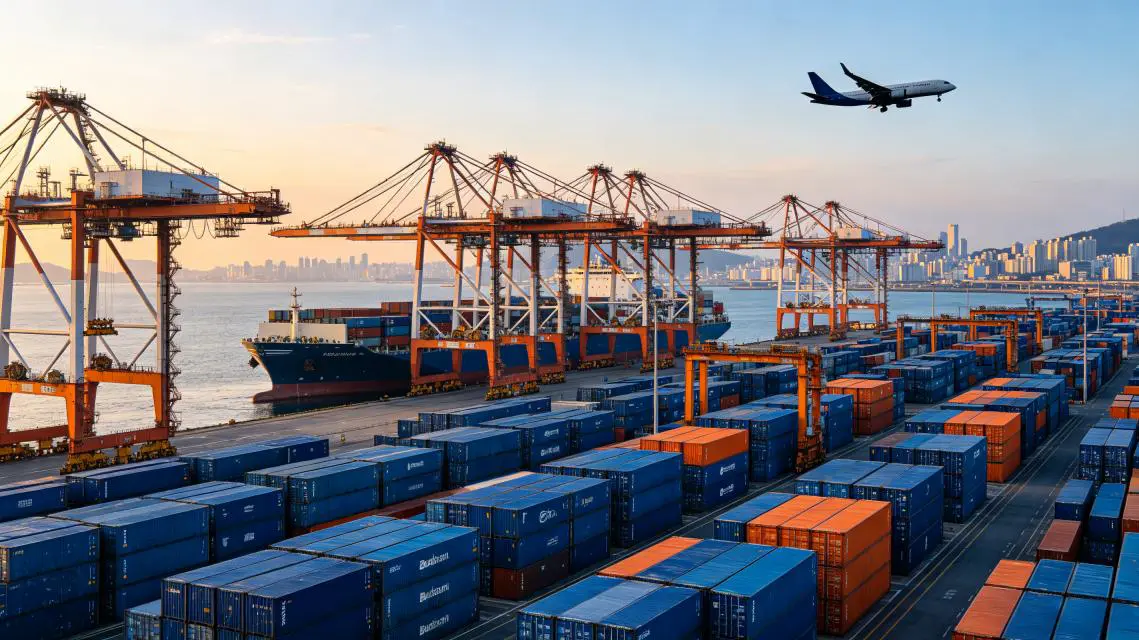
The catch is on the destination side. Korea's 10% value-added tax (VAT), the import duty applicable to your HS code, port and clearance charges, and — new for 2026 — a much stricter e-commerce customs regime can quietly turn a "cheap" shipment into a surprise bill. This guide gives you the full 2026 cost picture: sea freight (FCL and LCL) by port pair, air freight per kilogram, express courier, and door-to-door DDP — plus the tax stack and compliance rules that determine your real landed cost. Every figure is an indicative market range for August–September 2026; rates on this lane move weekly, so treat this as a planning reference and always request a written quote before you book. For a frame of reference on how far costs can diverge by destination, our cost guide for shipping costs from China to Brazil breaks down a much more expensive corridor on the other side of the globe.
1. The TL;DR: What It Costs to Ship from China to South Korea in 2026
| Shipping Mode | Indicative Cost (Aug–Sep 2026) | Transit Time | Best For |
|---|---|---|---|
| LCL (less than container load) | $15 – $35 per CBM (freight only) | 9 – 16 days door-to-door | Small loads under 13 CBM, trial orders |
| FCL 20ft container | $300 – $550 per container | 3 – 7 days port-to-port | 15–28 CBM, heavy or mixed cargo |
| FCL 40ft / 40HQ container | $500 – $850 per container (40HQ up to $1,000) | 3 – 7 days port-to-port | Large volumes, 28+ CBM |
| Air freight | $1.80 – $3.50 per kg (100+ kg) | 1 – 3 days airport-to-airport | Urgent, high-value cargo |
| Air express (DHL/UPS/FedEx) | $2.50 – $4.50 per kg | 1 – 3 days | Parcels under 100 kg, samples, documents |
| Door-to-door DDP (sea, all-in) | ~$800 – $1,500 per 20ft, tier-dependent | 10 – 18 days | One fixed landed price, no customs team |
Two things matter before you start comparing quotes. First, these are scope-specific numbers: port-to-port, door-to-door, and DDP include very different work, so compare like with like (Section 6 explains what each covers). Second, the landed cost is always higher than the freight quote, because Korea's 10% VAT, import duty, and port charges stack on top. On this lane the freight is genuinely cheap — the discipline comes from budgeting the taxes and clearance costs correctly.
2. Why China–Korea Shipping Is So Cheap in 2026
Unlike most routes out of China, the Korea lane has no geopolitical premium baked into the rate.
- A very short ocean leg. Busan, Incheon, and Pyeongtaek sit across the Yellow Sea and East China Sea from Qingdao, Tianjin, Shanghai, and Ningbo. Sailing times run 2–6 days — and from North China ports like Weihai, Yantai, Qingdao, or Dalian, some services reach Incheon or Busan in 1–3 days.
- High-frequency sailings. This is one of the busiest short-sea corridors in the world, with multiple weekly departures from every major Chinese port. Frequent capacity means stable pricing and easy booking — no 30-day rollover anxiety like you get on the transpacific.
- No Red Sea effect. Cape of Good Hope rerouting, which has inflated Europe and Africa lanes since 2024, does not touch intra-Asia short-sea services. Rates here are driven by local demand and capacity, not security premiums.
- Intense carrier competition. Dozens of Chinese and Korean carriers — including fast ferry/RO-RO services on the Qingdao–Incheon and Weihai–Incheon runs — fight for the same cargo, keeping headline rates near the lowest levels in the world.
The flip side: because base freight is so low, fixed destination costs dominate. Korea port charges, customs brokerage, and inland trucking can equal or exceed the ocean freight itself, and the 10% VAT applies to the full CIF value. Also expect a seasonal bump of roughly 10–25% around Chinese New Year and during the Q4 peak, when Korean retailers stock for the year-end trading season.
3. Sea Freight Costs: FCL and LCL, Broken Down
Sea freight carries the overwhelming majority of cargo volume between China and South Korea, and for anything over about 2 CBM it is the most economical option by far. Our Sea Freight from China service moves containers on exactly these lanes every week.
FCL Rates by Port Pair (2026 Q3 Reference)
| Origin Port (China) | Destination | 20ft (USD) | 40ft / 40HQ (USD) | Est. Transit |
|---|---|---|---|---|
| Qingdao / Tianjin | Incheon / Busan | $300 – $480 | $500 – $780 | 1 – 3 days |
| Shanghai / Ningbo | Busan / Incheon | $320 – $520 | $520 – $850 | 2 – 4 days |
| Shenzhen / Guangzhou | Busan / Incheon | $350 – $550 | $560 – $900 | 4 – 6 days |
A 20ft container holds roughly 28 CBM and a 40ft high-cube roughly 68 CBM. For dense, heavy goods (machinery, auto parts, building materials) the 20ft is usually the better buy; for light, bulky consumer goods the 40HQ wins on cost per CBM. On top of the freight quote, budget roughly $400 – $900 for destination port charges, customs clearance, and inland delivery to Seoul or the surrounding Gyeonggi region (more if your cargo moves onward to Busan-area destinations or requires special handling).
The 13–15 CBM rule: under 13 CBM, LCL is usually cheapest. Between 13 and 15 CBM, run the full math — once consolidation, deconsolidation, and destination handling are added, a 20ft FCL frequently ends up cheaper and clears faster. Over 15 CBM, book the FCL.
LCL: Paying by the Cubic Meter
LCL (less than container load) means your cargo shares a container with other importers' goods. Rates on the China–Korea lane currently run $15 – $35 per CBM, charged on the W/M rule (1 CBM = 1,000 kg — you pay for whichever is greater) with a typical minimum chargeable volume of 1 CBM. Because the sailing is so short, consolidation and deconsolidation time — not the ocean leg — drives LCL lead times of roughly 9 – 16 days door-to-door.
The low headline rate hides a familiar pattern: destination charges pile on. A typical LCL consignment to Korea also carries:
| Charge | Typical Range (2026) | What It Covers |
|---|---|---|
| Destination THC & port charges | $80 – $150 per CBM | Terminal handling at Busan/Incheon |
| CFS deconsolidation | $40 – $80 per CBM | Unpacking from the shared container |
| Customs clearance & brokerage | $100 – $250 per shipment | UNI-PASS filing, broker fees, D/O handling |
| Inland delivery (port → Seoul) | $150 – $350 per shipment | Trucking, rail, or courier to final address |
| Demurrage & storage risk | $30 – $60+ per day | If paperwork is late; the clock starts at discharge |
Add those up and a "cheap" $25/CBM LCL shipment can easily land at $120 – $250 per CBM by the time it reaches a Seoul warehouse — before duties and VAT. For small trial orders and samples that is still the most economical route; for anything over about 13 CBM, a full container wins.
4. Air Freight Costs: Per KG to Incheon
Air freight from China to South Korea is one of the cheapest air lanes in the world. General cargo typically runs $1.80 – $3.50 per kg for shipments above 100 kg, with large consolidated lots (1,000 kg+) sometimes quoting as low as $1.60/kg — a fraction of the $4–8/kg you would pay on the transpacific. Express services run $2.50 – $4.50 per kg all-in for parcels under 100 kg. Transit is 1 – 3 days airport-to-airport, and roughly 3 – 5 days door-to-door including pickup, export handling, clearance, and final delivery.
| Weight Band | Rate per KG (USD, airport-to-airport) | Example Cost |
|---|---|---|
| 21 – 45 kg | $2.80 – $4.50 | 30 kg ≈ $85 – $135 |
| 45 – 100 kg | $2.30 – $3.80 | 80 kg ≈ $185 – $305 |
| 100 – 300 kg | $2.00 – $3.20 | 200 kg ≈ $400 – $640 |
| 300 – 1,000 kg | $1.80 – $2.80 | 500 kg ≈ $900 – $1,400 |
| 1,000+ kg | $1.60 – $2.40 | 2,000 kg ≈ $3,200 – $4,800 |
Air is priced on chargeable weight: the greater of actual gross weight and volumetric weight (length × width × height in cm ÷ 6,000). A light, bulky 1 CBM carton weighs 167 kg for pricing purposes even if it only tips the scale at 60 kg — so do the volumetric math before you assume air is affordable for your product. On this lane, air makes sense when time genuinely matters: urgent restocks, high-value electronics, spare parts for production lines, samples, and e-commerce reorders. Our Air Freight from China team routinely moves time-sensitive Korea-bound cargo through ICN (Incheon) with door-to-door tracking.
5. Express, Door-to-Door, and DDP: The All-In Price
For parcels under 100 kg, international express (DHL, UPS, FedEx, SF Express) is the default choice: $2.50 – $4.50 per kg, 1 – 3 days to Seoul or Busan, with the courier handling clearance on your behalf. For anything larger — or for importers who want one fixed price and zero customs paperwork — door-to-door DDP (Delivered Duty Paid) is the answer.
Korea requires imports to be declared by a local Importer of Record (IOR) through the KCS UNI-PASS electronic clearance system. If you have no Korean entity, a DDP service solves this by acting through a licensed local partner. A well-structured sea DDP quote (roughly $800 – $1,500 per 20ft all-in, depending on cargo and service tier) bundles:
- China origin: pickup, export customs, and container loading;
- Ocean freight on the short-sea leg;
- Korea destination: UNI-PASS import declaration, customs clearance, duties and 10% VAT paid on your behalf;
- Final delivery to your warehouse in Seoul, Incheon, Busan, or elsewhere.
Air DDP runs $3.50 – $6.00 per kg all-in with 3 – 5 day delivery. You pay a margin for convenience and for the forwarder's risk — but you eliminate the two biggest budget killers on this lane: compliance mistakes (a mismatch in consignee data can freeze your cargo, as Section 7 explains) and demurrage surprises. For first-time importers, SMEs, and e-commerce sellers without a Korean entity, DDP is usually the right call. If you are still mapping out end-to-end timing for any mode, our guide to how long shipping from China takes is a useful planning reference.
6. The Tax Stack: Duties, VAT, and the $150 Rule
Here is where "cheap freight" meets Korean fiscal reality. Freight gets your cargo to Korea; taxes get it out of the port.
Import Duty (Customs Tariff)
Duty rates depend on the HS code of your goods. Korea's most-favored-nation (MFN) tariff averages roughly 4–8%, with sensitive agricultural and textile categories running higher and many industrial inputs at 0%. The big opportunity is the China–Korea Free Trade Agreement (FTA), in force since December 2015: most industrial goods — electronics, machinery, auto parts, chemicals — have been phased down to 0–5%, and many sit at 0%. To claim the preferential rate you need a valid Certificate of Origin (C/O) issued for the shipment, with the goods meeting the FTA's rules of origin. Importers who skip the C/O pay full MFN rates for no reason — a classic, avoidable cost.
VAT: 10% on Nearly Everything
Korea applies a 10% VAT to almost all imported goods, calculated on the CIF value plus import duty (i.e., the assessed customs value). This is not optional and it is not hidden — but first-time importers routinely forget to budget it, and it applies even when the duty rate itself is 0% under the FTA. On a $10,000 CIF shipment with 3% duty, expect about $1,060 in VAT and duty before anything else.
The $150 De Minimis Rule
For low-value shipments, Korea exempts goods from duty (not necessarily VAT) below a $150 threshold — measured on goods value, excluding freight — and clears them through a fast list-based clearance (목록통관) with minimal documentation. Shipments from the United States benefit from a higher $200 threshold under the KORUS FTA. Above the threshold, formal import declaration applies: full duty plus 10% VAT, longer processing, and stricter scrutiny. This makes the $150 line a practical planning number for samples and small e-commerce orders — but deliberately splitting a large commercial order into sub-$150 parcels to dodge duty is exactly the pattern Korean customs is now actively targeting (see Section 7).
Product Compliance You Cannot Skip
- KC certification applies to electrical and electronic products, toys, and certain industrial goods — a legal requirement before sale in Korea.
- MFDS registration applies to foods, health supplements (personal-use limits, e.g., 6 bottles per product type), cosmetics, and pharmaceuticals.
- Certain goods need import licenses or quotas; others (some used goods, agricultural products) face special restrictions.
7. New for 2026: Korea's E-Commerce Customs Crackdown
This is the most important compliance change on the lane right now, and it affects everyone shipping parcels to Korean consumers — marketplace sellers on Coupang, Naver, Gmarket, and 11Street, plus brands selling D2C into Korea.
- Stronger PCCC verification (effective February 2, 2026). Korea Customs now cross-checks every B2C shipment against the recipient's Personal Customs Clearance Code (PCCC). The consignee's name, mobile phone number, and postal code must exactly match the details registered against the PCCC — for both low-value and formally declared shipments. Any mismatch triggers a customs hold while the recipient is contacted to correct the data, which means delays and failed deliveries.
- New e-commerce declaration system (live August 15, 2026). KCS launched a dedicated e-commerce customs declaration format for registered operators. Registration for e-commerce operators and API connections ran from June 5 to July 31, 2026. Shipments from non-registered or non-integrated operators face longer clearance and more inspections, and buyers now confirm identity with PCCC + OTP verification. Korean Customs also verifies that the buyer's registered details match the shipping data exactly.
The practical takeaway for sellers: data hygiene is now a shipping requirement, not an afterthought. Collect the buyer's exact name (as registered), correct phone number, and postal code at checkout; use a carrier or customs broker with a registered e-commerce pipeline; and never ship blind to an unverified address. This is also why working with a forwarder that handles Korean compliance daily — rather than a generalist — is worth real money on this lane. If you are new to the freight forwarding model, our explainer on what a freight forwarder does covers how a good partner absorbs exactly these kinds of regulatory changes for you.
8. Three Real-World Cost Scenarios
Every shipment is different, but these worked examples show the shape of a real China–Korea budget (all figures indicative, August–September 2026):
Scenario A — Sample order: 30 kg of electronics samples via express - Air express: $85 – $135 (at ~$2.80–$4.50/kg) - Door-to-door in 2 – 4 days, courier handles clearance - All-in: roughly $100 – $150. Below the $150 duty threshold if valued accordingly.
Scenario B — Trial stock: 3 CBM of homeware via LCL - LCL freight: $45 – $105 (at $15–$35/CBM) - Destination THC, CFS, clearance: $150 – $350 - Duty + 10% VAT on CIF (assume ~13% combined): $400 – $800 on a $4,000–6,000 cargo - All-in landed: roughly $600 – $1,250. Freight is under 10% of the total — the taxes and handling dominate.
Scenario C — Full container: 20ft of electronics from Shenzhen to Busan - FCL 20ft freight: $350 – $550 - Destination port charges, clearance, trucking to Seoul: $400 – $900 - Duty + VAT on a $25,000 CIF cargo (assume ~12% combined incl. FTA-dependent duty): ~$3,000 - All-in landed: roughly $3,800 – $4,500. The container is cheap; the tax bill is the real number.
The lesson across all three: on the China–Korea lane, budget for the tax stack from day one, and use the FTA C/O to keep duty as close to 0% as your HS code allows.
9. How to Cut Your China–Korea Shipping Costs
- Use the China–Korea FTA. Ask your forwarder for a Certificate of Origin on every shipment and confirm your HS code's FTA rate. This single step often saves 3–8% of CIF value — the biggest legitimate saving on the lane.
- Classify accurately. A wrong HS code means wrong duty, possible penalties, and clearance delays. Get a professional classification review before your first shipment.
- Ship from North China ports for speed. Qingdao, Tianjin, Weihai, and Yantai offer 1–3 day sailings to Incheon or Busan — faster than South China routings and often slightly cheaper per box.
- Respect the 13–15 CBM crossover. Below 13 CBM use LCL; above it, price out a 20ft FCL — the all-in math frequently favors the container.
- Avoid peak windows. Rates rise 10–25% around Chinese New Year and in the Q4 peak; plan Q4 inventory early and book allocations in advance.
- Verify consignee data for e-commerce. PCCC name/phone/postcode must match exactly. A returned parcel costs you the round-trip freight, the duties, and the customer.
- Work with a forwarder that clears Korea weekly. UNI-PASS filing, D/O handling, FTA paperwork, and the 2026 e-commerce rules are routine for specialists — and expensive to learn by trial.
10. FAQ
How much does it cost to ship from China to South Korea? As a 2026 reference: sea freight runs $300 – $550 for a 20ft container, $500 – $850 for a 40ft, $15 – $35 per CBM for LCL, and air freight runs $1.80 – $3.50 per kg. Budget 10% VAT plus duty (often 0–5% under the China–Korea FTA) and $400 – $900 in destination charges on top of the freight quote.
How long does shipping from China to South Korea take? Port-to-port sea transit is 2 – 6 days (1 – 3 days from North China ports like Qingdao). Door-to-door sea shipments typically take 8 – 16 days including consolidation, clearance, and delivery. Air freight takes 1 – 3 days airport-to-airport and 3 – 5 days door-to-door.
Do I pay VAT on imports into South Korea? Yes — Korea levies 10% VAT on almost all imports, calculated on the CIF value plus import duty. It applies even when the FTA reduces the duty rate to 0%.
Is there a duty-free threshold for shipments to South Korea? Yes. Goods valued at or below $150 (excluding freight) are generally exempt from duty and clear through fast list-based clearance; shipments from the US get a $200 threshold under KORUS. VAT treatment can still apply depending on the shipment type, and deliberately splitting commercial orders to stay under the threshold is actively scrutinized.
Do I need a Korean entity or IOR to receive goods? For formal import declarations, Korea requires a local Importer of Record — either your own Korean entity or a licensed customs broker/forwarder acting on your behalf. Door-to-door DDP services include this, which is why they are popular with first-time importers.
What is the PCCC and why does it matter in 2026? The Personal Customs Clearance Code (PCCC) is the customs ID Korean shoppers use for parcel clearance. Since February 2, 2026, Korea Customs verifies that the consignee's name, phone number, and postal code exactly match the PCCC registration on every B2C shipment — mismatches cause customs holds. Sellers must collect precise buyer data at checkout.
Do I need KC certification to import electronics into Korea? Electrical and electronic products, toys, and several other categories require KC certification before they can be sold in Korea. Confirm your product's certification requirements before shipping commercial quantities.
Work with a Forwarder That Knows the Korea Lane
The China–Korea corridor is cheap, fast, and — as of 2026 — compliance-heavy. The difference between a smooth shipment and a stuck one is usually the partner on your side: someone who files UNI-PASS declarations correctly, produces the FTA Certificate of Origin, manages the PCCC data, and quotes you a landed cost rather than a freight-only number. That is exactly what AllBestShipping does from Shenzhen, with weekly sailings and flights to Busan, Incheon, and beyond — transparent pricing, real-time tracking, and professional customs support on every China-to-Korea shipment. Request a written quote before you book, and compare like for like: freight, destination charges, duty, VAT, and final delivery. The numbers above are a planning baseline — your actual rate is one conversation away.