Typhoon Saudel Shuts Ningbo & Shanghai: Transpacific Shipping Rates Surge to 2026 Highs
If you have cargo booked out of Ningbo or Shanghai in the last week of August 2026, you already know this was not a normal shipping week. Typhoon Saudel — the 18th named storm of the Pacific season — made landfall on the Zhejiang–Fujian coast on August 27–28 and forced the complete suspension of container terminal operations at Ningbo-Zhoushan, one of the world's busiest container gateways, with Shanghai's port complex following into a partial shutdown. Hapag-Lloyd's operational update was blunt: Shanghai and Ningbo were expected to close from August 26 to 29, and recovery would take several weeks.
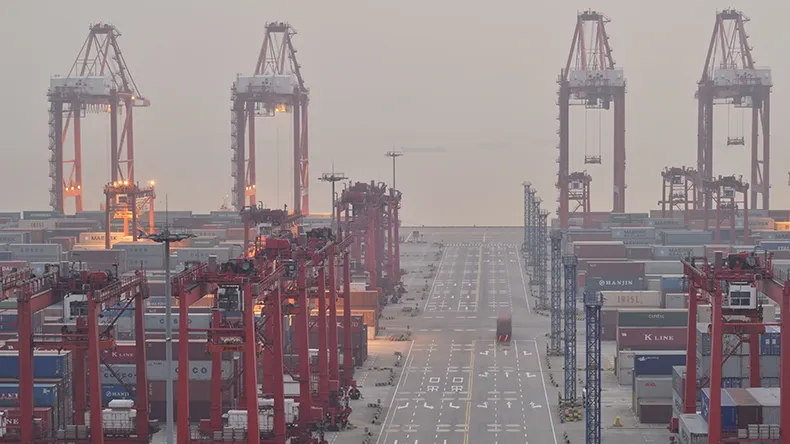
The storm did not arrive in an empty system. It hit after Typhoons Bavi and Dolphin had already piled up vessel and yard backlogs across East China, and it landed in a market where carriers were already managing capacity hard. The result is the story of this week: global port congestion hit a record 4.3 million+ TEU waiting at berth (Linerlytica, exceeding the previous peak of about 4 million TEU), and transpacific spot rates surged to 2026 highs — Drewry's World Container Index jumped 4% to $4,526 per 40ft, with Shanghai–New York at $9,507 (+9%) and Shanghai–Los Angeles at $6,802 (+9%).
This article walks through what happened, what it means for your shipments and your Q4 plans, and what to do about it this week — with the same straight talk we give our own clients shipping out of Shenzhen, Shanghai, and Ningbo.
What happened: the Saudel disruption, week by week
To understand where the market stands, it helps to see the storm sequence in order — because the damage is cumulative, not one-off.
- Early August — Typhoon Bavi. The first in a series of storms disrupted East China gateways and started the backlog. Terminals worked through residual delays through mid-month.
- Mid-August — Typhoon Dolphin. A second storm hit while the system was still recovering. By August 19, OOCL Logistics was reporting waiting times of up to 12 days at Shanghai Yangshan, 7–8 days at Waigaoqiao, and 3–5 days at Ningbo — with knock-on vessel delays, cargo rollovers, port omissions, equipment shortages, and longer truck turnaround times, and recovery expected to take several weeks.
- August 26–29 — Typhoon Saudel. Emergency response levels were raised to Level II in Ningbo and Level IV in Shanghai. Ningbo's container terminals — including Beilun, Daxie, and Meishan — suspended all operations from the evening of August 26; yards and warehouses followed on August 27. Hapag-Lloyd reported vessel waiting times of 5–11 days at Shanghai Yangshan (5–7 for larger Gemini vessels, 8–10 for smaller Gemini, 7–11 for non-Gemini services) and 3–6 days at Ningbo.
The pattern matters as much as any single number. As Xeneta's chief shipping analyst Peter Sand put it to WorldCargo News, this has been a "special typhoon season" for China's mega ports: normally the gap between landfalls gives terminals time to clear accumulated cargo, but this summer that recovery window has been repeatedly squeezed.
Carriers have responded by cutting port calls outright. Maersk said on August 24 that its vessel Delos Wave would omit its Shanghai call because of adverse weather, with cargo re-routed; Hapag-Lloyd listed vessels including Barzan, Paris Express, Linah, Al Nasriyah, and Estelle Maersk among those scheduled to omit Shanghai. When a vessel omits a port, your container does not simply wait — it is discharged at an alternate port or carried to the next voyage, and the delay can stretch into weeks.
Why transpacific rates are surging right now
The typhoons explain the congestion, but the rate surge has a second engine: carriers are running the tightest capacity discipline of the year, and the storms gave them cover to push pricing further.
- Blank sailings are running at peak levels. According to Drewry's Container Capacity Insight, 10 sailings were cancelled in each of the past two weeks, with another seven cancellations planned for the following week. Removing voyages ahead of demand softness is standard carrier playbook; doing it while two of China's largest gateways are closed turns a routine schedule adjustment into a genuine capacity squeeze.
- Effective capacity on the transpacific is shrinking. Drewry estimates Asia–US East Coast capacity fell 9% month over month in August, while Asia–US West Coast capacity edged down 0.4%. Fewer ships, closed terminals, and longer berth queues all compound into less usable space.
- Rate benchmarks confirm the squeeze. The Shanghai Containerized Freight Index (SCFI) rose for a third straight week, to 3,509.53 on August 28 (from 3,409.63 a week earlier). On the transpacific specifically, Drewry's August 20 assessment put Shanghai–New York at $9,507 per 40ft (+9% week over week) and Shanghai–Los Angeles at $6,802 (+9%). The composite WCI of $4,526 is the highest level of 2026 to date.
- Costs are being layered on from every direction. The Panama Canal cut maximum draft to 48.5 feet from August 15, with low-water surcharges of $100–320 per TEU announced by CMA CGM, Hapag-Lloyd, and MSC from August 19 — and carriers have announced Panama Canal surcharges on Asia–US East Coast and Asia–Gulf Coast services starting in September. Meanwhile, USTR port fees on Chinese-built vessels (now $23 per net ton or $153 per container, whichever is higher, since April 2026, with CBP requiring advance payment from October 14) continue to push carriers to redeploy tonnage away from US routes, tightening supply at the margin.
None of this is happening in a demand vacuum. The Port of Los Angeles handled 960,464 TEUs in July, its second-highest July on record, and August volume is expected to exceed 900,000 TEUs. Importers moved cargo early through the summer in response to tariff policy shifts — the new Section 301 "forced labor" tariff of 12.5% on Chinese goods took effect July 24, 2026 — and while that front-loading impulse has faded, the demand it created is still working its way through the system, exactly when the supply side is at its most fragile.
What this means for your shipments
If you ship from China to the US — or rely on any of the East China gateways for Q4 stock — here is the practical translation, in the order it will hit you.
1. Your rates have moved up, and the quoted number will keep moving. Spot levels this week are at or near the 2026 highs. As a planning reference for August–September 2026 (rates move weekly; these are indicative ranges, not quotes):
| Lane | 40ft FCL spot reference | Direction |
|---|---|---|
| China → US West Coast | $5,400 – $6,800+ | Rising, storm-driven |
| China → US East Coast | $7,400 – $9,500+ | Rising; Panama surcharges stacking from September |
| China → US (peak-season July levels) | up to $6,500 – $9,800 inland | Reference ceiling for Q4 planning |
| LCL (per CBM) | $80 – $180 | Tightening with consolidation space |
Contract shippers are not immune: with carriers blanking voyages, contracted space is being rationed and shortfalls are being offered back at spot-plus premiums.
2. Expect delays measured in weeks, not days. Between terminal closures, vessel omissions, and berth queues, cargo loaded in the last week of August is looking at 1–3 weeks of additional origin-side delay on top of normal transit — and the backlog will bleed into September even after terminals reopen. For a normal transpacific transit of 14–22 days to the West Coast (28–35 days to the East Coast via Panama), add the congestion buffer on top.
3. Rollovers and omissions are your biggest hidden risk. When a vessel omits Shanghai and discharges at an alternate port, your cargo can end up on a different vessel, at a different terminal, with new costs and new paperwork. Confirm in writing — before you book — which voyage your container will roll to if the planned sailing is blanked or omitted, and who carries storage, demurrage, and inland repositioning costs in the gap. Demurrage and storage at congested terminals are not hypothetical: every day of delay compounds them.
4. Q4 timing is the real casualty. Golden Week (October 1–7) is now two weeks away — factories and ports will wind down again, and carriers have already announced Golden Week blankings on Asia–Europe services (we covered the Maersk cuts in our Golden Week 2026 Blank Sailings Impact analysis). Cargo that misses its vessel in the next two weeks does not recover: it slides into the post-holiday rush, when space tightens again ahead of Black Friday and Christmas. For Amazon FBA sellers, a late-September rollover can mean missing the Q4 sales window entirely.
5. Air freight is the pressure valve — at a price. For genuinely time-critical cargo, air remains the reliable fallback. Rates from China to the US are running roughly $5.50–8.00/kg for heavier shipments, with door-to-door air express transit of 5–10 days. That is expensive per kilo, but for a missed sales window or a production line stoppage it is usually the cheaper option. See our Air Freight from China service for what that looks like end to end.
What to expect: the September–November outlook
Here is our read on the next ten weeks, based on the signals above. Treat it as scenario planning, not certainty — this market has a habit of proving forecasters wrong.
- September — the squeeze continues, then gradually eases. Roughly 148,000 TEU of newbuild capacity (about 60% of it concentrated in Q3–Q4) begins entering the network from late August, which should take pressure off rates by mid-September if terminals clear their backlogs. But the Saudel backlog has to be worked through first, and another typhoon in this active season could reset the clock. The practical window to lock rates for Q3–Q4 cargo is late August to early September — that is now.
- October — the Golden Week lull, then the real peak. Expect a brief demand dip during October 1–10 as factories close. Do not mistake it for a bargain: carriers will hold rates, and the post-holiday catch-up collides with the run-up to year-end demand. Add the September Panama Canal surcharges on East Coast and Gulf services and the US East Coast stays structurally expensive. This is also when carrier consolidation moves — including Hapag-Lloyd's planned acquisition of ZIM, which hit regulatory headwinds this month from Brazilian authorities and Israeli legislators — start to matter for capacity decisions.
- November — peak season, full stop. Space tightens, rates firm again, and rollover risk returns. The standard advice applies with extra force: book early, lock rates, and build a buffer into every plan.
The honest summary: 2026 is not a year for last-minute shipping, and the typhoon season has made September look like October. The carriers hold the pricing power, the costs are structurally higher, and every week of delay in booking now compounds into a week of risk in November.
What to do this week
- Book now, and lock the rate. If you have Q3–Q4 cargo, the late-August/early-September window is the softest it will get before the peak. Ask for FAK or contract protection that holds through October — a confirmed rate on a confirmed vessel beats a cheaper quote on a rolled voyage every time.
- Confirm rollover and omission terms in writing. Which voyage does your container roll to if the sailing is blanked? What if the vessel omits Shanghai or Ningbo? Who pays demurrage, storage, and inland moves in the gap? Get it in the booking confirmation.
- Add a 1–3 week buffer to every transit plan. Whether it is a PO date, an FBA delivery window, or a retail in-store date, plan as if your container arrives late. If it arrives on time, that is a pleasant surprise.
- Diversify your routings. If you normally load in Ningbo or Shanghai, ask about loading in Shenzhen, Guangzhou, Qingdao, or via transshipment hubs — and on the US side, compare direct West Coast with US East Coast via Panama against the West Coast plus rail intermodal alternative. A forwarder with multi-port options keeps cargo moving when a specific gateway is closed. Our Sea Freight from China team runs exactly these comparisons daily.
- Split your critical cargo. For anything with a hard deadline — seasonal goods, FBA replenishment, retail orders — consider splitting: most volume by sea, the must-arrive portion by air. It costs more overall but caps your downside.
- Do not panic-buy spot space. Desperate last-minute bookings at premium rates are how shippers lose money in a congestion market. If you must buy space late, get the rollover terms in writing first.
For a full picture of lanes, transit times, and what is moving right now between China and the United States, our Shipping from China to USA guide is kept current with the 2026 rate and transit reality — including the new tariff stack (Section 301 + 12.5% forced-labor duty, with De Minimis gone since 2026) that every US-bound shipment now carries.
The AllBestShipping view
From our base in Shenzhen, we watch typhoon season the way other businesses watch weather forecasts: it tells us where the rough patches are and when to move cargo early. The Saudel disruption is not a crisis — it is a predictable, manageable squeeze, provided you act with the right lead time and the right partner.
What matters most in a market like this is having someone who sees the full picture: which terminals are closed, which vessels are omitting which ports, what the alternative routings actually cost, and what the rate trajectory looks like on your specific lane. That is the daily work of a freight forwarder, and it is where a local, operationally strong partner earns its fee. We are advising our clients this week to front-load September bookings, lock rates now, and build congestion buffers into every Q4 plan — and we are watching those clients avoid the worst of the squeeze.
For context on how fast this market can reverse, our analysis of the Container Shipping Rates Crash in Feb 2026 is worth re-reading: the same carriers who are blanking sailings today cut rates aggressively when demand softened — which is exactly why locking terms now, rather than betting on a direction, is the right move.
If you are shipping from China this fall and want a straight answer on rates, space, and the best routing for your cargo, talk to AllBestShipping. We offer transparent pricing, real-time tracking, and honest advice on every lane we serve — from the transpacific to Europe, Africa, the Middle East, and the Americas. Get a free quote from AllBestShipping and lock your Q4 capacity before the October rush.
FAQ: Typhoon Saudel and transpacific rates
Why are transpacific shipping rates so high right now? A combination of record port congestion — 4.3M+ TEU waiting at berth globally, driven by three typhoons hitting East China in one month — and aggressive carrier capacity management. Carriers cancelled 10 sailings in each of the past two weeks, and closed terminals at Ningbo and Shanghai removed working capacity exactly when demand from early-peak-season importing was still strong.
How long will the Ningbo and Shanghai congestion last? Carriers warn that recovery will take several weeks. Terminals reopened after Saudel passed, but they must clear accumulated vessel and yard backlogs before schedules normalize. Realistic expectation: elevated waiting times through most of September, with lingering schedule slippage into October.
Will transpacific rates drop in September? Some easing is possible as ~148,000 TEU of newbuild capacity enters the network from late August — but only if terminals clear their backlogs first, and another typhoon in this active season could reset the clock. The safe planning assumption is firm-to-higher rates through the Golden Week lull, then renewed firmness in the Q4 peak.
What is a port omission, and how is it different from a rollover? A rollover means your container moves to the next available voyage on the same or an adjacent service — typically 7–14 days late. A port omission means the vessel skips your loading or discharge port entirely and your cargo is discharged at an alternate port or transferred to another vessel, which can add weeks and new inland costs. Both should be confirmed in writing before you book.
Should I use air freight instead of sea freight during the congestion? For time-critical cargo — seasonal goods, FBA replenishment, retail orders with fixed delivery windows — air freight is the reliable fallback and often the cheaper option once you count the cost of a missed sales window. For volume with flexible timing, sea freight remains far more cost-effective; just book early, lock rates, and build in a buffer.
What are the new tariffs on US-bound shipments from China? As of July 24, 2026, a new Section 301 "forced labor" tariff adds 12.5% on Chinese goods, stacking on top of the original Section 301 duties (7.5% or 25% for most goods) and MFN duties. The de minimis exemption is fully gone — every shipment, even small samples, needs formal entry through a licensed customs broker. Total duties for many manufactured goods now land around 37.5–42.5%; confirm your specific rate with your broker before quoting landed costs.