Sea Freight from China to Spain: FCL & LCL to Valencia, Barcelona & Algeciras
Spain is one of the European Union's most important gateways for Chinese goods. Its Mediterranean ports sit at the western end of the Asia–Europe trade route, its rail network reaches deep into the Iberian peninsula, and its terminals keep growing faster than most of their northern European rivals. China is now the single largest trade partner of Valenciaport — Spain's biggest container port — and in 2025 it was the fastest-growing source of full import containers there, up more than 21% in a single year.
But if you have priced a container to Valencia lately, you also know that 2026 is not a normal year for ocean freight. Most Asia–Europe services still round the Cape of Good Hope to avoid the Red Sea, transit times run 10–15 days longer than they did before 2024, and rates have swung from a geopolitical peak in April down through a summer lull and are now climbing again as the fourth-quarter peak season opens.
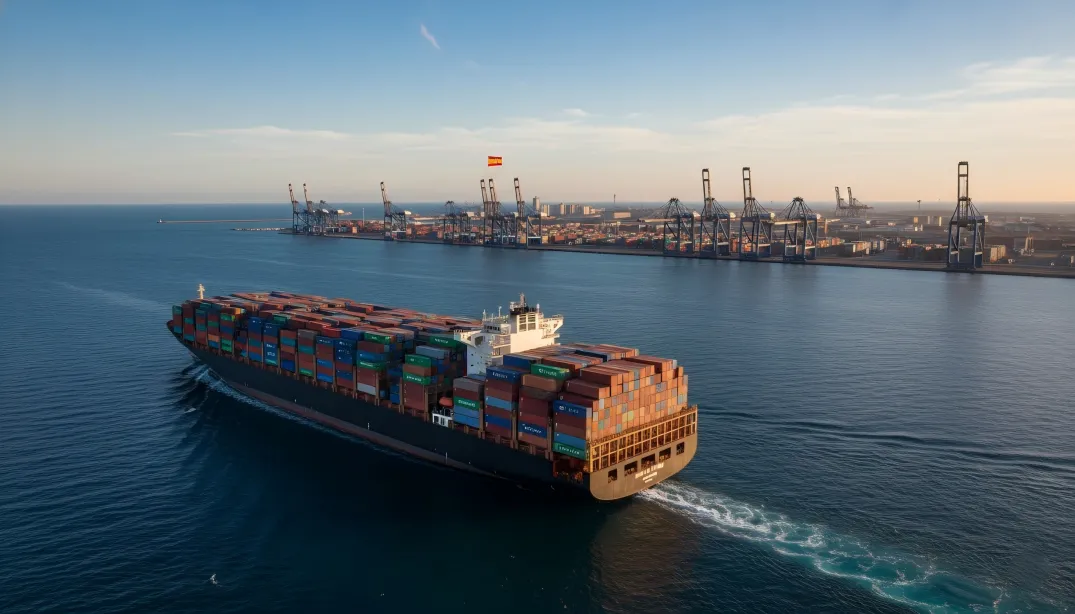
This guide breaks down what sea freight from China to Spain really involves in 2026: current FCL and LCL rates, how the three gateway ports — Valencia, Barcelona and Algeciras — compare, realistic transit times and sailing routes, and the Spanish customs steps that decide whether your container clears in a day or a week. Every rate in this article is an indicative market range: ocean freight moves weekly, so treat the numbers as a planning reference and always ask for a written quote before you book. For a compact overview of routes and transit times, see our Shipping From China to Spain guide.
1. Why Sea Freight Is the Backbone of China–Spain Trade
China is Spain's largest trading partner in Asia and its biggest source of containerized imports by a wide margin. The trade runs overwhelmingly in one direction: roughly 84% of the tonnage moving between Valenciaport and China in 2025 was import traffic, and the numbers keep compounding. In 2025 the Port Authority of Valencia's terminals handled 5,662,661 TEU, up 3.4% year on year, with China confirmed as the No. 1 trade partner ahead of Italy and the United States. Full import containers from China jumped 21.5% to 853,830 boxes in a single year, and the Far East overtook the Mediterranean as the port system's largest source of full-container traffic.
That flow exists for one simple reason: for anything that is not urgent, sea freight is dramatically cheaper per cubic meter than any alternative. A 40ft high-cube container moves roughly 68 CBM of cargo from Shanghai to Valencia for what a few pallets would cost by air. Furniture, ceramics, tiles, textiles, appliances, auto parts, toys, machinery and building materials — the categories that dominate Spain's import list from China — are exactly the kind of dense, price-sensitive cargo that container shipping was built for.
Sea freight also wins on scope. Reefers for pharmaceuticals and fresh produce, open-top and flat-rack units for machinery and project cargo, and hazardous-goods containers all move by sea because air freight cannot carry them economically — or at all. When Spanish importers tell us they are "shipping from China," nine times out of ten they mean a container on the water, not a pallet on a plane.
2. 2026 China–Spain Sea Freight Rates at a Glance
Before diving into routes, here is the TL;DR. These ranges reflect early-September 2026 conditions on the China–Spain corridor and assume standard dry cargo with no special equipment or dangerous-goods handling. Port-to-port means Chinese port to Valencia, Barcelona or Algeciras.
| Shipping Mode | Indicative Cost (Sep 2026) | Transit Time | Best For |
|---|---|---|---|
| LCL (Less than Container Load) | $60 – $150 per CBM | 28 – 40 days | Loads under ~15 CBM |
| FCL 20ft container | $2,300 – $3,500 per container | 25 – 35 days | 15–28 CBM, heavy or dense goods |
| FCL 40ft / 40HQ container | $3,500 – $5,400 per container | 25 – 35 days | Large volumes, 28+ CBM, bulky light goods |
| FCL door-to-door (sea DDP) | $4,200 – $6,200 all-in (typical 40HQ) | 35 – 50 days | Importers who want one fixed landed price |
| Air freight (for comparison) | $4.50 – $8.00 per kg | 3 – 7 days | Urgent samples, high-value, time-critical cargo |
Three things matter when you read this table. First, the 2026 rate arc has been extreme: base ocean rates surged 35–40% in the first quarter as Cape of Good Hope rerouting became the norm, peaked around April on geopolitical headlines, then eased through the summer — monthly trackers on the China–Spain lane showed 20ft base rates around $2,400 in May and roughly $2,200–2,500 in July, with 40HQ boxes around $3,300–3,700 and LCL base rates as low as $45–55 per CBM. As September opens, carriers are announcing September–October rate increases and peak-season surcharges for the Q4 rush, so expect the upper half of the ranges above to be where the market actually trades into year-end.
Second, the quoted base rate is not the price you pay. The all-in cost typically runs 30–50% higher once you add origin handling, export documentation, the ocean freight, destination terminal handling charges (THC) at the Spanish port, customs clearance fees and any bunker (BAF) or war-risk surcharges. Two quotes that look identical on paper can differ by $600–1,200 per container once every line item is on the table — which is why we always advise comparing all-in door prices rather than headline ocean rates.
Third, the spread between the cheapest and most expensive week can be huge. Booking two weeks earlier or later around a general rate increase (GRI) date can move your cost by $300–600 per box. On a lane where the Suez shortcut remains closed to most services and capacity is tight, the importers who win are the ones who plan bookings 3–6 weeks ahead and lock rates with validity dates.
3. Choosing Your Spanish Gateway: Valencia vs Barcelona vs Algeciras
"Spain" is not one port, and in 2026 the choice of discharge port affects your transit time, your trucking cost and your clearance speed. Spain's containerized imports from China land mainly through three gateways, each with a distinct role.
Valencia: Spain's Container Capital and China's Main Door
Valencia is the largest container port in Spain and the most important Spanish gateway for China trade. Its 2025 throughput of 5.66 million TEU made it one of the fastest-growing major ports in the Mediterranean, and its container terminals are connected to Madrid (about 350 km away) and the rest of the peninsula by dedicated rail services. For Chinese exporters and Spanish importers alike, Valencia offers the densest network of direct Asia–Mediterranean sailings: on the Shanghai/Ningbo–Valencia corridor you can typically choose from three to four departures per week, which means more flexibility on cut-off dates and faster recovery when a sailing is blanked.
Valencia is the right choice for the majority of China imports — cargo for Madrid, Castilla-La Mancha, Aragón, Valencia itself, and anywhere in central or eastern Spain. It also handles a large share of the country's reefer and project cargo. With the port's northern extension adding deep-water berths and rail capacity, Valencia is where most forwarders (including us) default-rout China FCL cargo.
Barcelona: The Gateway for Catalonia and Southern France
Barcelona, Spain's second container port, handled more than 3.6 million TEU in 2024 and has been growing its import-export traffic steadily, with Asian shipments the main driver. Its ZAL logistics zone sits right at the terminal gates, which shortens the gap between discharge and delivery for importers in Catalonia, the Ebro valley and the Balearics — and its rail connections also serve southern France and Andorra.
Barcelona tends to suit e-commerce and consumer-goods importers who want cargo cleared and distributed close to where their Spanish customers are. If your warehouse or Amazon FBA center is in Catalonia, choosing Barcelona over Valencia can save a day of trucking and several hundred euros per container in inland haulage — a calculation worth doing before you book, not after the vessel sails.
Algeciras: Europe's Great Transshipment Hub
Algeciras, on the Strait of Gibraltar, is a different animal. It is one of the largest container ports in Europe by throughput — around 4.7 million TEU a year — but more than 85% of that volume is transshipment: boxes dropped by deep-sea mother vessels and reloaded onto feeders, rather than import cargo for the Spanish market. Algeciras is the European relay hub of major carrier networks (APM Terminals' facility there is a cornerstone of Maersk and Hapag-Lloyd's hub-and-spoke model), which makes it brilliant at connecting Asia–Europe mainline services with the western Mediterranean, the Atlantic, Portugal, the Canaries and North Africa.
For China imports, Algeciras is rarely the fastest door. Cargo discharged there for Spanish consumption usually continues on a feeder or is trucked north, adding handling, cost and risk compared with a direct Valencia or Barcelona discharge. Book Algeciras when your final destination is Andalusia or southern Spain, when you need a connection to Portugal or the Canary Islands, or when your carrier's rotation makes it unavoidable — but for most importers, a direct call at Valencia or Barcelona is both cheaper and quicker. If you are weighing ports against delivery addresses, talk to a forwarder who can quote the door-to-door comparison, not just the ocean leg.
Other Options
Bilbao on the Atlantic coast is a sensible alternative for northern Spain and parts of Portugal, though direct China services are thinner than at the Mediterranean ports. Cartagena, Gijón and others play niche roles. For the purposes of this guide, Valencia, Barcelona and Algeciras cover the practical choices for 95% of China–Spain sea freight.
4. FCL vs LCL: Which One Should You Book?
The first booking decision is whether to fill a container (FCL) or share one (LCL). FCL (Full Container Load) gives you the whole box, sealed at origin and opened at your destination. LCL (Less than Container Load) shares the container with other importers' cargo, and you pay only for the space your goods occupy. For a full run-down of container sizes, capacities and the FCL/LCL trade-off, see our separate guide to container shipping from China to Spain; here we focus on the 2026 rate and route picture.
FCL Rates by Origin Port (Port-to-Port, Indicative Sep 2026)
Rates to Valencia and Barcelona are broadly similar — carriers price the two ports on the same West Mediterranean services. Figures are base ocean rates for standard dry containers; add destination THC and clearance for the all-in picture.
| Origin Port (China) | 20ft (USD) | 40ft / 40HQ (USD) | Est. Transit to Valencia / Barcelona |
|---|---|---|---|
| Shanghai | $2,300 – $3,200 | $3,500 – $4,900 | 25 – 32 days |
| Ningbo | $2,300 – $3,200 | $3,500 – $4,900 | 25 – 32 days |
| Shenzhen / Yantian | $2,500 – $3,400 | $3,700 – $5,200 | 27 – 35 days |
| Qingdao / Tianjin | $2,600 – $3,500 | $3,900 – $5,400 | 28 – 35 days |
Shanghai and Ningbo anchor the lane — they have the most weekly services and usually the sharpest rates. Shenzhen and Yantian in the Pearl River Delta are close behind, with more frequent services than a few years ago as carriers add South China capacity. Qingdao and Tianjin are typically $100–300 higher because services are thinner and transshipment is more common. A 20ft box carries roughly 28 CBM and suits dense, heavy cargo; the 40HQ, at about 68 CBM, is the best per-cubic-meter deal for light, bulky goods. For cargo over roughly 15 CBM, FCL almost always beats LCL on per-CBM cost — your box is sealed in China, nobody else's cargo touches it, and there is no deconsolidation wait at destination.
LCL: The Economics Below a Full Container
LCL on the China–Spain lane runs roughly $60–150 per CBM depending on origin, season and how much handling the quote includes (base consolidation rates dipped to $45–55/CBM in mid-2026). Charges follow the W/M rule — 1 CBM or 1,000 kg, whichever is greater — with most forwarders applying a minimum chargeable volume of 1 CBM. The headline per-CBM rate looks seductive, but destination CFS deconsolidation, documentation and handling fees add on top, so always ask for the all-in per-CBM price to the Spanish CFS.
The rule of thumb we use when advising clients:
- Under ~13 CBM → LCL is normally the cheapest option.
- 13–15 CBM → run the full landed-cost math; once CFS fees are added in Spain, a 20ft FCL is often cheaper and clears faster.
- Over 15 CBM → book a 20ft FCL.
- Over 28 CBM → move to a 40ft or 40HQ.
One lever that saves many Spanish importers real money is buyer consolidation. If you source from several factories across Guangdong, Zhejiang or Fujian, a forwarder with an origin warehouse (we consolidate in Shenzhen and Guangzhou) can collect every order, stuff one FCL container and ship it as a single consignment. You avoid repeated LCL minimums and per-CBM destination fees, and the container arrives sealed with one set of documents — on this lane, consolidation typically cuts total freight cost by 15–25% versus shipping the same volume as separate LCL parcels.
5. Transit Times & Sailing Routes in 2026
If you quote lead times to your own customers, be conservative. The Red Sea situation is now in its third year, and a large-scale return to the Suez Canal route is unlikely in 2026 — Suez transits remain a fraction of their pre-crisis level, so most Asia–Europe services continue to round the Cape of Good Hope, adding roughly 3,500 nautical miles and 10–15 days versus the pre-2024 schedules.
Typical sea freight transit times in 2026:
| Routing | Typical Transit | Notes |
|---|---|---|
| Direct: Shanghai / Ningbo → Valencia or Barcelona | 25 – 32 days | Densest weekly service; most reliable option |
| Direct: Shenzhen / Yantian → Valencia or Barcelona | 27 – 35 days | Growing South China coverage |
| FCL via transshipment (Singapore / Colombo relay, or Algeciras / Tanger Med hub) | 33 – 42 days | Two-handling route; watch the feeder connection |
| LCL (consolidated) | 28 – 40 days | Adds origin consolidation + destination deconsolidation |
| FCL door-to-door (DDP) | 35 – 50 days | Includes Spanish clearance, duty/VAT and final trucking |
The practical advice: ask for the actual vessel rotation, not an average. A "28-day service" can be 34 days if your container transships twice or misses a weekly feeder at Algeciras. Direct Valencia/Barcelona strings from Shanghai and Ningbo are the most predictable; if you are offered a significantly cheaper rate via a relay hub, price in the extra 5–10 days and the double-handling risk before you take it. And add a 7–10 day buffer for any shipment booked between September and December, when carriers blank sailings to defend rates and terminals in both China and Spain tighten up.
The major operators on the lane — MSC, Maersk, CMA CGM, COSCO, Hapag-Lloyd, ONE, Evergreen and others — all serve Spain through their Asia–Mediterranean networks, either with direct Valencia/Barcelona calls or through hub relays at Algeciras and Tanger Med. Alliance reshuffles in 2025–2026 (MSC sailing standalone, Maersk and Hapag-Lloyd running the Gemini hub-and-spoke network, the Premier Alliance and the extended Ocean Alliance) changed rotations and which port is a direct call on any given week — another reason to have a forwarder track the actual schedules rather than relying on last year's routing habits. For a full comparison of sea, air, rail and express timelines including door-to-door estimates, see our guide to how long it takes to ship from China to Spain.
6. Clearing Spanish Customs: Duties, IVA & the ICS2 Deadline
The ocean leg ends at the dock; customs decides when your cargo actually reaches your warehouse. Spain applies the EU's common customs rules, with a few Spanish specifics, and in 2026 the single biggest change for sea freight is the full enforcement of the EU's ICS2 import control system.
Duties and Spanish VAT (IVA)
- Import duty: The EU Common Customs Tariff (TARIC) applies by HS code, with rates mostly in the 0–17% band depending on the product.
- Spanish VAT (IVA): The standard rate is 21%, with reduced rates of 10% (many foods and some goods) and 4% (essential items). IVA is charged on the CIF value plus duty — that is a 21% charge on top of your goods value, ocean freight and insurance, and the duty itself, so it is usually the largest single tax line in your landed cost.
- EORI: Every business clearing goods in Spain needs an EU EORI number (Spanish format starts with ES). Under a DDP arrangement your forwarder clears the shipment using its own EORI and accounts for the IVA on your behalf; if you self-clear, register yours before the vessel arrives.
- Declaration: Importers or their agents lodge the standard customs declaration (DUA) electronically through Spain's customs system, pay duty and IVA, and obtain release.
ICS2 / ENS: The 2026 Rule Every Sea Shipper Must Know
Since June 2026, the EU's ICS2 safety-and-security regime is fully enforced for maritime cargo. In practice this means an Entry Summary Declaration (ENS) with complete, accurate data about your shipment must be filed before your container is loaded on the vessel in China. If the data is incomplete or inconsistent, EU customs can issue a "Do Not Load" instruction — and your container stays behind while the vessel sails without it.
This is exactly the kind of requirement that punishes last-minute booking documentation. The good news: a competent forwarder files the ENS automatically as part of the export process, and our origin teams do it for every China–Spain sailing we handle. The bad news: if you buy freight from a broker who treats ICS2 as an afterthought, you are the one who eats the delay. When you compare quotes, ask directly: "Who files the ENS, and what data do you need from me before cut-off?" The answer tells you a lot about whether your cargo will actually make the ship.
GPSR, CE Marking and the Low-Value Parcel Rule
Two more EU-wide rules matter if you sell consumer goods. GPSR (General Product Safety Regulation) has required, since December 2024, that every consumer product sold in the EU has an "economic operator" established in the EU — a manufacturer, importer or authorized representative — who can be reached about product safety. Amazon Spain sellers and e-commerce importers routinely get held at the border (or delisted) for missing GPSR responsibility. Regulated categories — electronics, toys, machinery — also need CE marking and technical documentation. None of this is handled by the shipping line; it sits with you and your compliance chain.
One 2026 change that mostly does not apply to sea freight: the EU's removal of the €150 duty-free threshold for low-value e-commerce parcels (a flat €3 duty per parcel since July 2026). FCL and LCL sea shipments are far above that threshold and follow the normal duty/IVA route — but if you are also testing the Spanish market with small direct-to-consumer courier parcels, make sure your quote includes the new rules.
When You Want One Fixed Price: Sea DDP
If your business has no customs team in Spain — or you simply do not want to think about TARIC codes, IVA payments and EORI numbers — a sea DDP (Delivered Duty Paid) quote puts the whole chain in the forwarder's hands: origin pickup, export customs, ocean freight, Spanish clearance, duty and IVA payment, and trucking to your door for one agreed all-in price. It is the most popular structure we ship for SME importers, and it removes the single biggest source of surprise costs on this lane. For a closer look at how the process works end to end, read our guide to door-to-door shipping from China to Spain.
7. Why Shipments Get Delayed (and How to Avoid It)
In our experience the ocean itself is rarely what makes a China–Spain shipment late. Delays happen at the edges, and almost always for one of these reasons:
- Document mismatches — the bill of lading, commercial invoice and packing list disagree on weights, values or descriptions. Spanish customs queries the declaration and the container sits until corrected. Fix: one pre-shipment document audit by your forwarder.
- Late or sloppy ICS2 data — filed after cut-off, or with wrong consignee details, triggering a Do Not Load or a hold at the first EU port of call. Fix: send complete data when you book, not when the vessel is about to sail.
- Peak-season blank sailings — carriers cancel sailings to support rates in Q4, and your cargo rolls to the next vessel. Fix: book 3–6 weeks ahead and confirm the vessel name and rotation in writing.
- Terminal congestion at destination — Valencia and Barcelona run smoothly most of the year, but in November–December (and after any strike or weather event) truck turnaround slows and rail slots fill. Fix: pre-book inland transport and allow a few extra days between vessel arrival and your committed delivery date.
- Demurrage and detention — containers left beyond their free days (typically 5–7 days at Spanish terminals) accrue €50–100+ per day, and the clock runs even while paperwork is stuck. Fix: stage every document before the vessel arrives, and negotiate free-time terms in the booking.
Our industry insight: The importers who clear fastest in Spain are not the ones with the biggest volumes — they are the ones with the most complete paperwork. On this lane, we stage the full file (commercial invoice, packing list, HS codes, ENS data, trucking reservation) while the vessel is still at sea, so the moment the container lands the declaration is already being processed. Treat documentation as part of the transit time, because for customs purposes it is.
8. Which Shipping Option Fits Your Business?
| Your Situation | Recommended Option | Why |
|---|---|---|
| Samples, trial order, under ~13 CBM | LCL | Pay only for space used; ideal for first orders |
| 13–15 CBM, regular restocking | Compare LCL vs 20ft FCL | Spanish CFS fees often tip the math to FCL |
| 15+ CBM of regular inventory | FCL 20ft | Best per-CBM cost; sealed and secure |
| Bulky light cargo, full pallets | FCL 40HQ | Lowest per-unit cost at scale |
| Destination in Catalonia | Discharge at Barcelona | Saves a day of trucking and inland cost |
| Destination in Madrid / central Spain | Discharge at Valencia | Densest direct services; strong rail links |
| Urgent restock or high-value goods | Air freight | 3–7 days versus 25–50 days by sea |
| No customs capability, want one fixed price | Sea DDP door-to-door | Forwarder clears, pays IVA and delivers |
| Multiple suppliers across China | Consolidation → FCL | One container, one document set, 15–25% savings |
Whichever option fits, work with a forwarder that has real operations at both ends: consolidation warehouses in China's manufacturing hubs, direct relationships with carriers on the Asia–West Med strings, and a destination team in Spain that clears cargo through Spanish customs every day. That combination — not the cheapest headline rate — is what protects your margin on a lane as volatile as this one. Our sea freight services are built exactly that way: transparent all-in quotes from Shenzhen and Guangzhou to Spanish ports and inland points, real-time tracking from factory to final delivery, and dedicated customs and ICS2 support on every sailing.
9. FAQ: Sea Freight from China to Spain
How much does it cost to ship a container from China to Spain in 2026? Indicative September 2026 port-to-port rates are $2,300–3,500 for a 20ft container and $3,500–5,400 for a 40ft/40HQ, depending on origin port, carrier and week. Add roughly 30–50% for destination THC, clearance and surcharges to get the all-in cost, or ask for a door-to-door DDP price if you want one fixed number. Rates rise into the Q4 peak season, so request written quotes with validity dates.
Which Spanish port should my container go to: Valencia, Barcelona or Algeciras? For most China imports, Valencia (densest direct services, best for Madrid and central Spain) or Barcelona (closest for Catalonia and southern France) is the right choice. Algeciras is mainly a transshipment hub — more than 85% of its volume is relay traffic — so using it as your discharge port usually adds handling time unless your destination is Andalusia, Portugal or the Canaries.
What is the difference between FCL and LCL, and which is cheaper? FCL rents you the whole container (sealed in China, opened at destination) for a flat rate; LCL shares space and charges per CBM or per 1,000 kg, whichever is greater. LCL wins under roughly 13 CBM; above 15 CBM a 20ft FCL is almost always cheaper per CBM once Spanish CFS handling fees are included.
How long does sea freight from China to Spain take in 2026? Because of the Cape of Good Hope routing, direct FCL sailings from Shanghai or Ningbo to Valencia/Barcelona take about 25–32 days; from South China ports, 27–35 days. LCL adds 3–7 days for consolidation and deconsolidation. Add a 7–10 day buffer for September–December bookings.
Who files the ICS2 entry summary declaration, and what happens if it is wrong? Your freight forwarder files the ENS with EU customs before your container is loaded in China — full maritime enforcement of ICS2 began in June 2026. Incomplete or inaccurate data can trigger a "Do Not Load" instruction, so provide consignee details and shipment data at booking time, not at cut-off.
How long does customs clearance take in Spain? With complete, matching documents and correct HS codes, Spanish clearance typically takes 1–3 working days after arrival; goods requiring inspection or flagged for GPSR/CE issues can take longer. Most delays trace back to document mismatches or late ENS data rather than the customs system itself.
Why are 2026 rates from China to Spain so volatile? Asia–Europe services round the Cape of Good Hope because of the Red Sea security situation, adding days and fuel per voyage; that structural cost sits under every quote. On top of it, carriers manage capacity aggressively and pass through bunker and war-risk surcharges, producing sharp swings between Q1's surge, April's peak, the summer easing and the Q4 climb.
Conclusion
Sea freight from China to Spain is one of Europe's most dynamic trade lanes — and in 2026 it rewards preparation. The gateway port choice (Valencia, Barcelona or Algeciras) shapes your cost and speed, the FCL-vs-LCL decision should be made on full landed cost rather than headline rates, and the customs side now includes a hard ICS2 deadline that punishes sloppy data. The importers who win on this lane do three things consistently: they compare like-for-like all-in quotes, they book 3–6 weeks ahead through the volatile Q4 season, and they hand the documentation to a forwarder who has cleared China-origin containers in Spain hundreds of times. Whether you are shipping a few cubic meters of samples or a monthly program of full containers, AllBestShipping provides transparent, all-in pricing, real-time tracking and dedicated Spanish customs support from our base in Shenzhen to your door in Spain — so the only surprise is how smoothly your cargo clears.