Door to Door Shipping from China to Spain: The Complete 2026 Guide (Costs, Methods & DDP Explained)
Door to door shipping from China to Spain is the simplest way to move your goods from a Chinese factory to a Spanish address — without touching a customs form, calculating IVA, or arranging last-mile trucking yourself. In mid-2026, you can expect to pay roughly $3,500–$6,500 per 40ft container for sea DDP, $8–$14 per kg for air DDP, $250–$380 per CBM for rail DDP, and $12–$18 per kg for express courier door to door. But here is what most freight rate pages do not tell you: the real value of DDP is not just the freight — it is everything you do not have to do.
If you are a B2B importer buying furniture from Foshan, an e-commerce seller restocking from Yiwu, or an Amazon FBA merchant sending pallets to BCN1, you have probably received a confusing FOB price from your supplier and wondered: "What happens next?" That gap — between a factory-gate quote and goods sitting in your Spanish warehouse — is exactly what door to door shipping solves. This guide breaks down every method, every cost component, and every Spanish customs requirement you need to know before your first shipment.
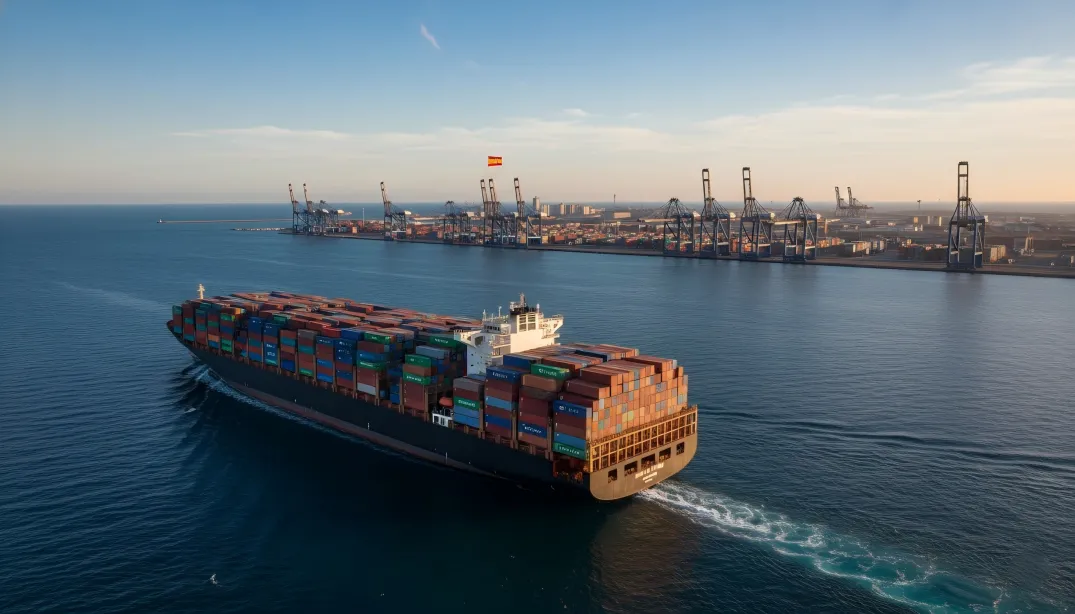
1. What Is Door to Door Shipping from China to Spain?
Door-to-Door Shipping means a single freight forwarder handles the entire journey: factory pickup in China → export customs clearance → international freight (sea, air, rail, or courier) → Spanish import customs clearance → duty and IVA (VAT) payment → final truck delivery to your address. Under DDP (Delivered Duty Paid) Incoterms, the forwarder acts as the importer of record in Spain, paying all import duties and taxes on your behalf.
This is fundamentally different from what most Chinese suppliers offer by default:
| Incoterm | What You Get From the Seller | Who Handles Spain Customs? | Who Pays IVA? |
|---|---|---|---|
| EXW | Goods at factory gate | You | You |
| FOB | Goods loaded onto vessel in China | You | You |
| CIF | Goods + insurance to Spanish port | You | You |
| DDP | Goods delivered to your door | Your forwarder | Your forwarder (included in price) |
For a complete overview of all freight routes, transit times, and logistics options connecting Chinese departure ports to Spain's major gateways, see our dedicated guide to Shipping From China to Spain.
Our Industry Insight: Many first-time importers do not realize that a CIF quote from a Chinese supplier only gets the container to Valencia or Barcelona — not to your warehouse. The destination charges alone (THC, documentation, customs brokerage, trucking) can add €800–€1,200 for a 40ft container, before duty and IVA even touch the invoice. DDP consolidates everything into one predictable number.
2. Door to Door Shipping Methods: Sea, Air, Rail & Express
Sea DDP (FCL & LCL)
Sea Freight from China is the most cost-effective door to door option for shipments above 1 CBM, especially once you reach full container volumes. Major routes connect Chinese ports — Shenzhen (Yantian/Shekou), Shanghai, Ningbo, Guangzhou, and Qingdao — to Spain's primary gateways: Valencia (largest Mediterranean container port), Barcelona, Algeciras (Europe's biggest transshipment hub at the Strait of Gibraltar), and Bilbao (Atlantic-facing, serving northern Spain).
For FCL (Full Container Load), you book an entire 20ft or 40ft container for your exclusive use. This is the most economical choice above roughly 15 CBM. For LCL (Less than Container Load), your cargo shares a container with other importers' goods and you pay per cubic meter — ideal for 1–15 CBM shipments.
Sea DDP is best for furniture, machinery, tiles, textiles, and heavy industrial goods where the 35–45 day total transit is acceptable.
Air DDP
Air Freight from China DDP connects major Chinese cargo airports — Shanghai Pudong (PVG), Guangzhou Baiyun (CAN), and Shenzhen Bao'an (SZX) — to Madrid-Barajas (MAD) and Barcelona-El Prat (BCN). Total door to door time is typically 7–12 days.
Air DDP is priced per kilogram based on chargeable weight (the greater of actual weight or volumetric weight). It is the go-to choice for high-value electronics, urgent seasonal restocks, pharmaceutical products, and time-sensitive samples where the higher per-kg cost is offset by faster inventory turnover.
Rail DDP
The China-Europe Railway Express offers a compelling middle ground. Trains depart from inland hubs like Yiwu, Zhengzhou, and Chongqing, traveling through Kazakhstan, Russia, Belarus, Poland, Germany, and France before reaching Madrid or Barcelona. Total door to door transit runs 20–28 days — roughly half of sea freight at significantly less cost than air.
Rail DDP suits mid-weight goods where sea is too slow but air is too expensive: electronics, automotive parts, machinery, and e-commerce inventory needing faster replenishment than ocean allows.
Express Courier DDP
DHL, FedEx, and UPS provide the fastest door to door channel — 5–8 days from pickup to delivery. This option is best for samples, documents, small B2C parcels, and personal effects shipments. Above roughly 100–150 kg, standard air freight typically becomes more economical.
3. 2026 Door to Door Shipping Costs: Complete Price Breakdown
The following table reflects mid-2026 DDP rates. These are all-inclusive — covering factory pickup, export clearance, international freight, Spanish import customs brokerage, EU customs duty, Spanish IVA, and final delivery to your door. Prices are indicative market ranges; your exact quote depends on cargo type, ports, and seasonal demand.
| DDP Door to Door Mode | Cost Range (USD) | Cost Range (EUR) | Best For |
|---|---|---|---|
| Sea FCL 20ft | $3,500–$5,200 | €3,250–€4,830 | Heavy cargo, 15–28 CBM, machinery |
| Sea FCL 40ft/40HQ | $4,800–$6,500 | €4,460–€6,040 | Bulk orders, furniture, bulky goods |
| Sea LCL | $150–$250 / CBM | €140–€230 / CBM | 1–15 CBM, mixed small-batch shipments |
| Air DDP | $8–$14 / kg | €7.40–€13 / kg | High-value, urgent, electronics |
| Rail DDP | $250–$380 / CBM | €230–€350 / CBM | Mid-weight, time-sensitive industrial goods |
| Express Courier DDP | $12–$18 / kg | €11–€16.70 / kg | Samples, personal effects, small parcels |
What drives the wide ranges? Three main factors. First, seasonality: July through December peak season pushes rates 15–25% higher due to capacity constraints and Peak Season Surcharges (PSS). Second, routing: direct sailings to Valencia are cheaper than transshipment routes via Algeciras. Third, fuel costs: Bunker Adjustment Factor (BAF) and the Cape of Good Hope rerouting (still in effect through 2026) add cost to Mediterranean-bound vessels.
Real-Life Scenario: We recently quoted a Spanish furniture retailer importing 55 CBM of home goods from Foshan to Madrid. The supplier offered FOB Nansha at $12,500 for the goods. Shipping FCL DDP added $5,800 — but that single line item covered ocean freight, Spanish customs brokerage, the 2.7% EU furniture duty, 21% IVA on the CIF value, and trucking from Valencia port to their Madrid warehouse. When they ran the numbers for handling everything themselves under CIF, the landed cost came within $400 of our DDP quote — without accounting for their time and the risk of customs delays.
4. Transit Times: How Long Does Door to Door Shipping Take?
Total door to door time includes three segments: origin handling (pickup + export clearance), international transit (sea voyage, flight, or rail journey), and destination processing (import clearance + IVA settlement + final delivery).
| DDP Mode | Total Door to Door | Transport Segment | Customs & Delivery |
|---|---|---|---|
| Sea FCL DDP | 35–45 days | 28–40 days | 5–7 days |
| Sea LCL DDP | 40–50 days | 30–42 days | 7–10 days |
| Air DDP | 7–12 days | 5–9 days | 2–3 days |
| Rail DDP | 20–28 days | 18–22 days | 3–5 days |
| Express Courier DDP | 5–8 days | 3–5 days | Included |
Key port-to-port benchmarks for sea freight: Shanghai → Valencia takes 28–35 days, Shenzhen → Barcelona 26–32 days, and Ningbo → Algeciras 28–33 days. LCL adds roughly 7–10 days over FCL due to consolidation and deconsolidation at both ends. In 2026, the ongoing Cape of Good Hope routing (avoiding the Red Sea) adds 7–14 days to Mediterranean-bound vessels compared to pre-2024 Suez Canal schedules.
For importers with moderate urgency, rail DDP at 20–28 days hits the sweet spot — nearly twice as fast as sea at roughly half the cost of air. Express courier at 5–8 days is the fastest option, but per-kg costs make it impractical for shipments above roughly 50 kg.
5. FCL vs LCL Door to Door: Which Container Option Is Right for You?
The single most important decision for sea freight DDP is whether to ship FCL or LCL. The 15 CBM threshold is the practical rule of thumb, but the math is worth understanding.
FCL (Full Container Load) gives you a dedicated 20ft or 40ft container. Below 15 CBM, you pay for space you do not use. Above it, FCL becomes cheaper per CBM because the fixed destination charges (THC, documentation, customs brokerage) are spread across more volume. FCL also means less handling — your container is sealed at the factory and not opened until it reaches the destination port, reducing damage risk and eliminating the delays that come with LCL consolidation.
LCL (Less than Container Load) charges you only for the cubic meters your cargo occupies. It is the right choice for 1–15 CBM shipments. However, LCL comes with trade-offs: your goods are handled twice (consolidation in China, deconsolidation in Spain), and the per-CBM rate includes a share of the fixed costs that make LCL less economical as volume grows.
Our Industry Insight: We see many e-commerce sellers default to LCL out of habit. If you are shipping 12 CBM one month and 14 CBM the next, ask your forwarder for both an LCL and an FCL 20ft quote side by side. Around 13–15 CBM, the difference can be as little as $200–$400 — and the faster transit and lower damage risk of FCL often justify the small premium.
6. Spanish Customs, IVA & Import Compliance
Spain operates within the EU Customs Union, which means standard EU import rules apply — but with several Spain-specific layers that directly affect your DDP shipment. For importers distributing goods across multiple European markets, our Shipping From China to Europe hub page covers regional logistics strategies.
EORI Number. Every business importing into Spain needs an Economic Operators Registration and Identification (EORI) number starting with "ES." It is free, valid across all 27 EU countries, and issued by the AEAT (Agencia Estatal de Administración Tributaria). Under DDP, your freight forwarder uses their own EORI or a partner's, so you do not need one — one of the key advantages.
Spanish IVA (VAT). Spain applies three VAT tiers on imports: 21% standard for most goods (electronics, furniture, machinery, textiles), 10% reduced for food products and books, and 4% super-reduced for medicines and basic essentials. Since July 2026, the previous €150 customs-duty exemption has been eliminated — replaced by a temporary flat duty of €3 per item on consignments up to €150, running until 2028. This means virtually all commercial imports from China now attract both duty and IVA.
IVA Diferido (Deferred VAT). Regular Spanish importers registered for monthly VAT returns can apply for Postponed VAT Accounting, which allows IVA to be recorded on the VAT return rather than paid in cash at the border. However, this requires compliance with Spain's SII (Suministro Inmediato de Información) real-time VAT reporting system — one of the EU's most digitally advanced tax frameworks. Under a DDP arrangement, these complexities are absorbed by your forwarder.
EU CET Duty. Import duties are calculated on the CIF value (goods + freight + insurance) using the EU TARIC database. Typical rates by category: electronics 0–6%, machinery 0–3.7%, furniture 0–2.7%, textiles 8–12%, footwear 8–17%. Some China-origin goods — notably steel, aluminium, ceramics, and bicycles — also carry anti-dumping duties.
Canary Islands. Important exception: the Canary Islands are outside the EU VAT area and do not charge Spanish IVA. Instead, the local IGIC (Impuesto General Indirecto Canario) applies at a general rate of 7%. Shipments to the Canaries require a separate customs and tax flow.
CE Marking. Electronics, machinery, toys, PPE, and medical devices imported into Spain must carry CE marking demonstrating compliance with EU safety and environmental standards. Your freight forwarder can advise on documentation requirements but cannot certify your products.
7. Hidden Costs & Common Pitfalls in DDP Shipping
Even with a DDP quote in hand, certain costs can still surprise you if they fall outside the standard scope. Here are the five most common ones and how to avoid them.
1. Port storage and demurrage. If customs clearance takes longer than the free storage period (typically 3–5 days at Spanish ports), daily charges accumulate fast. A customs hold for document verification can trigger €50–€150 per day.
2. Customs inspection fees. Random physical inspections by AEAT — roughly 3–8% of shipments — incur handling fees of €150–€400 even if nothing is found. These are rarely included in standard DDP quotes.
3. Remote area delivery surcharges. Final delivery to addresses in rural Spain, the Balearic Islands, or the Canary Islands often carries a surcharge. Confirm your delivery postcode with your forwarder before booking.
4. ISPM-15 non-compliance. Wooden pallets and crates must be heat-treated and stamped with the IPPC mark. Missing stamps mean the container is rejected at EU border inspection — leading to re-export or destruction at the shipper's cost.
5. Undervaluation. Some suppliers suggest declaring a lower cargo value to reduce duty. This is illegal, triggers AEAT audits, and can result in cargo seizure, fines up to 150% of the evaded duty, and blacklisting of your importer record. Always declare the true transaction value.
Our Industry Insight: A DDP quote should include a line-item breakdown — freight, origin handling, customs brokerage, duty estimate, IVA, and final delivery. If a forwarder refuses to provide this breakdown or quotes DDP at a price that seems too good to be true (e.g., Air DDP at $5/kg), they are almost certainly omitting IVA or destination charges. Request the breakdown, compare three quotes, and walk away from any forwarder who cannot explain exactly what you are paying for.
Cargo insurance deserves its own mention. DDP covers the freight and customs process, but it does not automatically include comprehensive insurance. We recommend insuring your shipment for CIF value + 10% with all-risk coverage. The premium is typically 0.2–0.5% of the cargo value — a trivial cost compared to losing an entire container.
8. FAQ
How much does door to door shipping from China to Spain cost? Sea FCL DDP runs roughly $3,500–$6,500 per container, LCL DDP $150–$250 per CBM, air DDP $8–$14 per kg, rail DDP $250–$380 per CBM, and express courier DDP $12–$18 per kg. All ranges are all-inclusive for mid-2026.
How long does door to door shipping take? Sea FCL: 35–45 days, Sea LCL: 40–50 days, Air: 7–12 days, Rail: 20–28 days, Express: 5–8 days. Times include customs clearance and final delivery.
What is the cheapest way to ship door to door? Sea freight LCL is cheapest for shipments under 15 CBM. Above 15 CBM, FCL sea freight delivers the lowest cost per unit.
Do I need a Spanish VAT number or EORI for DDP shipping? No. Under DDP, your freight forwarder acts as the importer of record using their own EORI number and handles all IVA payments on your behalf.
Can I ship to the Canary Islands with the same DDP service? Yes, but the tax treatment is different. The Canary Islands apply IGIC at 7% instead of Spanish IVA. Inform your forwarder that the destination is in the Canaries so they can set up the correct customs and tax flow.
What documents does my supplier need to provide? Your supplier must provide a commercial invoice, packing list, and any product-specific certificates (CE marking documentation, test reports for regulated goods). Wood packaging must carry ISPM-15 heat-treatment stamps.
Is cargo insurance included in DDP quotes? Usually not by default. While your forwarder carries limited liability, comprehensive all-risk cargo insurance should be purchased separately. A 0.2–0.5% premium protects 100% of your cargo value.
How do I avoid customs delays in Spain? Provide accurate HS codes, complete commercial invoices with true transaction values, ensure CE marking compliance, and confirm your supplier's wood packaging meets ISPM-15 standards. Working with an experienced China-to-Spain freight forwarder drastically reduces AEAT clearance delays.
Can I use DDP for Amazon FBA shipments to Spain? Yes. Amazon FBA Shipping from China to Spain — including warehouses MAD4, BCN1, and SVQ1 — is fully supported under DDP. Requirements include FNSKU labels, CE marking compliance, and coordinated carrier appointments. Your DDP forwarder should have FBA-specific experience to avoid delivery rejections.
9. Conclusion
Door to door shipping from China to Spain transforms a multi-step, multi-vendor process into a single predictable transaction. Whether you choose sea, air, rail, or express, the key decision is not just the freight rate — it is finding a forwarder who understands both sides: Chinese export procedures and Spanish customs compliance.
A transparent DDP quote with a line-item breakdown, a clear timeline, and a forwarder who answers your questions in plain English is worth far more than the cheapest rate. If your forwarder cannot explain exactly what is included, what is excluded, and why, keep looking. The right partner makes importing from China to Spain feel routine. The wrong one makes it feel like a crisis every time.
Ready to ship? Request a free DDP quote for your China-to-Spain shipment and get a transparent, all-inclusive price within 24 hours.