Shipping from Shenzhen to Egypt: The Definitive 2026 Guide for Importers & E-Commerce Sellers
Shipping from Shenzhen to Egypt has become one of the most dynamic corridors under the Belt and Road Initiative, yet it is also one of the most complex. A single missing ACID number or an expired GOEIC certificate can strand your cargo at the port for weeks, draining margins and breaking delivery promises. Whether you are a B2B importer in Alexandria sourcing electronics from Huaqiangbei or an e-commerce seller building an FBA pipeline to Cairo, this guide gives you the 2026 rate benchmarks, compliance workflows, and insider strategies you need to move freight with confidence.
We will break down every shipping method—Sea Freight (FCL/LCL), Air Freight, and DDP Door-to-Door—with real cost tables, transit times, and the compliance steps most guides gloss over. By the end, you will know exactly how to choose the right port, avoid hidden fees, and get your cargo through Egyptian customs without delays.
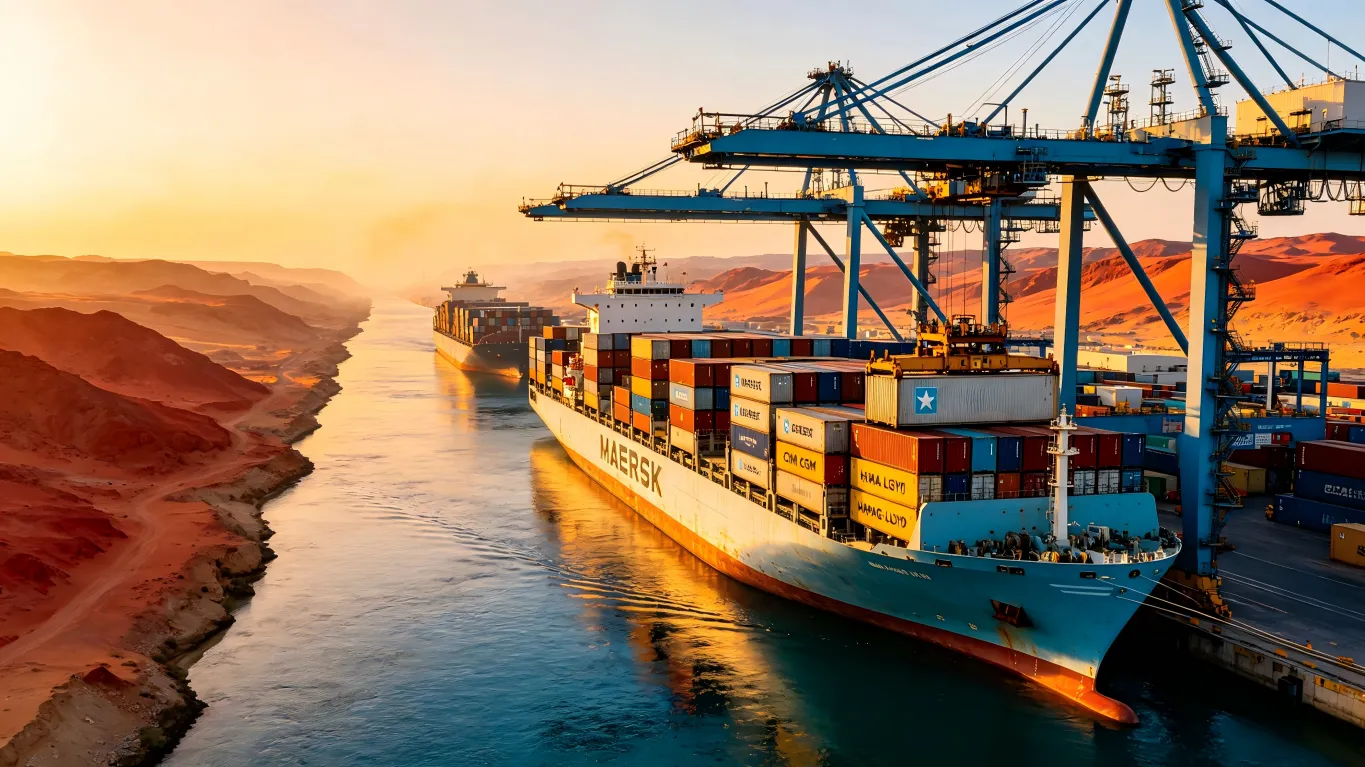
Why Ship From Shenzhen to Egypt? Understanding the Trade Corridor
Shenzhen is not just another Chinese port city. It is the world’s electronics capital, home to the densest ecosystem of manufacturers, component markets, and logistics infrastructure on the planet. For Egyptian importers, that means unmatched access to IoT devices, consumer electronics, textiles, and machinery—often within a single metro area.
Port Versatility That Other Cities Cannot Match
Unlike Shanghai or Ningbo, Shenzhen offers three distinct container gateways, each with strategic advantages:
- Yantian Port: The deep-water giant. If your cargo is bound for Alexandria or Damietta via the Suez Canal, Yantian hosts the largest mother vessels and the most frequent sailings to the Mediterranean.
- Shekou / Chiwan: Located in western Shenzhen, these terminals sit closer to the manufacturing belts of Bao’an, Nanshan, and Dongguan. They excel at Red Sea feeder services to Ain Sokhna, often shaving days off transit by avoiding full Suez Canal transits. If your distribution network also covers the Gulf, explore our parallel service for shipping from Shenzhen to Saudi Arabia through the same Red Sea corridor.
- Hong Kong (HKG) Air Freight: For high-value or time-critical cargo, routing through Hong Kong International Airport expands your carrier options beyond Shenzhen Bao’an (SZX). Emirates, Qatar Airways, and Etihad offer dense frequencies from HKG to Cairo (CAI), often at rates competitive with—or better than—SZX departures.
Shenzhen vs. Shanghai/Ningbo: Which Origin Makes Sense?
If your suppliers are in Guangdong province, shipping from Shenzhen is a no-brainer. Inland trucking from Longgang or Bao’an to Yantian takes hours, not days. But even if some components come from East China, Shenzhen can still win on flexibility. We frequently consolidate LCL cargo from Shanghai into our Shenzhen warehouse, giving clients a single origin document set and one Bill of Lading (B/L)—a simplification that Egyptian customs appreciates. This is one reason why many experienced importers choose shipping from China to Egypt through our Shenzhen hub.
Shipping Methods From Shenzhen to Egypt at a Glance
Choosing the wrong mode is the fastest way to blow your budget. Use this matrix to align your cargo profile with the right solution.
| Shipping Method | Best For | Transit Time | Cost Indicator | Min. Volume |
|---|---|---|---|---|
| Sea FCL | Bulk cargo >15 CBM; heavy machinery | 18–35 days port-to-port | Most economical per unit | 1 x 20ft container |
| Sea LCL | 1–15 CBM partial loads; multi-supplier orders | 25–45 days door-to-door | Priced per CBM | 1 CBM |
| Air Freight | Urgent electronics, samples, high-value goods | 3–7 days airport-to-airport | $4.50–$7.00 per kg | 45 kg |
| Express Courier | Documents, small parcels <100 kg | 5–9 days door-to-door | $12–$16 per kg | 1 kg |
| DDP Door-to-Door | SMEs without customs brokers; hassle-free delivery | 22–45 days by sea / 7–12 days by air | All-inclusive quote | 1 CBM or 45 kg |
Quick-start rule of thumb: If your cargo is heavy, bulky, or non-urgent, Sea Freight from China wins. If it is under 500 kg and time-sensitive, Air Freight from SZX or HKG is often worth the premium. If you simply want the cargo to appear at your warehouse without touching paperwork, choose DDP Door-to-Door. That said, if you already have a trusted Egyptian customs broker and prefer to manage duty payment yourself, FOB or CIF terms paired with our standard freight service may be more cost-effective.
Sea Freight From Shenzhen to Egypt: FCL vs. LCL Explained
Sea freight accounts for over 90% of volume on this lane, and for good reason: Egypt’s primary ports—Alexandria, Sokhna, Damietta, and Port Said—are all containerized and well-linked to Shenzhen’s sailing schedules. Whether you need Container Shipping from China to Egypt or LCL consolidation, the infrastructure supports both modes reliably.
FCL (Full Container Load)
With FCL, you rent the entire container. Your goods are sealed at the factory or at our Shenzhen consolidation warehouse and opened only at your Egyptian warehouse. That security matters for high-value electronics and textiles prone to pilferage.
Container selection guide: - 20ft container: Best for 15–28 CBM or loads under 18 metric tons. Think machinery parts, dense textile rolls, or mixed consumer goods. - 40ft container: Standard for 28–55 CBM. The sweet spot for most medium-volume importers. - 40HQ (High Cube): The same footprint as a 40ft but with an extra foot of height. Ideal for lightweight, voluminous cargo like furniture, packaging materials, or inflatable products.
Origin-port strategy: Book from Yantian if your destination is Alexandria or Damietta (Suez Canal routing). Book from Shekou/Chiwan if you are heading to Sokhna (Red Sea direct), where transit times can be 5–7 days faster.
LCL (Less than Container Load)
LCL lets you share container space with other shippers. It is the perfect fit for 1–15 CBM loads that do not justify a full box.
The real advantage of shipping LCL from Shenzhen is consolidation. We operate a consolidation warehouse in Shenzhen where we can collect goods from multiple suppliers—say, one in Longgang delivering circuit boards and another in Dongguan delivering plastic housings—palletize them together, and load them as a single consignment. That reduces your per-unit handling cost and gives you one unified document set for Egyptian customs. For more on cutting costs with shared containers, read our LCL Shipping Guide.
Risk mitigation: Always demand proper palletization and "Do Not Stack" cone labels if your cargo is fragile. Shared containers mean shared handling; a poorly stacked neighbor can crush your cartons.
Transit Times by Destination Port
| Port of Loading | Destination Port | Route | Port-to-Port | Door-to-Door |
|---|---|---|---|---|
| Shenzhen (Yantian) | Alexandria | Suez Canal | 28–35 days | 35–45 days |
| Shenzhen (Yantian) | Damietta | Suez Canal | 30–38 days | 38–48 days |
| Shenzhen (Shekou) | Ain Sokhna | Red Sea Direct | 20–25 days | 28–35 days |
| Shenzhen (Shekou) | Port Said | Suez Canal | 19–26 days | 27–35 days |
Pro tip: If your final warehouse is in Cairo or the Red Sea corridor, Sokhna is usually the smarter choice. The new highway connects Sokhna to Cairo in under two hours, bypassing Delta traffic entirely. If you are serving the Nile Delta or Alexandria itself, stick with Alexandria port despite the slightly longer sail.
Sea Freight Rates (2026 Benchmarks)
Freight rates are volatile, but here are the Q2 2026 ranges we are seeing for standard general cargo:
| Service | Rate Range (USD) | Notes |
|---|---|---|
| 20ft FCL to Alexandria | $2,800 – $3,700 | Volatile; up ~22% from early 2026 |
| 40ft FCL to Alexandria | $3,600 – $4,800 | More stable than 20ft |
| 40HQ to Alexandria | $3,700 – $4,900 | Best per-CBM value for light cargo |
| LCL per CBM to Alexandria | $90 – $130 | Stable; depends on density and destination |
| 20ft FCL to Sokhna | $2,400 – $3,200 | Red Sea routes often slightly cheaper |
What drives volatility? - BAF (Bunker Adjustment Factor): Fluctuates with fuel prices. - PSS (Peak Season Surcharge): Kicks in from September through January; budget an extra $300–$500 per TEU. - Suez Canal Surcharge: Carriers may apply transit fees or rerouting premiums during geopolitical tension. - Red Sea Geopolitical Premiums: Ongoing instability can push carriers to divert around the Cape of Good Hope, adding 10–14 days and significant cost.
Air Freight From Shenzhen to Egypt: When Speed Matters
When a Cairo factory line is down waiting for a Shenzhen-made sensor, air freight is the only answer.
When to Choose Air Freight
- High-value electronics: Smartphones, laptops, and semiconductors where the cost of a stockout exceeds the freight premium.
- Urgent spare parts: Industrial machinery components with strict MRO deadlines.
- Seasonal samples: Fashion or electronics samples that must reach Cairo buyers before a trade show.
- Perishables: Pharmaceuticals and temperature-sensitive goods.
Chargeable weight: Airlines bill whichever is greater—actual weight or volumetric weight. The formula is simple:
Volumetric Weight (kg) = Length (cm) x Width (cm) x Height (cm) / 6000
Example: A carton measuring 60 x 50 x 40 cm has a volumetric weight of 20 kg. If the actual weight is only 14 kg, you pay for 20 kg.
Departures: SZX vs. HKG vs. CAN
| Departure Airport | Best For | Key Carriers | Typical Routing |
|---|---|---|---|
| Shenzhen Bao’an (SZX) | General cargo; direct bookings | Hainan Airlines, Sichuan Airlines, Etihad | Direct or via Abu Dhabi/Doha |
| Hong Kong (HKG) | High-value, oversized, or premium service | Emirates, Qatar Airways, Cathay Pacific | Direct to CAI or via DXB/DOH |
| Guangzhou Baiyun (CAN) | Large-volume charters; EgyptAir direct | EgyptAir, Sichuan Airlines | Direct CAN→CAI |
From our Shenzhen warehouse, trucking to HKG takes roughly 2–3 hours with proper customs transit documentation. For shipments over 300 kg, the extra carrier choice at HKG often offsets the inland trucking cost. Many clients also use our Shenzhen hub for shipping from Shenzhen to UAE, leveraging the same consolidation infrastructure.
Air Freight Rates & Transit Times
| Weight Break | Rate per kg (USD) | Transit Time (Airport-to-Airport) |
|---|---|---|
| +45 kg | $5.50 – $7.00 | 3–5 days |
| +100 kg | $4.80 – $6.20 | 3–5 days |
| +300 kg | $4.20 – $5.50 | 3–7 days |
| +500 kg | $3.80 – $5.00 | 3–7 days |
Note: These are base freight rates. Always confirm whether your quote includes fuel surcharge (FSC), security surcharge, and terminal handling—all of which can add $1.00–$2.50 per kg.
Shipping Costs From Shenzhen to Egypt (2026 Rates)
Sea Freight Cost Breakdown
| Container Type | Port-to-Port (Alexandria) | Port-to-Port (Sokhna) | Typical Door-to-Door Add-on |
|---|---|---|---|
| 20ft GP | $2,800 – $3,700 | $2,400 – $3,200 | $800 – $1,500 |
| 40ft GP | $3,600 – $4,800 | $3,200 – $4,200 | $1,000 – $1,800 |
| 40HQ | $3,700 – $4,900 | $3,300 – $4,300 | $1,000 – $1,800 |
| LCL (per CBM) | $90 – $130 | $85 – $120 | $40 – $60 per CBM |
Door-to-door add-ons cover Egyptian Customs Clearance, Duties and Taxes advance (if DDP), port handling, and inland trucking to your warehouse. Always ask whether your quote is port-to-port or all-in.
Air Freight Cost Breakdown
| Chargeable Weight | SZX/HKG to CAI | Notes |
|---|---|---|
| 45–100 kg | $5.50 – $7.00/kg | Express-like pricing; higher per-kg cost |
| 100–300 kg | $4.80 – $6.20/kg | Standard air freight sweet spot |
| 300–500 kg | $4.20 – $5.50/kg | Spot-rate negotiations begin |
| 500+ kg | $3.80 – $5.00/kg | Charter or block-space options available |
Hidden Fees & Destination Charges
The sticker price is never the whole story. Budget for these line items:
| Fee Type | Estimated Cost | Who Charges |
|---|---|---|
| THC (Terminal Handling) | $150–$250 per container / $0.50–$1.00/kg air | Origin/destination terminals |
| Documentation (B/L, COO) | $50–$100 | Forwarder or broker |
| Customs Declaration (China) | $80–$150 | Chinese customs broker |
| Egyptian Port Handling | $200–$500 per container | Egyptian port authority |
| Storage / Demurrage | $80–$150/day after free time | Port or carrier |
| Inland Trucking (Egypt) | $300–$800 depending on distance | Local trucking provider |
Egyptian ports are notoriously strict on free time. You typically get 5–7 days of free storage before demurrage kicks in. We strongly recommend negotiating 14–21 days of free detention at booking, especially if you are new to Egyptian customs.
Seasonal Price Calendar
| Period | Sea Freight Trend | Air Freight Trend | Driver |
|---|---|---|---|
| January–February | Spike (+20–30%) | Moderate spike | Pre-Chinese New Year rush |
| March–June | Stable/softening | Stable | Post-CNY lull; best value window |
| July–August | Gradual rise | Rise | Back-to-school and Ramadan restocking |
| September–October | High (+PSS) | High | Golden Week + Q4 inventory buildup |
| November–December | Elevated | Spike | Black Friday + year-end air rush |
Strategic takeaway: If your supply chain allows, book ocean freight in March–June and air freight in May–June (recent rate easing has made air unusually competitive in Q2 2026).
Disclaimer: The rates and compliance requirements in this guide reflect market conditions as of Q2 2026. Ocean and air freight rates fluctuate daily based on fuel surcharges, capacity, and geopolitical events. Always request a current, itemized quote before booking. This guide is for informational purposes only and does not constitute legal, tax, or customs advice; consult a licensed Egyptian customs broker for shipment-specific compliance matters.
Egyptian Customs Compliance: ACID, GOEIC & Duties
This is where most shipments fail. Egyptian customs digitization is advanced, but the rules are unforgiving.
The ACID Number & Nafeza System
Since October 2021, every shipment to Egypt must carry a valid 19-digit ACID (Advanced Cargo Information Declaration) number. No exceptions. If your Bill of Lading (B/L) or Air Waybill (AWB) lacks the ACID, the carrier may refuse to load the cargo in Shenzhen—or Egyptian customs will reject it on arrival and return it at your expense.
The 6-step workflow: 1. Importer Registration: You (the Egyptian importer) register on Egypt’s Nafeza single-window portal. 2. Supplier Registration: Your Chinese supplier registers on the CargoX blockchain platform. This is the step where most delays happen—many Shenzhen factories have never heard of CargoX. 3. Filing: You submit preliminary shipment data to Nafeza to request the ACID. 4. Issuance: Nafeza generates the 19-digit ACID number, usually within 24–48 hours. 5. Document Annotation: The ACID must appear on every shipping document—Commercial Invoice, Packing List, and B/L. 6. Upload: The supplier uploads final documents to CargoX before the vessel arrives.
Troubleshooting: If your supplier cannot navigate CargoX (and many cannot), a Shenzhen-based forwarder can step in. We regularly visit factories in Longgang and Bao’an to complete CargoX registration and upload documents on the supplier’s behalf—saving days of back-and-forth.
GOEIC Registration: The Missing Piece Most Guides Ignore
While ACID gets the headlines, GOEIC (General Organization for Export and Import Control) is the silent killer of Egyptian imports. If your product falls under regulated categories, you need a GOEIC Certificate of Inspection issued before shipment.
Categories commonly requiring GOEIC: - Household electrical appliances (irons, kettles, heaters) - IT equipment (laptops, tablets, routers) - Textiles and garments - Food products and cosmetics
How to comply: 1. Verify your HS Codes against the GOEIC regulated list. 2. Submit samples or product data to an accredited lab in Shenzhen (e.g., SGS, BV, or local CMA-certified labs). 3. Obtain the GOEIC Certificate of Inspection. 4. Include the certificate in your Nafeza filing and CargoX upload.
Skipping GOEIC does not result in a fine—it results in cargo rejection. We have seen entire LCL shipments held at Alexandria for weeks because one carton of LED lamps lacked the proper GOEIC paperwork.
Customs Duties, VAT & the China-Egypt Free Trade Agreement
Egypt applies Duties and Taxes — specifically a 14% VAT on the CIF value plus customs duties. Duty rates are HS-specific:
| Product Category | Customs Duty Range | VAT | Total Estimated Tax Burden |
|---|---|---|---|
| Electronics | 10%–30% | 14% | 25%–48% of CIF |
| Textiles | 5%–20% | 14% | 20%–37% of CIF |
| Machinery | 2%–15% | 14% | 16%–31% of CIF |
| Raw Materials | 0%–5% | 14% | 14%–20% of CIF |
China-Egypt FTA in action: Under the bilateral Free Trade Agreement, many Chinese-origin goods qualify for reduced or zero customs duties—provided you hold a Certificate of Origin issued by CCPIT (China Council for the Promotion of International Trade) or an authorized chamber of commerce.
Example: A shipment of plastic kitchenware (HS 3924.10) might face a standard 20% duty, but with a valid China-Egypt Certificate of Origin, that duty drops to 0%. On a $20,000 CIF shipment, that is $4,000 saved—far more than the certificate’s modest $50 processing fee.
Required Documents Checklist
Before your cargo leaves Shenzhen, confirm you have: - [ ] Commercial Invoice (with ACID number clearly stated) - [ ] Packing List (with ACID number) - [ ] Bill of Lading (Ocean) or Air Waybill (Air) - [ ] Certificate of Origin (standard or preferential FTA version) - [ ] GOEIC Certificate of Inspection (if applicable) - [ ] Certificate of Conformity (CoC) or CE documentation (for electronics) - [ ] MSDS / UN38.3 (for battery shipments)
DDP Door-to-Door Shipping From Shenzhen to Egypt: A Complete Walkthrough
For importers seeking fully managed Door-to-Door Shipping From China, DDP (Delivered Duty Paid) is the Incoterm of choice for Egyptian SMEs that lack dedicated customs teams or easy access to hard currency for duty payments.
What Is DDP and Why It Matters
Under Incoterms 2020, DDP places maximum obligation on the seller (or forwarder). We handle pickup in Shenzhen, export clearance, international freight, Egyptian ACID/GOEIC compliance, duty/VAT payment, and final delivery to your warehouse. You simply receive the cargo.
This is especially valuable in Egypt, where importers often face Form 4 hard-currency complications at local banks. With DDP, the forwarder pre-clears duties, eliminating that friction.
Step-by-Step DDP Journey
- Factory Pickup: We collect cargo from your supplier’s facility in Longgang, Bao’an, or Dongguan.
- Shenzhen Consolidation & QC: Goods arrive at our warehouse for palletization, labeling, and optional quality inspection.
- China Export Customs: We file the export declaration and secure the customs release seal.
- International Transit: Ocean or air freight to Alexandria, Sokhna, or Cairo.
- Egyptian Clearance: We manage ACID validation, GOEIC verification, and duty/VAT settlement.
- Last-Mile Delivery: Vetted local trucking partners deliver to your Cairo or Alexandria warehouse.
DDP Cost Structure & Transparency
| Mode | Typical DDP Estimate | Includes |
|---|---|---|
| Sea LCL DDP | $140–$190 per CBM | Origin handling, freight, customs, duties, delivery |
| Sea FCL DDP (20ft) | $3,500–$4,800 per container | All-in to warehouse |
| Sea FCL DDP (40ft) | $4,800–$6,200 per container | All-in to warehouse |
| Air DDP | $6.50–$9.00 per kg | Pickup, freight, clearance, duties, delivery |
Note: DDP quotes should always be itemized. If a forwarder gives you a single lump-sum number without breakdown, demand clarity—especially on the duty/VAT estimate.
Hidden Risks & How to Avoid Them
- Underestimated duties: Some forwarders lowball the duty component to win business, then bill you the difference later. We fix the duty estimate upfront using confirmed HS codes.
- Storage fee explosions: If customs holds your cargo beyond free time, demurrage racks up fast. We negotiate extended free detention and monitor clearance daily.
- Last-mile failures: Not every Egyptian trucking company covers remote Delta towns. We pre-confirm delivery coverage before booking.
Shipping Electronics & E-Commerce Cargo From Shenzhen to Egypt
Shenzhen: The Global Electronics Hub
Egyptian tech importers do not just buy from China—they buy from Shenzhen. Huaqiangbei alone hosts thousands of suppliers for everything from microcontrollers to finished consumer electronics. That density creates both opportunity and compliance complexity.
Compliance for Electronics Shipments
- Battery shipments: Lithium-ion cells require UN38.3 test reports and an MSDS (Material Safety Data Sheet). Some airlines restrict DG (Dangerous Goods) cargo to specific days or require special packaging. Always cross-check lithium battery rules against the latest IATA Dangerous Goods Regulations before booking.
- CE marking: While CE is a European mark, Egyptian customs increasingly treat it as a baseline quality indicator. A Certificate of Conformity (CoC) from an accredited body (Intertek, SGS, TÜV) smooths clearance significantly.
- GOEIC for electronics: As noted earlier, most IT and household appliances need GOEIC pre-approval. Plan an extra 7–10 days in your lead time for lab testing.
Amazon FBA & E-Commerce Logistics to Egypt
Egypt’s e-commerce market is growing rapidly, driven by platforms like Noon, Jumia, and Amazon Egypt. For sellers sourcing from Shenzhen, the Amazon FBA Forwarding pipeline looks different from traditional B2B:
- FBA Prep in Shenzhen: Before cargo leaves China, we handle barcode labeling (FNSKU or EAN), poly-bagging, carton labeling, and palletization to Amazon Egypt’s inbound standards.
- Parcel consolidation: For dropshippers or small-batch sellers, we offer B2C parcel consolidation—combining dozens of small orders into one LCL or air shipment to reduce per-unit freight cost.
- Last-mile standards: Egyptian fulfillment centers require specific carton dimensions and weight limits (usually under 25 kg per carton). We enforce these at our Shenzhen warehouse so your cargo is not rejected on arrival.
Choosing the Right Egyptian Port of Entry
Alexandria / El Dekheila
Alexandria handles roughly 60% of Egypt’s container trade. If your warehouse is in the Nile Delta, Alexandria is the default choice. The downside is congestion—peak season can add 3–5 days to berth waiting times.
Ain Sokhna
Sokhna is the fastest-growing alternative. Located on the Red Sea, it avoids Suez Canal transit and connects to Cairo via a modern highway in under two hours. If your final destination is Cairo or the Red Sea corridor, Sokhna often saves both time and inland trucking cost. For example, a Cairo-based electronics importer we work with switched his monthly LCL shipments from Alexandria to Sokhna and cut inland trucking costs by roughly 30% while shaving four days off average transit.
Damietta & Port Said
- Damietta: Specializes in furniture and bulk cargo. Use it as an overflow alternative when Alexandria is congested.
- Port Said: Strategic for transshipment and Suez Canal Economic Zone projects. Best for project cargo or importers with free-zone licenses.
Port Selection Quick Guide
| Your Final Destination | Recommended Port | Rationale |
|---|---|---|
| Cairo / Giza | Ain Sokhna | Fastest inland link; avoids Delta traffic |
| Alexandria / Delta | Alexandria / Dekheila | Largest network; closest to destination |
| Sinai / Red Sea | Sokhna | Direct Red Sea routing |
| Free Zone / Industrial Project | Port Said | SCZone incentives; transshipment hub |
Risk Management: Red Sea Disruptions, Delays & Cargo Insurance
Navigating Red Sea & Suez Canal Uncertainty
Geopolitical instability in the Red Sea has forced carriers to consider Cape of Good Hope rerouting, adding 10–14 days and significant fuel cost. These same pressures affect sea freight from China to Saudi Arabia and other Gulf routes that share the Suez corridor. A Shenzhen-based forwarder with real-time vessel monitoring can pivot bookings to Red Sea-direct services or alternative transshipment hubs (e.g., Jebel Ali) when disruptions spike.
What If Your Cargo Is Held by Egyptian Customs?
Common hold reasons: - HS code mismatch or undervaluation - Missing GOEIC / CoC for regulated goods - ACID number discrepancies between invoice and B/L
Escalation workflow: 1. Forwarder contacts the customs broker for clarification. 2. Broker files corrected documents or valuation justification. 3. If disputed, an appeal is lodged with the Egyptian Customs Authority with supporting lab reports or supplier affidavits.
Cargo Insurance: Is It Worth It?
For shipments valued over $10,000, All-Risk cargo insurance is non-negotiable. Premiums typically run 0.1–0.3% of insured value. Given Egyptian customs’ strict inspection regime and the handling intensity of LCL consolidation, insurance protects against the unexpected. Institute Cargo Clauses (C) covers total loss; clauses (A) cover partial damage and theft. For electronics, always opt for (A).
How to Choose a Reliable Freight Forwarder in Shenzhen
Knowing what is a freight forwarder is the first step; finding one that truly understands Egypt is the harder part. Here are six criteria to filter out the pretenders:
- Route experience: Have they handled ACID and GOEIC filings regularly, or are they learning on your shipment?
- Carrier network: Do they have direct contracts with COSCO, MSC, and Emirates SkyCargo, or do they subcontract everything?
- Compliance expertise: Is there a dedicated team for Nafeza/CargoX troubleshooting?
- Transparency: Are quotes itemized, or are you guessing what "all-in" really means?
- Communication: Do they respond in real time, or do you wait 24 hours for a tracking update?
- Local infrastructure: Do they own or operate a Shenzhen warehouse for consolidation and QC?
Why AllBestShipping?
AllBestShipping is headquartered in Shenzhen, not Shanghai or Hong Kong. That matters because we speak the language of your suppliers, visit their factories, and troubleshoot CargoX uploads in person.
- Local presence: Bilingual operations team, owned consolidation warehouse, and direct carrier contracts.
- Compliance-first: Dedicated ACID/GOEIC support team that guides your suppliers through every digital filing.
- Transparent pricing: Itemized quotations with seasonal rate guidance and no hidden destination charges.
- End-to-end visibility: Real-time tracking from Shenzhen factory floor to Egyptian warehouse door.
If you are new to importing, our guide on how to ship from China covers the fundamentals. Ready to move your next shipment? Request a free, tailored quote and let our Shenzhen team handle the rest.
FAQ
How long does shipping from Shenzhen to Egypt take? Sea freight ranges from 20–25 days to Sokhna and 28–35 days to Alexandria. Air freight takes 3–7 days, while express courier delivers in 5–9 days.
What is the cheapest way to ship from Shenzhen to Egypt? For cargo over 15 CBM, Sea FCL is almost always cheapest per unit. For smaller loads, Sea LCL beats air freight until you hit the 300–500 kg threshold. Book during March–June for the most stable rates.
Can I ship from Shenzhen to Egypt without an ACID number? No. Egyptian law mandates a 19-digit ACID for every shipment. Without it, cargo will be rejected or returned at the shipper’s expense.
Is air freight or sea freight better for electronics from Shenzhen? It depends on value and urgency. High-value or time-sensitive electronics should fly. Bulk consumer electronics (chargers, cables, accessories) should sail via FCL or LCL.
What documents do I need to import from China to Egypt? At minimum: Commercial Invoice, Packing List, Bill of Lading or AWB, and Certificate of Origin. Regulated goods also need GOEIC and CoC documentation.
How do I avoid customs delays in Egypt? Accuracy is everything. Match your HS codes precisely, secure ACID before loading, include GOEIC for regulated goods, and work with a forwarder who pre-clears documents via Nafeza.
Does AllBestShipping offer DDP shipping from Shenzhen to Egypt? Yes. We offer DDP door-to-door by both sea and air, handling pickup, clearance, duty payment, and last-mile delivery.
What is GOEIC and does my product need it? GOEIC is Egypt’s import control body. Electronics, appliances, textiles, and food products typically require a GOEIC Certificate of Inspection before shipment.
Can you ship lithium batteries from Shenzhen to Egypt? Yes, with proper UN38.3 testing, MSDS documentation, and DG-compliant packaging. Some airlines restrict lithium shipments, so routing through sea freight or approved air carriers is essential.
Conclusion
Shenzhen offers Egyptian importers unmatched manufacturing access, port flexibility, and cost efficiency. But the corridor rewards preparation and punishes oversight. Getting your ACID number early, confirming GOEIC requirements before production ends, and choosing the right port—whether Alexandria for the Delta or Sokhna for Cairo—are the decisions that separate seamless shipments from costly delays.
Whether you need FCL sea freight to Alexandria, air freight to Cairo, or a fully managed DDP door-to-door solution, AllBestShipping’s Shenzhen team is ready to quote, consolidate, and clear your cargo. Get your free, tailored quote today and move your goods with confidence.