RoRo Shipping from China to Australia: Deck Space, Approvals and What Each Unit Costs
RoRo shipping from China to Australia gets settled three weeks before your shipment reaches the load port, and the three questions that decide it are the ones importers ask three days before the vessel closes cargo: does it roll, is it approved, and is there a deck slot out of Nansha?
Rolling cargo is new cars and SUVs, utes, vans, buses, excavators and wheel loaders: units that go up a stern ramp under their own power and come down the same way. China exported 1.04 million vehicles in July 2026, up 81% year on year, and deck space is now a dealer question. Shipping From China to Australia covers the container side of the lane; this page stays with what rolls. If you read one section, read section 3.
Deck space, not the freight rate, is the 2026 constraint
Chinese-built cars were about 35% of Australia's new-vehicle market in October 2026, up from about 18% in September 2025. China exported 1.04 million vehicles in July 2026 alone, up 81% year on year, and 6.14 million in seven months, while car-carrier capacity grew about 3%.
Charter rates show the squeeze. A one-year charter for a 6,500 CEU car carrier reached about USD 80,000 a day in 2026, double the USD 45,000 a day of August 2025, and most newbuild capacity ordered against it arrives between 2029 and 2031. About two million vehicles are moving in containers this year instead.
For a single unit it shows up as booking lead time rather than freight rate. A deck slot is allocated against a cut-off: the unit has to be at the load terminal, declared and clean, before the vessel closes cargo. Six to eight weeks ahead is the working window, and a used electric vehicle, which carriers accept only in writing, needs longer.
What each unit costs, and the measurement that sets the price
Car-carrier freight is quoted per unit, and three measurements decide the price: the lane metre it occupies, the revenue tonne the terminal charges on, and the cubic measurement a carrier falls back on when it will not sit on a deck cleanly.
Unit | RoRo shipping cost, China to Australia | ≈AUD, 15–16 Nov 2026 | What sets the price |
|---|---|---|---|
Car, sedan or small SUV | USD 1,500–3,000, September 2026 | 2,210–4,430 | One unit, one lane position, no packing |
Ute, 4WD or large SUV | No China-lane figure; top of the car band, so USD 1,500–3,000 | 2,210–4,430, inferred | Length and roof height over the car deck |
Van, Transit or Sprinter class | No China-lane figure published | Not quoted | Height above 2 m and lane metres blocked |
Bus, truck or prime mover | USD 3,500–6,000, September 2026 | 5,170–8,850 | Lane metres plus ramp weight rating |
Excavator, 8–20 t | USD 3,500–6,000 per unit, or USD 150–300 per CBM | 5,170–8,850 | Revenue tonne; CBM is the carrier basis |
Excavator, 20–45 t | USD 4,500–9,000+ per unit | 6,640–13,280 | Revenue tonne, often a flat rack instead |
Break-bulk plant | USD 80–200 per revenue tonne | 118–295 per tonne | Greater of mass or L×W×H |
Two rows are not quotes. No China-lane rate is published for a ute or a van, so the ute line is inferred from the ceiling of the car band and the van line has nothing behind it. The excavator band is worse: one source prices an 8–20 t machine at USD 3,500–6,000 per unit and at USD 150–300 per CBM, or USD 8,000–15,000 at 20 t.
Outside the freight line sit origin handling at Shanghai Haitong, Tianjin Xingang, Lianyungang, Ningbo Meixi, Qingdao, Nansha or Zhoushan; maritime security; the destination charges in section 9; cleaning; duty, GST and luxury car tax; and inland delivery. Origin and security charges are published nowhere we could reach, so an all-in figure that omits them is an estimate. Container rates are the obvious benchmark — our sea freight guide to Australia carries the September 2026 20GP and 40HQ bands — but a box price is not a deck-slot price.
A new car from a Chinese dealer needs a ROVER import approval before a booking
Section 22 of the Road Vehicle Standards Act 2018 makes it an offence to import a road vehicle without an approval, and the application goes through ROVER, where assessment can take up to 60 business days. The Australian Border Force will not release an unapproved vehicle, and storage until approval issues falls on the importer, not the supplier.
A dealer's type approval covers the vehicles that dealer imports, not the one you buy. Buy privately and you are the importer, with your own application to lodge.
Approval is the first gate. Entry on the Register of Approved Vehicles is the second, and customs clearance is where an entry gets checked against both. The Department of Infrastructure sets out the routes in full.
What is arriving | Approval route | Assessment time | Where it is applied for |
|---|---|---|---|
New car, SUV, ute or van for road use | ROVER import approval with RAV entry | Up to 60 business days | ROVER |
Up to 30 identical road vehicles | One single-road-vehicle application | Up to 60 business days | ROVER |
Vehicle 25 years or older | Concessional RAV entry, older vehicle | Up to 60 business days | ROVER |
Vehicle for modification by a workshop | Concessional RAV entry, RAW route | Up to 60 business days | ROVER, with the registered workshop |
Trailer or towable implement | Concessional RAV entry, trailer | Up to 60 business days | ROVER |
Race, exhibition, film or testing unit | Non-RAV entry approval | Up to 60 business days | ROVER |
Tracked excavator, dozer, farm machine | Not a road vehicle, no approval needed | None, subject to the determination | Section 233 advisory notice, optional |
Charge | Basis | 2026 figure |
|---|---|---|
Import duty under ChAFTA | Certificate or declaration of origin | Zero on originating goods, all tariff lines eliminated from 1 January 2019 |
GST | 10% of the value of the taxable importation: customs value, transport and insurance, plus duty | 10% |
Luxury car tax | Thresholds from 1 July 2026 | AUD 91,661 fuel-efficient, AUD 80,809 other |
The concessional routes that change the maths
Concessional RAV entry approvals cover vehicles 25 years or older, modification by a Registered Automotive Workshop, special purpose vehicles, personal effects and trailers. That approval doubles as the import approval, and the 60-business-day allowance still applies, but the evidence shifts: a workshop route needs the workshop involved from the start, and a personal-effects claim needs ownership and migration records.
Non-RAV entry covers vehicles that will not be used on Australian roads: races and rallies, exhibition, film and advertising, testing or market evaluation, heavily modified and temporary imports. It suits a museum piece and is the wrong approval for a car you intend to register.
An excavator is not a road vehicle, but a trailer is
The department's list is specific: agricultural machines, quad bikes, tracked vehicles such as bulldozers and excavators, golf carts, light utility vehicles and personal mobility devices are not road vehicles. A section 233 advisory notice under the Road Vehicle Standards Rules 2019 confirms that for a make and model, and can be reused until it expires.
The test is the manufacturer's design, not your plan. An excavator built for a site stays outside the act even if you mean to drive it between two yards. A machine built to be towed on a public road is inside, which catches the towable implements and plant trailers importers routinely assume are out of scope.
Asbestos is the stop at the wharf: brake pads, gaskets and an import that gets seized
Importing asbestos is prohibited under regulation 4C of the Customs (Prohibited Imports) Regulations 1956, and the Australian Border Force risk-assesses every consignment. A unit suspected of containing asbestos is held at the border, goods found to contain it are seized, and penalties or prosecution can follow.
ABF names brake and clutch servicing as one of the top five non-occupational exposure routes in Australia, which is why brake pads, clutch linings and gaskets are the first items anyone looks at on a used unit. A Chinese supplier's letter saying the car is asbestos-free is not assurance: a face-value letter from the supplier or their mechanic is insufficient, and other countries' tolerance levels do not count here. Testing must come from a NATA-accredited laboratory, or an MRA-recognised overseas equivalent, and state that no level was detected. If a unit is held, you engage an independent competent person to take samples, and you pay for that and for storage at the section 9 rates.
BMSB season 2026-27 runs to 30 April, and the clock is the bill of lading
DAFF's seasonal measures for brown marmorated stink bug apply to targeted goods shipped between 1 September 2026 and 30 April 2027, and the shipped-on-board date on the ocean bill of lading is what decides. Gate-in dates are not accepted, so a unit that reaches the terminal in August and sails on 3 September is inside the season.
China's status is what importers misread in both directions. China is a target-risk country for heightened vessel surveillance only, so the ship is inspected and the cargo is not treated, and it is separately an emerging-risk country subject to random onshore inspection, Nothing in that requires fumigation of a Chinese car. Break-bulk is where it bites: flat racks and open tops included, it must be treated offshore, and untreated break-bulk is denied discharge or directed for export. DAFF publishes the measures in full, including the 2026-27 change that removed the Rolled Goods Policy and the Safeguarding Arrangements Scheme.
Used machinery answers to a cleanliness rule of its own: soil, seeds and plant material have to be gone on arrival, and a heavily contaminated machine can be directed for export at the owner's expense.
Port Kembla, Webb Dock West Melbourne and the rest of Australia's RoRo terminals
The RoRo import terminals of Australia are a short list: AAT Port Kembla on Yampi Way, AAT Webb Dock West in Melbourne at Berth 2, AAT Fisherman Islands in Brisbane, Qube Outer Harbour in Adelaide and P&O Ports Fremantle. Sydney is served through Port Kembla rather than Port Botany, the routing mistake this lane sees most, and that terminal handles more than 800 vessel calls a year.
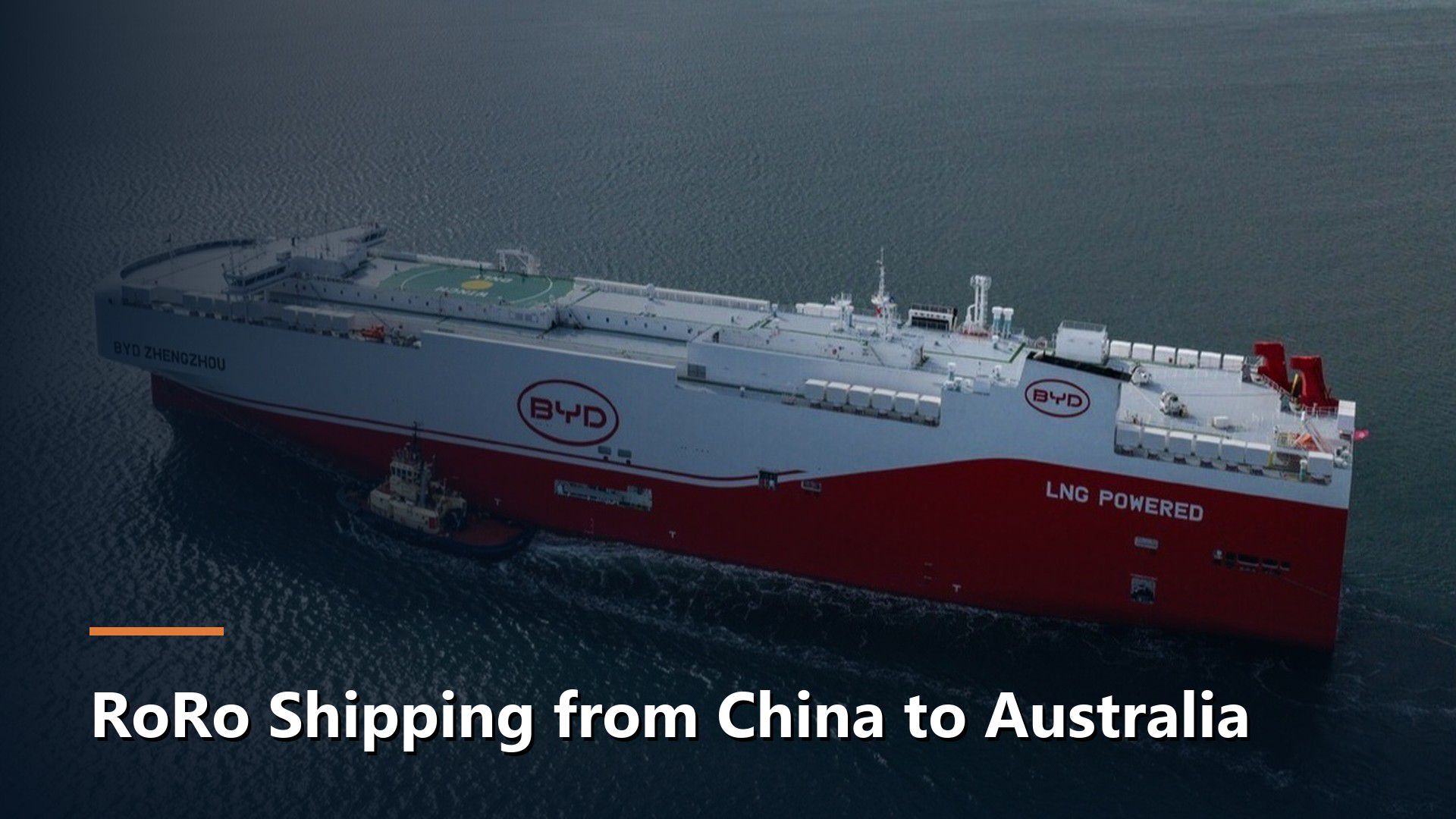
Most Chinese units never see a direct sailing. The published China-to-Australia loop runs Xingang in Tianjin, Shanghai and Xinsha in Guangzhou to Singapore, then Fremantle, Adelaide, Melbourne, Port Kembla and Brisbane, on a South-East Asia service that sails every 14 days. In June 2026, BYD's BYD Zhengzhou made its first Australian call at Webb Dock West with almost 5,000 vehicles, about 2,000 of them discharged in Melbourne and the rest at Port Kembla and Fisherman Islands.
What the Australian terminal charges after the vessel berths
AAT Webb Dock West FY27 tariff, effective 1 July 2026, AUD ex GST. These are the figures most per-car quotes leave out.
Charge | Basis | Rate |
|---|---|---|
Facility access charge | Per revenue tonne, wheeled and tracked units | AUD 5.21 |
Stevedoring access charge | Per unit | AUD 15.10 |
Receival and delivery | Per unit | AUD 3.65 |
Second-hand car handling | Per unit | AUD 62.40 |
Import storage, first three business days | Per unit, after arrival | No charge |
Import storage, wheeled unit under 20 CBM | Per unit per day | AUD 63.43 |
Import storage, wheeled unit 20–50 CBM | Per unit per day | AUD 90.77 |
Import storage, unit over 50 CBM | Per CBM per day | AUD 2.27 |
Import storage, tracked unit under 25 CBM | Per unit per day | AUD 71.66 |
Import storage, tracked unit over 25 CBM | Per unit per day | AUD 102.53 |
Break-bulk storage | Per revenue tonne per day | AUD 11.10 |
Biosecurity cleaning, new passenger, utility or van | Per unit, standard clean | AUD 644.36 |
Biosecurity cleaning, used wheeled unit under 25 CBM | Per unit | AUD 518.81 |
Biosecurity cleaning, used wheeled unit over 25 CBM | Per unit | AUD 622.57 |
Washbay | Per unit | AUD 77.82 |
Quarantine inspection | First hour, then AUD 94.85 an hour | AUD 98.42 |
Worked examples on AAT's revenue-tonne basis, which takes the greater of the metric tonnage or the cubic measurement on maximum dimensions: a sedan at about 13 revenue tonnes pays about AUD 86 in access and receival charges, and a 20-tonne excavator at about 85 revenue tonnes pays about AUD 462. Storage is the line that hurts: free for three business days after arrival, then AUD 63.43 a day for a wheeled unit under 20 CBM, charged even during a biosecurity hold.
The insurance gap nobody prices: SDR 666.67 against a real car
Under Hague-Visby the carrier's liability is capped at SDR 666.67 per package or SDR 2.00 per kilogram, whichever is higher, which is why cover at the declared value of a RoRo vehicle is a separate purchase. At SDR 1 = AUD 1.981354 on 15 November 2026 the cap is about AUD 1,321 for the unit, or AUD 5,944 at 1,500 kg, AUD 7,133 at 1,800 kg and AUD 9,907 at 2,500 kg. On a AUD 45,000 car that is a rounding error.
The terms that decide whether you recover are the insured value, exclusions, deductible and claims procedure, and all four belong in writing before loading. The habit that protects a claim is cheap: a photo and VIN survey at the load terminal, before the car goes up the ramp.
RoRo vs container, and where the shipping cost crossover sits
A 40ft high cube has an internal height of 2,700 mm, a door opening of 2,340 by 2,597 mm and a payload of 28,650 kg; a 20ft box has a 2,292 mm door. A car that fits through 2,597 mm and rolls is cheapest on a car carrier, with no packing or lashing labour, at AUD 1,800–3,800 against AUD 3,200–8,000 for a shared container.
Volume is where the crossover sits. Two cars in one 40HQ at AUD 6,310–7,710 port to port can beat two individual RoRo units, and the cargo arrives weather-sealed. Break-bulk is the third option, per revenue tonne and typically 7–15 days slower, and what remains once a unit cannot roll and will not fit a box. Our sea freight services quote all three from one unit list.
Timing: 15–25 days on the water, plus the inland leg nobody plans
Car-carrier transit from China to Australia is quoted at 15–25 days port to port, Guangzhou to Sydney at 15–20 days, and a second Australian forwarder puts Asian-origin sea transit at 18–28 days. How long shipping from China to Australia takes breaks the lane down by port pair and mode.
The leg nobody plans is the coastal one. A unit discharged at Fremantle for a Perth buyer is finished; one discharged at Port Kembla for a Brisbane dealer is a truck or a feeder away. Add free storage, the approval clock and the 07:00–14:00 receival window, and door to door runs to 30–45 days.
RoRo shipping from China to Australia: questions importers ask
Can I ship a brand-new BYD or Chery on a RoRo, or does the dealer's approval cover it?
The dealer's type approval covers the vehicles that dealer imports, not the one you buy. Buy privately and you are the importer, needing your own ROVER approval, which can take up to 60 business days.
Do I need a ROVER approval for an excavator or a wheel loader?
Generally no. Tracked vehicles such as excavators, and farm machines, are determined not to be road vehicles; a section 233 advisory notice confirms that for the make and model. A trailer designed for road use is the exception.
How much does RoRo cost per car from Shanghai or Shenzhen to Melbourne in 2026, and what is excluded?
The bands are USD 1,500–3,000 per car, September 2026, and AUD 1,800–3,800 per vehicle on primary trade lanes, July 2026, ocean freight only. Terminal charges are in section 9; cleaning, duty, GST, luxury car tax and delivery sit outside.
Is RoRo cheaper than a 40ft container if I am shipping two utes?
Usually not. A 40HQ at AUD 6,310–7,710 port to port holds two vehicles and can undercut two RoRo units. RoRo wins on a single car, or a unit too tall for a box.
What happens if my car fails the biosecurity inspection at Port Kembla or Webb Dock West?
It is cleaned at the terminal and you pay: AUD 644.36 for a standard clean of a new passenger, utility or van, or AUD 518.81–622.57 for a used wheeled unit, plus AUD 98.42 for the inspection.
Does my car need an asbestos declaration, and is a letter from the Chinese dealer enough?
The declaration is not the point; the evidence is. ABF treats a face-value letter from the supplier or their mechanic as insufficient, so what works is a NATA-accredited report stating that no asbestos was detected.
My booking is for a December sailing. Does the stink bug season apply?
It applies to goods shipped between 1 September 2026 and 30 April 2027, and the shipped-on-board date on the bill of lading decides, not gate-in. China gets heightened vessel surveillance and random onshore inspection, not mandatory treatment.
How long does RoRo take from China to Australia, and why is space so hard to get?
Allow 15–25 days port to port and 30–45 days door to door. China exported 1.04 million vehicles in July 2026 while car-carrier capacity grew about 3%, and a one-year charter for a 6,500 CEU vessel reached about USD 80,000 a day.
Send the unit list, get a deck plan back
Start with a list rather than a price. For each unit send the length, width and height on maximum dimensions, the weight, whether it rolls, steers and brakes on its own wheels, and its approval status: ROVER number, concessional route, advisory notice, or a determination that it is not a road vehicle.
AllBestShipping works from that list instead of a rate sheet: a deck plan and a per-unit freight figure priced against the next three sailings, with terminal, biosecurity and tax lines named separately, and any unit that cannot roll or fails the approval test flagged with the alternative that fits it.