Brazil Ports from China: Santos, Paranaguá, Navegantes and Itajaí Compared
Brazil ports shipping from China is not really one routing decision, because the gateway you discharge at sets the carrier charge, the state VAT rate and the trucking bill before the ocean rate is quoted.
This page compares the gateways an importer into Brazil chooses between: Santos, Paranaguá, Navegantes and Itajaí, with Rio Grande and the northeast as alternatives. The lane, its rate bands and the booking path sit in shipping from China to Brazil, quoted port pair by port pair. Maersk's terminal charges on 1 November 2026 run from R$811 a container at Itajaí to R$2,188 at Suape, R$1,377 of gateway difference before a kilo of cargo moves. If you read only one section, read the second, where the four gateways sit in a single table.
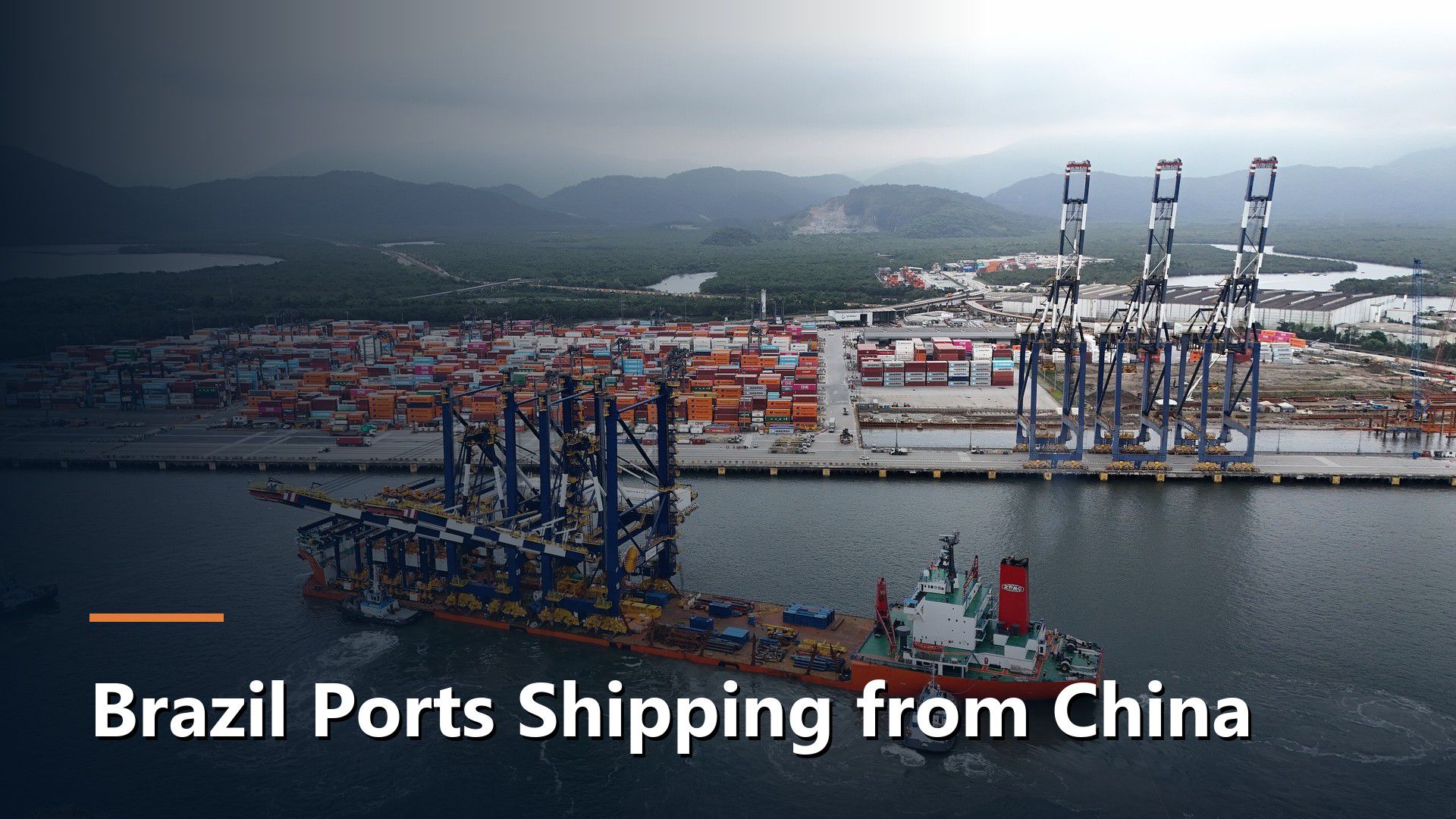
The gateway decides more than the ocean rate
Maersk's terminal charge for the same container moves by R$1,377 between Brazilian ports, on a schedule that has been public since 1 October 2026: R$811 at Itajaí, R$1,498 at Santos and R$2,188 at Suape from 1 November. Santos rose R$43 year on year, from R$1,455 in the October 2025 notice, so the gateway decision is worth about 32 times the terminal's annual price rise before tax.
The tax on top widens the gap again, because ICMS is charged with the tax inside its own base: São Paulo's 18% behaves like 21.95% of the value before ICMS, and Paraná's 19.5% like 24.22%. On a R$300,000 dutiable base, an illustrative figure, those rates sit R$6,810 apart.
The customs calendar adds a harder date: on 10 December 2026 the DI stops taking new registrations for the remaining operations, three weeks from today for anyone still filing the old way.
Ocean rates are where most guides stop. The bands, surcharges and DDP arithmetic sit in China–Brazil shipping costs; what follows stays on the gateway, its charge, its channel and its distance from your consignee.
The four gateways in one view
The table puts the four gateways beside each other on the carrier's own charge, the waiting status per terminal and the road distance to the cities where consignees usually sit. Charges are Maersk OHC/DHC from 1 November 2026, in reais per container, the same value in both directions, with no 20ft or 40ft split.
Gateway | Operators | Direct shipping transit time from China | Carrier charge, R$ (1 Nov 2026) | Congestion and waiting time, 10 Nov 2026 | Road km to hubs |
|---|---|---|---|---|---|
Santos (BRSSZ) | Santos Brasil, BTP, DP World Santos, Ecoporto | Yantian 26 days; Ningbo 38; Shanghai 39 | 1,498 dry / 1,549 reefer | Santos Brasil over 6 hours in bad weather; 1.93-day average, week to 3 Nov | São Paulo 78; Curitiba 399; Porto Alegre 1,125 |
Paranaguá (BRPNG) | TCP, three berths, 22 weekly calls | Shanghai 42; Ningbo 40; Shekou 36 | 1,310 / 1,440 | Under 6 hours; dwell above target | Curitiba 92; São Paulo 437; Porto Alegre 736 |
Navegantes (BRNVT) | Portonave (TiL/MSC) | On the ZIM Falcon loop; no CMA CGM figure published | 1,076 / 1,210 | Under 6 hours, 22 moves an hour | Curitiba 208; São Paulo 596; Porto Alegre 540 |
Itajaí (BRITJ) | JBS Terminais | Ningbo 44; Shanghai 45; Shekou 40 | 811 / 931 | Under 6 hours | Curitiba 213; São Paulo 601; Porto Alegre 537 |
The charge column runs from R$811 to R$1,498 inside this group, and the cheap end sits behind a channel that limits draft. The transit column is a sailing time on one loop, not a delivery date: how long shipping from China to Brazil takes covers the whole clock, including the queue after discharge.
Distances are OSRM's driving profile on 16 November 2026: Curitiba sits 92 km from Paranaguá and 399 km from Santos, Porto Alegre 540 km from Navegantes and 1,125 km from Santos.
Santos: the volume port and its two real costs
Santos handled 186.5 Mt of cargo, 5.9M TEU and 5,772 ship calls in 2025, the largest share of any Brazilian port, across 17 km of quays and 64 berths, according to the port authority's Facts & Figures 2026, 70 km from the city of São Paulo. August 2026 set a monthly container record of 538,200 TEU.
Waiting is mild by this port's history: 1.93 days on a seven-day average in the week to 3 November 2026, 0.81 days median in Portcast's series, and 3.4 days on 14 October.
Storage is the first real cost, and it is ad valorem, billed from discharge rather than from the gate: 0.60% of CIF per four-day period for a 20ft at DP World Santos, 1.30% for a 40ft, then 2.00%. A container of electronics that clears in twelve days can pay more for the yard than for the terminal charge.
Capacity is the second cost, and the version of it most importers carry around is out of date. STS10, the 3.25M TEU project with more than R$6bn attached, still had no auction date in mid-November 2026. What is funded is Santos Brasil's R$3.5bn plan filed on 9 November 2026, taking Tecon Santos from 2.9M to 4.0M TEU a year; DP World is spending R$1.6bn to reach 1.7M TEU by the end of 2026.
Containers also leave Santos by rail: four internal spurs at Santos Brasil put boxes straight onto the network. The channel runs 13.50 m at low water and 14.50 m at high water, with berths operational at 14.20 m.
Paranaguá: the reefer yard with a direct China call
Paranaguá now runs a direct weekly service from Shanghai, Ningbo, Hong Kong and Yantian, and 2026 is the first year the port is priced against Santos on the same timetable rather than as a feeder call.
ZIM Wilmington made the maiden call on 27 October 2026, opening the eleven-vessel ZIM Falcon rotation, and CMA CGM's SEAS2 rotation adds Paranaguá from 15 December 2026. TCP runs three berths and 22 weekly calls with 5,280 reefer plugs, the largest reefer yard in Brazil.
The draft changed the arithmetic: 13.30 m operational under Portaria 224/2025 is worth about 400 extra full TEU a call, and the channel auction held in October 2026 foresees 15.5 m within five years. October 2026 was the port's best October at 5,909,725 t, and China trade through TCP ran 2.08 Mt from January to September 2026.
The terms around it are ordinary: R$1,310 dry and R$1,440 reefer, five days of free import storage against seven on export, waiting under six hours on 10 November, 92 km to Curitiba. Sailing takes 36 days from Shekou, 40 from Ningbo and 42 from Shanghai, two days longer than Santos on the same loop.
Navegantes vs Itajaí: 2026 charges and the channel draft restriction
The two Santa Catarina terminals face each other across the Itajaí river mouth and charge R$265 apart for the same container. Navegantes, run by Portonave in the TiL/MSC group, is R$1,076 dry and R$1,210 reefer. Itajaí, run by JBS Terminais on the old APM Terminals site, is R$811 and R$931, the cheapest of the four gateways here.
Measure | Navegantes vs Itajaí, November 2026 |
|---|---|
Maersk dry charges, per container | R$1,076 at Navegantes vs R$811 at Itajaí |
Channel limits from 1 Sep 2026 | 12.9 m outer, 12.5 m inner, 12.2 m in basin 1, 12.6 m in basin 2, both terminals |
Quay and capacity | 700 m and two ships at once, 1.5M to 2.0M TEU vs berth 1 at JBS, up to 600k TEU |
Productivity, 2025 | 1,108,029 TEU at 114 moves an hour, the best in Brazil vs 800,000 TEU in two years |
Services in 2026 | ZIM Falcon/AS3, CMA CGM SEAS from 17 Dec 2026 vs ZFS/AS2 since Oct 2026, SEAS2/ESAS2 from Jan 2027 |
Waiting, 10 Nov 2026 | Under 6 hours, 22 moves an hour, up 40.3 points week on week vs under 6 hours, up 21.2 points |
The 1 September 2026 limits are shallower than the terminal was designed for, and surveys show the bed 0.4 m to 1.3 m short of project depth. MSC Pamela needed 12.70 m and sailed at 12.50 m once 0.80 m of under-keel clearance is allowed for, leaving roughly 2,400 t of reefer export cargo behind. Portonave puts the cost at about 1,000 t a call per 10 cm lost.
None of that is congestion any more: ships averaged five days at anchor in the week of 30 September to 6 October 2026, a level Kuehne+Nagel calls strongly affected, and by 10 November both terminals were back under six hours. ANTAQ logged three infractions since July 2023, and the R$350m concession vote came off its 12 November agenda.
Rio Grande, Suape and Pecém: when geography wins
Rio Grande is the deep-water answer in the far south: 900 m of quay, 15 m of draft, 25,000 TEU of stack and 2,800 reefer plugs at Tecon Rio Grande, R$1,248 dry and R$1,323 reefer, seven days of storage, 316 km to Porto Alegre. Wilson Sons is investing R$1.1bn through 2030 and took six automated RTGs from Shanghai on 18 September 2026; the port did 44.5 Mt and 1,032,804 TEU in 2025. Until MSC and ONE's Ipanema rotation calls on 3 April 2027, Rio Grande do Sul cargo is relayed through Santos or Paranaguá.
The northeast carries the highest terminal charge in the country. Suape charges R$2,188, the top of Maersk's 15-port table and R$690 above Santos, and its new weekly call is not an Asia service: the UCLA loop, calling since 1 November 2026, connects Suape to Houston in 21 days and Cartagena in 11. Pecém is cheaper at R$1,140.
No northeast port has a dedicated China mainline call in the sources reviewed here. CMA CGM reaches Fortaleza, Manaus and Suape through Mercosul Line feeders, so an Asia booking to the northeast is a relay with an extra handover and another set of terminal charges.
The charge table nobody publishes
Rate guides tend to quote one national band. The carrier publishes the port-by-port version, and it is the most useful table in a gateway argument.
Brazil port | Maersk terminal handling charge, R$ per container, 1 Nov 2026 |
|---|---|
Itaguaí | 740 |
Rio de Janeiro | 755 |
Itajaí | 811 |
Itapoá | 840 |
Manaus | 997 |
Vila do Conde | 1,008 |
Navegantes | 1,076 |
Pecém | 1,140 |
Rio Grande | 1,248 |
Paranaguá | 1,310 |
Salvador | 1,427 |
Santos | 1,498 |
Imbituba | 1,550 |
Vitória | 1,652 |
Suape | 2,188 |
A few caveats matter before you budget with it. These are the carrier's origin and destination handling charge, not an all-in terminal cost, so the terminal's own lift, weighing and storage sit on top. They carry the same value in both directions, unusual enough to confirm on a booking. Only Santos also has a published year-on-year comparison, R$1,455 to R$1,498, so the other 14 rows cannot be read as increases.
Landed cost moves by state, not by distance
ICMS is a state tax, and the state that applies is where the importer's establishment sits, which usually follows the consignee rather than the port. That is why two gateways a few hundred kilometres apart diverge by more on tax than on freight, and why the rate is quoted por dentro.
State in Brazil | ICMS on import | Effective share of the pre-ICMS base | Gateway in this article |
|---|---|---|---|
São Paulo | 18% | 21.95% | Santos |
Paraná | 19.5% | 24.22% | Paranaguá |
Santa Catarina | 17% | 20.48% | Navegantes, Itajaí |
Rio Grande do Sul | 17% | 20.48% | Rio Grande |
Pernambuco | 20.5% | 25.79% | Suape |
Ceará | 20% | 25.00% | Pecém |
The third column is arithmetic rather than policy: a rate r charged inside its own base equals r divided by 100 minus r. Pernambuco against Santa Catarina is 5.31 points of the pre-tax value, R$15,930 on a R$300,000 base before duty, IPI, PIS and COFINS.
The road leg adds distance. The average truck freight index was R$9.05 per km in October 2026, up 3.19% on September, so a container for Porto Alegre indexes at R$4,887 out of Navegantes and R$10,181 out of Santos. A quoted lane rate moves on weight and the return leg, but the R$5,294 gap does not close.
Two smaller lines belong in the same budget. AFRMM is 8% of the ocean freight under IN RFB 2102/2022 art. 4, follows freight rather than CIF, and does not apply to air; exemptions exist for specific regimes, so check it per shipment. The Siscomex fee is R$115.67 per declaration plus R$38.56 per addition.
DUIMP mandatory from 10 December 2026: what the deadline changes
The DI has a switch-off date. Under Siscomex's cronograma de desligamento, DI and DSI registration ends on 1 December 2026 for some operations and on 10 December 2026 for the rest; after that an import licence not already linked to a DI cannot be used, and the declaration has to be a DUIMP.
The licence therefore has to exist before the arrival window, not during clearance: an LI raised against a DI is lost if it is not linked in time, and the goods sit at a terminal that bills storage from discharge. Our Brazil customs clearance page covers the licence, the RADAR registration bound to the importer's CNPJ and the four inspection channels in the order they close.
Three facts sit alongside the deadline. The importer of record must be a Brazilian entity with valid RADAR, which rules out a foreign buyer without local structure. An eight-digit NCM error carries fines of up to 75% of the value. And a DUIMP filed against the wrong establishment moves the ICMS rate in the table above.
Choosing by cargo and by consignee
Reefer shipping from China to Brazil is decided by plug counts before it is decided by price, and Manaus is a different decision entirely: the Zona Franca route has no road link, only barge and feeder.
Reefer, plugs, and where a cold box should land
Paranaguá holds 5,280 plugs, the largest reefer yard in Brazil. Rio Grande holds 2,800, Santos Brasil 2,100, and Itajaí's 1,700 cover 10 services but not a peak surge. The reefer charge is the smaller number: R$931 at Itajaí against R$1,549 at Santos.
High-value electronics and the storage clock
Ad valorem storage is the risk that never appears in a freight quote. On a 40ft container with a CIF of R$500,000, the first four-day period at DP World Santos costs R$6,500 and the second R$10,000. Free time decides whether you ever pay it.
Port | Free time on imports | What storage costs after that |
|---|---|---|
Santos | 7 to 15 days by terminal, per broker summaries | Ad valorem at DP World: 0.60% of CIF per 4 days for a 20ft, 1.30% for a 40ft, then 2.00% |
Paranaguá (TCP) | 5 days, and 7 on exports | Terminal tariff, billed from the working day after |
Navegantes and Itajaí | About 7 days | Terminal tariff |
Rio Grande | 7 days | Terminal tariff |
Project cargo, FMCG, and the LCL question
Rio Grande's 15 m draft takes heavy lifts without a tide window, and Santos Brasil's plan includes 239,000 t a year of project cargo capacity. For FMCG below roughly 15 CBM the gateway matters less than the consolidation, because an LCL box is unpacked at a CFS before it ever reaches a truck. We price both on FCL and LCL sea freight, and the breakeven moves with distance.
Brazil ports shipping from China: questions importers ask
Which Brazilian port should I ship to from China: Santos, Paranaguá, Navegantes or Itajaí?
Santos for São Paulo, Minas Gerais or Brasília, at 78 km. Paranaguá for Curitiba at 92 km, with the largest reefer yard in the country. Navegantes or Itajaí for Santa Catarina and Rio Grande do Sul, and Itajaí when the charge is what decides it, at R$811.
Is Navegantes or Itajaí cheaper for a 40ft container from China in 2026?
Itajaí, by R$265 a container: R$811 against R$1,076 in Maersk's schedule of 1 November 2026, and R$931 against R$1,210 for a reefer. Both sit behind the same 12.5 m inner channel.
Why is my container waiting five days off Navegantes if the terminal is empty?
The constraint is the channel, not the berth. September 2026 surveys found the bed 0.4 m to 1.3 m short of project depth, so ships sail light or wait for tide. That five-day week was 30 September to 6 October 2026; by 10 November both terminals were under six hours.
Is there a direct container service from China to Paranaguá now?
Yes. ZIM Wilmington opened the weekly ZIM Falcon call on 27 October 2026 from Shanghai, Ningbo, Hong Kong and Yantian, and CMA CGM's SEAS2 rotation arrives on 15 December 2026.
Does it still make sense to route southern Brazil cargo through Santos?
Only when the rate difference pays for the road. Porto Alegre is 1,125 km from Santos and 540 km from Navegantes, about R$5,294 of extra road cost at the October 2026 index, before Santa Catarina's 17% and São Paulo's 18% are compared as 20.48% and 21.95%.
How much are port charges at Santos versus Paranaguá and Suape in 2026?
R$1,498 at Santos, R$1,310 at Paranaguá and R$2,188 at Suape, per container, in Maersk's OHC/DHC schedule of 1 November 2026. These are carrier terminal handling charges, so the terminal's own lift and storage sit on top.
When does the DUIMP become mandatory, and can I still use a DI?
DI registration ends on 1 December 2026 for some operations and on 10 December 2026 for the rest, per Siscomex's switch-off schedule. After that, any import licence not already linked to a DI becomes unusable.
Should I ship to Manaus through Santos, or is there a better gateway for the Zona Franca?
Manaus has no road link at all, so the question is which coastal port has the better barge schedule. Santos has the most sailings; Suape and Pecém add cost at R$2,188 and R$1,140.
Send the consignee postcode and the commodity, get a gateway recommendation
Gateway choice is arithmetic until it meets a specific consignee, and then it is arithmetic with a dozen local exceptions. Send the consignee's postcode, the commodity and its NCM, the volume in CBM or containers, and the goods-ready date, and AllBestShipping will come back with a recommendation: the port, the terminal, its carrier charge, the ICMS rate that applies, and the road leg in kilometres at the October 2026 index. Where two gateways land within a few hundred reais, we will show you where the difference falls.