Shipping from Guangzhou to Belgium: Nansha Sailings, Baiyun Air and the €3 Border Bill
Shipping from Guangzhou to Belgium runs on two different clocks, and the mistake that costs exporters real money is pricing it as a single journey. Nansha puts a container directly into Antwerp in 33 to 38 days, with 20GP space from $2,041 and 40HQ space from $3,712 at the 23 October 2026 market reference. Baiyun Airport puts a pallet into Liege in roughly 11 hours of flying, five to eight days door to door. Those two numbers are the easy part. The figure that decides whether the year works is the €3 per-item duty in force since 1 July 2026 plus 21% Belgian import VAT, a combination that can add a third to the invoice before anyone opens the container doors.
China shipped $19.8B of goods to Belgium in 2024 according to OEC. That lands in a country whose main port moved 266.5 million tonnes and 13.6 million TEU in 2025 and hosts Europe's largest integrated chemical cluster. For the national picture across every Chinese origin port, Shipping From China to Belgium is the reference page. Four questions decide the year for a Guangzhou seller: which gate to book, where LCL stops paying, whether the Zengcheng train beats the terminal, and how the 2026 compliance stack rewrites landed cost. If you only read one section, read section 6.
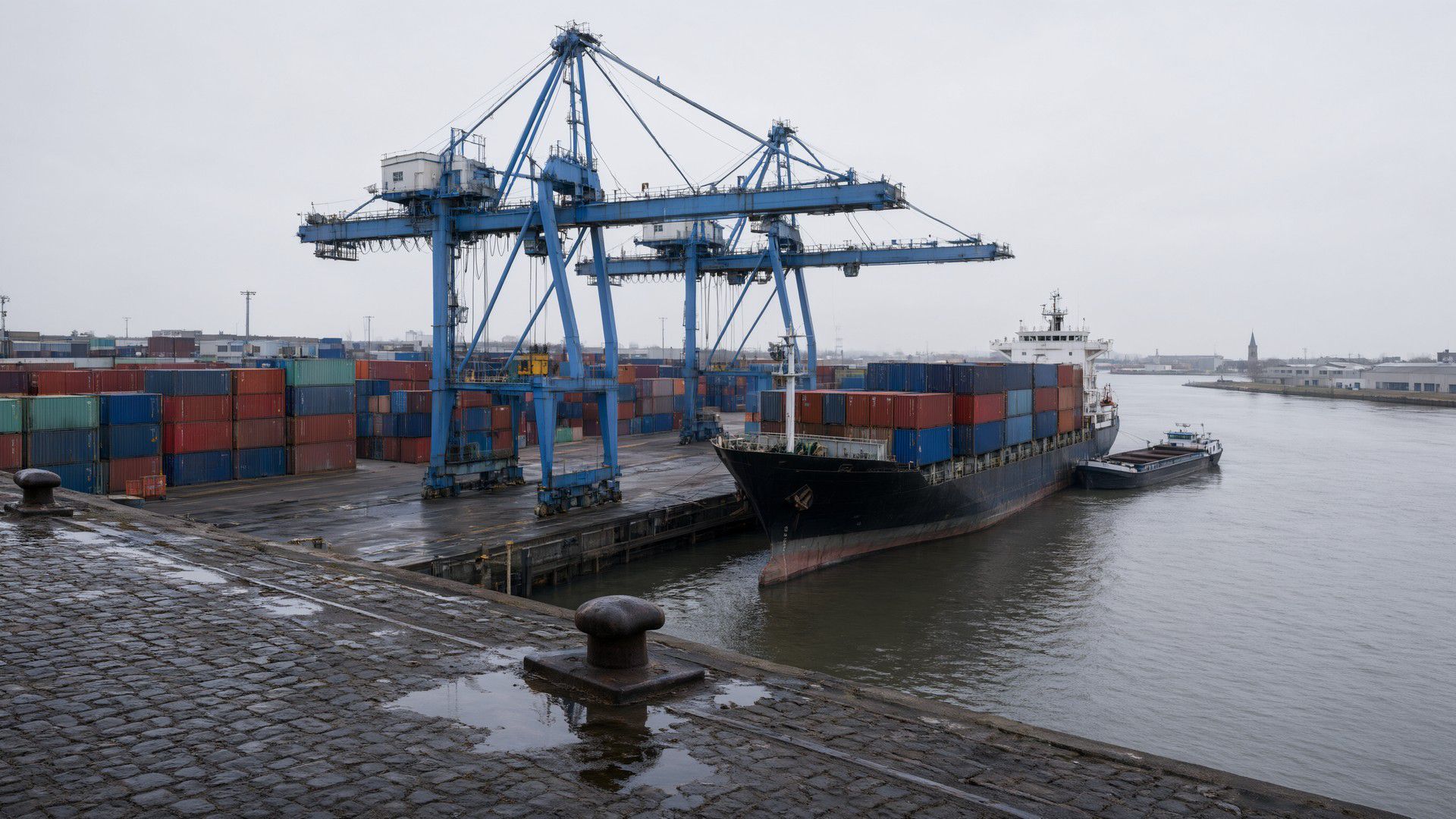
1. Nansha or Yantian: the gateway decision Guangzhou shippers get wrong
Guangzhou cargo leaves through four gates, not one, and the Nansha to Antwerp transit time is what decides which one you book. Nansha sits 50 to 70 km downriver from the trading districts in Yuexiu, Tianhe and Panyu, Huangpu handles river and feeder tonnage, and Yantian is a 150 km trailer run east into Shenzhen. Exporters pick on habit or on whoever answered the phone first. The gateway fixes three things you cannot renegotiate later: your cut-off, your sailing frequency, and the slack you have when the factory releases on Friday afternoon.
Nansha has become a deep-sea load port rather than a feeder stop. Evergreen Marine brought its CES Europe service into Nansha for the first time in 2026, calling Antwerp, Hamburg and Rotterdam direct out of the delta. OOCL works a direct Nansha to Antwerp string at 38 days, and the fastest direct transit quoted in October 2026 was 33 days.
| Gateway | European product | Transit to Antwerp | Cut-off buffer | Trailer from central Guangzhou | Where it wins |
|---|---|---|---|---|---|
| Nansha port (NS) | Direct: Evergreen CES (Antwerp, Hamburg, Rotterdam); OOCL direct Antwerp | 33–38 days | Same-day or next-day gate-in | 50–70 km, about 1.5 hours | Standard FCL when the factory releases on schedule |
| Huangpu (CNHUA) | River/feeder connection to Nansha and Hong Kong | Add 3–7 days for the relay | One extra working day | 15–25 km | Small LCL lots and barged cargo |
| Lianhuashan (CNLIH) | Barge or feeder relay to Nansha or Hong Kong | Add 2–5 days for the relay | One extra working day | Under 30 km from Panyu | Small lots barged out of the southern districts |
| Yantian (YT), by trailer | Deepest Europe schedule on the south China coast | 25–35 days (Shenzhen benchmark) | Two days earlier than Nansha | About 150 km, 2.5–3.5 hours | Peak-season space and cargo that must sail this week |
Guangzhou is one customs district covering several ports, and rate sheets treat them separately. Lianhuashan is a barge terminal, so cargo taken there is consolidated onto a Nansha sailing or a Hong Kong feeder; on a Guangzhou to Antwerp FCL booking that shows up as a relay day, not a different ocean rate. When a quote says only "Guangzhou", ask for the port code: CNNSA for Nansha, CNHUA for Huangpu, CNLIH for Lianhuashan. The code, not the city name, fixes the cut-off and the sailing you are booked on.
The trailer decides most of these comparisons. A box that has to be in Yantian by Wednesday morning leaves Guangzhou on Tuesday, and a factory running late loses the sailing. The same box going to Nansha gates in the next morning. Against that, Yantian carries more direct European strings, so in the August to October peak it is the port that still has slots. Our shipping from Shenzhen to Belgium guide covers the Shenzhen side: Nansha is the default from February to July, Yantian is the insurance policy from August to October.
One option almost nobody prices: on 19 August 2026 the first Arctic China-Europe Express (CAX) sailing left Nansha for Felixstowe, a seasonal weekly product on seven to eight ships of 1,740 to 4,890 TEU. It is not a year-round Belgium service. If someone offers it, ask for the Felixstowe arrival date and the on-carriage cost to Antwerp before you compare.
2. Guangzhou to Antwerp shipping: routes, carriers and what the rate numbers mean
Sea freight from China to Belgium is a national market with a national price index, but the Guangzhou to Antwerp distance of 9,834 nautical miles and a Guangzhou to Antwerp transit time of 33 to 38 days are two numbers the index cannot tell you. Rates on the lane as of 23 October 2026 sit at $2,041 for a 20GP, $3,675 for a 40GP and $3,712 for a 40HQ, port to port, before the surcharges in section 8.
| Container shipping from China to Belgium: 20ft, 40ft and 40HQ lanes | Service and routing | Port-to-port transit | Cost per container, 23 October 2026 |
|---|---|---|---|
| Nansha → Antwerp | Evergreen CES, direct, first Nansha call 2026 | 35 days | $2,041 / $3,675 / $3,712 (20GP / 40GP / 40HQ) |
| Nansha → Antwerp | OOCL direct string | 38 days | Same reference; spot bookings move weekly |
| Nansha → Antwerp | Fastest direct transit quoted on the lane | 33 days | Same reference |
| Nansha → Rotterdam, then Antwerp | Direct call to Rotterdam plus barge or truck | Direct transit plus 2–5 days on-carriage | Priced per sailing, usually within $100–200 of the Antwerp direct |
A 33-day transit and a 38-day transit between the same two ports are different products, and no rate sheet says which one you bought. The 38-day string usually has the steadier allocation and the later cut-off; the 33-day one is the first to be rolled when the vessel is overbooked. Ask which service your rate is attached to before comparing two forwarders.
For the national picture rather than the Guangzhou sheet, our sea freight from China to Belgium guide walks the same FCL lane out of Shanghai, Ningbo and Shenzhen; on a Guangzhou booking the terminal changes, the ocean leg does not.
Quotes come off two tracks. Spot rates move weekly and are what a quote portal shows you; FAK rates are filed per service and hold for a defined window. Either way the quote holds for 7 to 14 days, not the month: Drewry's World Container Index on 29 October 2026 put Shanghai to Rotterdam at $3,686 per FEU, up 1% on the week, against a composite of $4,429 per FEU, down 3%.
Routing needs confirming, not assuming. About 19% of Asia-Europe capacity has returned to the Suez Canal, and the week ending 5 November 2026 recorded the highest weekly Suez transit count of the year, but that does not mean your box goes that way. Confirm the routing for the specific vessel and voyage on every booking: the Cape of Good Hope diversion still adds 10 to 14 days and roughly 3,500 nautical miles, and a routing change after booking changes your delivery date, not your rate.
Container choice deserves thirty seconds. A 20ft container is the 20GP, a 40ft container is the 40GP, and the 40ft high cube is the 40HQ. On the October reference a 40HQ costs $37 more than a 40GP and carries about 9 CBM more, which is $4.11 per additional CBM. Per usable cubic metre the numbers are $48.84 for a 40HQ, $54.85 for a 40GP and $61.85 for a 20GP. Take the 40HQ unless the cargo is dense; take the 20GP when weight, not volume, is the constraint.
3. LCL from Guangzhou: the consolidation math
LCL shipping from Guangzhou to Antwerp (less than container load, consolidated at a Guangzhou warehouse) runs $55 to $130 per CBM on our September 2026 numbers, plus destination CFS charges, and the minimum billable volume is normally 1 CBM. Consolidated cargo is received at a Guangzhou warehouse, co-loaded, devanned in Antwerp and released against a delivery order. Port-to-port time is 30 to 45 days; door to door it is 38 to 52, because deconsolidation and co-loading add 3 to 7 days.
The crossover is the only LCL question that matters, and it is arithmetic rather than opinion. A 20GP that lands door to door at about $3,024 against LCL at $200 per CBM all-in breaks even at 15 CBM. Below that, LCL wins on cash even though the per-CBM rate looks expensive next to a container. Above it, you are paying for someone else's consolidation and taking on someone else's damage risk.
LCL's real cost sits at the destination end. CFS handling, document fees and a delivery order charge are billed per shipment rather than per CBM, so a 2 CBM lot can carry $200 of fixed Belgian costs before the truck moves. Ask for the destination CFS figure in euros. A forwarder who cannot name it is quoting a rate, not a cost.
4. Guangzhou Baiyun to Liège: air freight that actually lands in Belgium
Guangzhou to Liege air cargo is the one Belgium lane where the airport, not the seaport, sets the clock, and it is the only air freight from China to Belgium that runs on a Guangzhou schedule instead of a Shanghai one. Baiyun International (CAN) sends freighters to Liege (LGG) in about 11 hours nonstop, typically on 777F equipment at two to four rotations a week depending on season. Brussels (BRU) is the alternative, but from CAN it usually means one connection; Amsterdam plus a truck is the third option.
Air freight on the lane runs $5.00 to $10.00 per kg, express courier $7.00 to $13.00 per kg, with door-to-door delivery in 5 to 12 days and airport-to-airport transit of 3 to 7. The billing unit is chargeable weight: the greater of actual gross weight and volume in cubic centimetres divided by 6,000, with express carriers using the harsher 5,000 divisor. Apparel is the classic casualty, because one cubic metre of garments divides to 200 kg of chargeable weight on an express divisor even when the cartons weigh 70 kg. You pay for the air, not the fabric.
Liège changed shape in 2026, and that matters more to a Guangzhou shipper than any airport ranking. In July 2026, the month the €3 per-item duty took effect, e-commerce volume through the Bierset customs area fell 24% year on year and 41% month on month, declaration counts fell 52%, and consignments valued at €150 or more rose 10%. Total tonnage still grew 4% to 114,064 tonnes on pharmaceuticals, data centre equipment and flowers. Low-value, high-volume parcels became expensive and slow; consolidated commercial freight became relatively more attractive. Selling 40-dollar items one parcel at a time is no longer the arbitrage it was in 2024. If you ship 200 kg of components to a Belgian assembler, the only thing that changed is the paperwork.
5. The Guangzhou rail freight option to Belgium most exporters never price
Rail freight from China to Belgium runs out of Guangzhou on its own train, and what Guangzhou does not have is a direct train into Brussels or Liège. Guangzhou International Port at Zengcheng West moved 27,300 TEU in the first nine months of 2026, carried RMB 4.0 billion of cargo value in the first seven months, and has booked over RMB 110 billion in ten years. Cargo leaves through Khorgos or Manzhouli and changes gauge at the border.
Routing is where this lane gets misquoted. Liège is the only Belgian hub with genuine direct China trains, built on the Zhengzhou service from 2018, Yiwu from 2019 and Chengdu from 2020, with a new Shijiazhuang to Liège service added in July 2026. Trains that leave Guangzhou mostly enter the EU through Malaszewicze in Poland, the border crossing that handles 85% to 90% of all China-Europe rail volume. Gauge change and queueing at that one point is the single largest variable in the transit time, worth several days either way. A booking that says "Liège" and a booking that says "Malaszewicze then Liège" are different products with different risk, and cargo going from China to Belgium by train only reaches Brussels or Liège as an FCL or LCL block after a road leg from Poland.
Rail is cheaper than air and dearer than sea, and the gap to sea is what decides most bookings. A 40HQ runs $5,000 to $7,500 and LCL $180 to $280 per CBM, with 18 to 26 days station to station and 25 to 34 days door to door. That makes rail 40% to 60% cheaper than air, and still above sea freight, where the same 40HQ is $3,712 before surcharges. Anyone quoting rail at ocean money is either confusing a subsidy with a rate or leaving a terminal charge out of the number. For the service side, our rail freight page covers what the Zengcheng booking actually requires.
The use case is narrow: 500 kg to 8 tonnes of mid-value cargo with a four-week deadline that ocean cannot meet and air overprices. Electronics accessories, machine spares, week-46 restocking. Not samples, not 20 CBM of furniture, not anything that must be in Antwerp on a named day.
6. Belgium import duty and VAT in 2026: the compliance gates that change what you pay at the border (ET 14.000 deferment, IDMS, ICS2)
Belgium customs clearance requirements for 2026 now run through IDMS rather than PLDA, with an ICS2 ENS filed 24 hours before loading, and the China to Belgium import duty and VAT bill no longer matches the rate sheets: the €150 duty-free threshold was abolished for parcels entering the EU on 1 July 2026 under Council Regulation (EU) 2026/382. Those three changes sit on top of a duty range of 0% to 17% and a 21% import VAT, so the border bill is now the largest single line in a small shipment's landed cost.
1. €3 per item replaced the value threshold. Council Regulation (EU) 2026/382 of 11 February 2026 amended Regulation (EC) No 1186/2009 and removed the relief for consignments below €150. Since 1 July 2026, goods under that value carry a flat €3 duty per item, running until 1 July 2028, when normal tariff classification takes over through the EU Customs Data Hub. Two details get misquoted constantly: it is charged per item rather than per parcel, and it is charged to business sellers rather than to the consumer at the door. Ordinary B2B commercial consignments above €150 are unaffected.
2. PID became mandatory on 1 November 2026. Product identifier data, both merchant PID and manufacturer PID, is now required on affected consignments, with an international standard PID accepted where one exists. A €2 per-parcel processing fee is expected to follow and sits on the agenda for late 2026; it is not in force, and a forwarder telling you it is already billed is guessing.
3. IDMS replaced PLDA, and PLDA is gone. The Import Declaration Management System went live on 23 October 2024 and its transition period is over. Export declarations moved to AES, which changed the Incoterms field to shipment level rather than item level, and transit runs on NCTS Phase 5.
4. ICS2 wants the ENS before the box moves. Release 3 has been fully live since 1 September 2025, version 3 messages became mandatory on 3 February 2026, and from 1 June 2026 every inbound consignment needs a valid entry summary declaration. For sea freight that means a six-digit HS code and an EORI filed 24 hours before loading. Miss it and you get a refused loading, a held container, or a fine reported at up to €5,000 per shipment.
5. ET 14.000 is the cash-flow lever worth chasing. The authorisation moves import VAT from the point of release to your periodic VAT return, so you stop financing 21% at the port. On €100,000 of goods that is €21,000 no longer tied up per cycle, or €252,000 a year at a monthly €100,000 rhythm. It is an authorisation, not an exemption, and it is not retroactive: you have to be filing Belgian VAT, which means a Belgian VAT number, and a non-EU company generally needs a Belgian fiscal representative or local entity to get there. The application runs through MyMinfin under Apply for a document, and the official ET 14.000 page sets out the conditions. Bonded warehousing and T1 transit are the two companions: store duty and VAT suspended, or declare where the cash flow suits you.
6. A non-EU seller needs a fiscal representative anyway. Registering for Belgian VAT from outside the EU generally requires a representative inside Belgium who is jointly and severally liable for unpaid VAT, interest and penalties. That includes B2C sellers and FBA users acting as their own importer of record. A DDP arrangement where the forwarder holds that role is how most Chinese sellers avoid the exposure.
7. Invoices between Belgian VAT-registered businesses must be structured. Since 1 January 2026 the 2024-02-06 Act requires Peppol BIS Billing 3.0 electronic invoices for domestic B2B transactions. A PDF is no longer a valid VAT invoice and the input VAT deduction is at risk if you send one. Near-real-time e-reporting follows on 1 January 2028.
8. Anti-dumping is the line item that ruins budgets. Duties of 9.9% to 122.8% apply to more than 15 categories of Chinese goods. The invoice has to carry the correct TARIC additional code; when it is missing or wrong, customs applies the highest rate in the bracket rather than the one you meant. That is a documentation error with a five-figure consequence.
Before booking, the file should hold an EORI number, a commercial invoice with CN or TARIC codes and Incoterms 2020 terms, a packing list, the bill of lading or air waybill, certificates of origin or CE or SDS documents as the product requires, and GPSR responsible-person details for consumer goods. The European Commission's taxation and customs portal is where tariff and TARIC lookups live.
7. Where your container actually lands: Antwerp, Zeebrugge, Liège, Brussels
Antwerp port congestion in 2026 shows up behind the quay rather than at it, and the last one to three days of any Guangzhou to Belgium shipping time are usually spent inland rather than at sea. Antwerp-Bruges handled 266.5 million tonnes in 2025, down 4.1%, and 13.6 million TEU, up 0.7%, with reefer boxes at a record 1,170,394 TEU. A strike of roughly 25 days cost about 2.4 million tonnes. The pinch is inland: in August 2026 barges waited around 96 hours for a slot, which is why urgent cargo should be pre-pulled by truck rather than waiting on a barge window.
Zeebrugge handles ro-ro and vehicle traffic and works as the breakbulk and short-sea door for the coast. Liège takes air and rail; Brussels takes air with a smaller freighter footprint. From any of the four, a truck reaches all of Belgium plus southern Netherlands, northern France and western Germany in one to three days, with last-mile delivery at €200 to €600 depending on postcode and tail-lift.
The city on the quote matters more than the port, because the ocean leg never changes. Inside the delivery bands used throughout this article, the truck from the gateway is the only number that moves:
| Delivered to | Usual gateway | Truck time from the port | Delivery band per shipment |
|---|---|---|---|
| Antwerp city and the left bank | Antwerp | Same day | €200–300 |
| Brussels, canal zone included | Antwerp, or Brussels airport for air cargo | 1 to 2 hours | €250–380 |
| Mechelen, Leuven | Antwerp or Brussels | 45 minutes to 1.5 hours | €230–380 |
| Ghent | Antwerp or Zeebrugge | 1 to 1.5 hours | €280–420 |
| Bruges and the coast | Zeebrugge | 20 to 45 minutes | €350–480 |
| Liège and Wallonia | Liège | 1 to 2 hours | €450–600 |
| Charleroi, Namur | Liège or Antwerp | 1.5 to 2.5 hours | €480–600 |
None of those legs moves the sailing date, and none of them is inside a port-to-port rate.
Antwerp direct suits consignees in Flanders or the Netherlands, Zeebrugge matters when the cargo rolls, and Liège is the landing point for air and rail-fed distribution into Wallonia.
8. What the quote excludes, line by line
Two quotes for the same box can differ by 40% and both be honest, because base ocean freight is roughly half of what you pay and the rest arrives as surcharges.
| Charge | Typical range | What it actually is |
|---|---|---|
| BAF / bunker adjustment | +10% to 25% of base freight | Fuel-driven, recalculated monthly |
| EU ETS surcharge | $170–220 per FEU | 100% emissions coverage from 2026, now including methane and nitrous oxide; Maersk moved its Far East to North Europe charge from $155 to $170 per FEU on 1 October 2026, ONE from $204 to $220 |
| PSS | $150–600 per container | Peak-season surcharge, seasonal and negotiable at the margin |
| Origin handling | $400–900 per container | THC, documentation, export declaration |
| Destination port charges | €150–350 | Terminal handling and release at Antwerp |
| Customs brokerage | €80–200 per declaration | Higher with inspections or TARIC queries |
| Last-mile delivery | €200–600 | Postcode and equipment dependent |
| Demurrage and detention | €90–180 per container per day | Antwerp dry containers commonly get 7 free days, reefers fewer |
Three questions close most of the gap before you sign: how long is the rate valid, is the EU ETS surcharge inside the ocean freight or separate, and how many free days do I get at destination.
9. Four Guangzhou shipments, four answers
Run the landed cost instead of the freight rate and the mode decision stops being abstract. The cases below use the October 2026 rate references, the ECB reference rate of $1.1224 to the euro on 5 November 2026, and a VAT base of goods plus freight plus duty at 21%. Duty is taken on goods value; on an FOB sale customs adds the freight to the customs value, so the real duty line runs slightly higher. VAT is recoverable for a VAT-registered importer, which is why it has its own column.
| Shipment | Goods value | Mode | Freight and door fees | Duty | VAT 21% | Landed total | Landed as % of goods |
|---|---|---|---|---|---|---|---|
| A: 1 CBM apparel samples | $2,500 | LCL sea | $545 | $300 | $703 | $4,048 | 162% |
| A: same cargo by express | $2,500 | Express courier | $1,867 | $300 | $980 | $5,647 | 226% |
| B: 6 CBM appliance parts | $9,000 | LCL sea | $948 | $225 | $2,136 | $12,309 | 137% |
| C: 22 CBM machinery | $40,000 | 20GP FCL | $3,024 | $680 | $9,178 | $52,881 | 132% |
| C: same cargo on a 40HQ | $40,000 | 40HQ FCL | $4,695 | $680 | $9,529 | $54,903 | 137% |
| D: 180 kg urgent electronics | $25,000 | CAN-LGG air | $1,966 | $0 | $5,663 | $32,628 | 131% |
| D: same cargo by rail | $25,000 | Rail LCL | $771 | $0 | $5,412 | $31,183 | 125% |
Case A is the one that surprises people. One cubic metre of garments costs $545 by sea and $1,867 by express, because 1 CBM becomes 200 chargeable kilos on a 5,000 divisor. The cheapest line on the rate sheet is the most expensive line on the invoice. What gets underestimated is the duty, not the freight: 12% on apparel is $300 on $2,500 of goods and it does not shrink with the parcel.
Case B is ordinary LCL at 6 CBM, still under the crossover, and the fixed Belgian destination charge lands on a small shipment. Case C shows why the 40HQ is a bad default for dense cargo: the same 22 CBM costs $2,022 more landed and buys nothing but air. What gets underestimated in C is the VAT float, $9,178 held between release and your next return, which is exactly what ET 14.000 removes. Case D is the only one where air is defensible, and even then rail saves $1,446 for 20 extra days. In D the €3 rule does not apply at all: at $25,000 of goods the per-item duty and the expected processing fee are irrelevant, and treating them as if they were is an expensive misreading.
For how those layers stack across the corridor, what the full China-to-Belgium cost stack looks like breaks the same components down by mode.
10. A decision table for Guangzhou exporters
| Your situation | Book this | One-line reason |
|---|---|---|
| Under 2 CBM a month, mixed SKUs | LCL sea, or courier if the value per kilo is high | Fixed destination charges punish tiny lots more than the per-CBM rate does |
| 2–15 CBM | LCL sea | Still under the 15 CBM crossover against a $3,024 door-to-door 20GP |
| 15–22 CBM | 20GP | Sealed box, later cut-off, cheaper per CBM than any LCL quote |
| 22–55 CBM, light goods | 40HQ | $48.84 per usable CBM, the cheapest space on the lane |
| Over 18 tonnes in a 20GP footprint | 20GP, weight-limited | Volume is not your constraint, mass is |
| Under 200 kg, deadline inside two weeks | Air CAN-LGG | 11 hours in the air, 5–8 days door to door |
| 500 kg to 8 tonnes, four-week deadline | Rail from Zengcheng West | 40–60% cheaper than air, 25–34 days door to door |
| High-value, low-volume, repeat | Air plus ET 14.000 | Deferral turns the 21% into a return-line item |
| Goods under €150 per item, sold B2C | Consolidate before shipping | €3 per item plus PID data makes single parcels uneconomic |
| Anti-dumping categories | Nothing until the TARIC code is confirmed | A wrong additional code is charged at the top of a 9.9%–122.8% bracket |
| Buyer wants one all-in number | DDP from China to Belgium | The €3, PID and 21% arguments land on the forwarder's EORI, not yours |
| Consignee sits in Brussels, Ghent or Liège | Same sailing, inland leg from Antwerp or Zeebrugge | Port-to-port rates ignore a €250–600 truck leg |
11. Guangzhou to Belgium shipping questions
How long does shipping from China to Belgium take door to door? Sea freight from Nansha to Antwerp is 33 to 38 days port to port, or 38 to 45 door to door with clearance and inland delivery. Air from Baiyun to Liège is 5 to 8 days, rail out of Zengcheng West 25 to 34. Add a week for August to October sailings and for any TARIC query.
Is Yantian faster than Nansha for Guangzhou cargo? On paper yes: the Shenzhen benchmark is 25 to 35 days and Yantian carries more direct European strings. The 150 km trailer and the earlier cut-off eat part of that advantage, and a rolled booking eats all of it. Yantian for schedule depth in peak season, Nansha for the later gate-in.
How much does door to door shipping from China to Belgium cost, and where does a 40HQ land? A 40HQ at the 23 October 2026 reference is $3,712 port to port and about $4,695 with origin handling, destination charges and last-mile added. On $40,000 of machinery at 1.7% duty the landed total is roughly $54,903, including $9,529 of VAT.
Can my cargo go from China to Belgium by train and reach Liège without a Polish border queue? Not usually. Liège has real direct China trains from Zhengzhou, Yiwu and Chengdu plus the Shijiazhuang service added in July 2026, but Guangzhou volume mostly enters through Malaszewicze, which handles 85% to 90% of China-Europe rail traffic. Budget several days of queue variance at the gauge change.
Is the €150 duty-free threshold still in force in 2026? No. Council Regulation (EU) 2026/382 removed it, and since 1 July 2026 goods below €150 carry a €3 per-item duty until 1 July 2028. A rate sheet still promising €150 duty-free describes the pre-July regime.
Can a Chinese seller defer Belgian import VAT under ET 14.000? Not alone. The authorisation requires Belgian VAT registration, and a company established outside the EU generally needs a fiscal representative or local entity to register. On €100,000 of goods the deferral frees €21,000 per import cycle, which usually covers the setup cost within two shipments.
Should Guangzhou air cargo land at Liège or Brussels? Liège, for almost everything. CAN to LGG is about 11 hours nonstop on 777F freighters at two to four rotations a week, while Brussels normally needs a connection. Use Brussels only when the road leg from Liège costs more than the connection saves.
How much does it cost to ship a 20ft container from Guangzhou to Belgium? $2,041 port to port at the 23 October 2026 reference, and about $3,024 door to door once origin handling, destination charges and delivery are added. The same date priced a 40ft container at $3,675 and a 40HQ at $3,712. The 20ft only wins when weight fills it before volume does.
Is shipping from Guangzhou to Brussels cheaper than shipping to Antwerp? Only by the truck leg. Antwerp is the ocean gateway either way, and a Brussels delivery runs €250 to €380 per shipment against €200 to €300 inside Antwerp. Ghent off Antwerp or Zeebrugge sits in the same band, so pick the gateway on sailing date and let the postcode pick the truck.
Do you offer DDP shipping from China to Belgium, and who is the importer of record? The forwarder, on paper. Under DDP the seller's side clears the goods and pays duty and VAT, and the party named on the declaration carries the liability. Confirm in writing who holds the EORI, who receives the VAT assessment, and whether that VAT comes back to you through an ET 14.000 authorisation or sits inside the all-in price. The answer moves your effective cost by 21%. Door to door shipping from China to Belgium sets out the same structure leg by leg.
12. Send the packing list, get a landed cost the same day
The guesswork ends with three things: a packing list with carton dimensions and gross weight, the destination city and postcode in Belgium, and the goods value with the HS code your supplier already uses. Send those and a door-to-door price with a landed-cost breakdown comes back the same working day, including the duty line, the VAT treatment and the surcharges from section 8.
AllBestShipping books Nansha and Yantian sailings, Baiyun air into Liège and Zengcheng West rail, with customs at both ends. Use the contact page and ask for the landed cost rather than the freight rate, because the rate is the part every forwarder quotes.