How Much Does It Cost to Ship from China to Ghana in 2026? Three Prices, One Landed Bill
How much does it cost to ship from China to Ghana in November 2026, before anything is added: a 20GP to Tema quotes $2,950–4,350 port to port across the six main load ports, a 40GP or 40HQ $4,400–5,900, LCL $190–290 per cubic meter, air freight $5.00–8.50 per chargeable kilo, DDP sea $220–320 per CBM and DDP air $7.50–10.50 per kilo. Those six numbers buy the ocean passage or the aircraft and very little else. Duty and VAT are assessed on CIF and take another 40–50% of the cargo value on an ordinary 20% duty line, and the terminal starts charging by the day once seven free days run out. That is how a $3,000 rate ends up as a $5,900 payment.
The scale behind those numbers keeps growing: two-way trade between China and Ghana reached US$14.1bn in 2025, up 19.3%, China supplies 22.7% of Ghana's imports and 29.7% in the first quarter of 2026, and Tema handled about 2.2 million TEU in 2025. Shipping From China To Ghana runs that lane weekly out of Shenzhen, Guangzhou, Shanghai and Ningbo, and the money leaves your account in a fixed order — rate desk, customs file, terminal gate. If you read one section, read 2: that is where a fair quote becomes the invoice you actually pay.
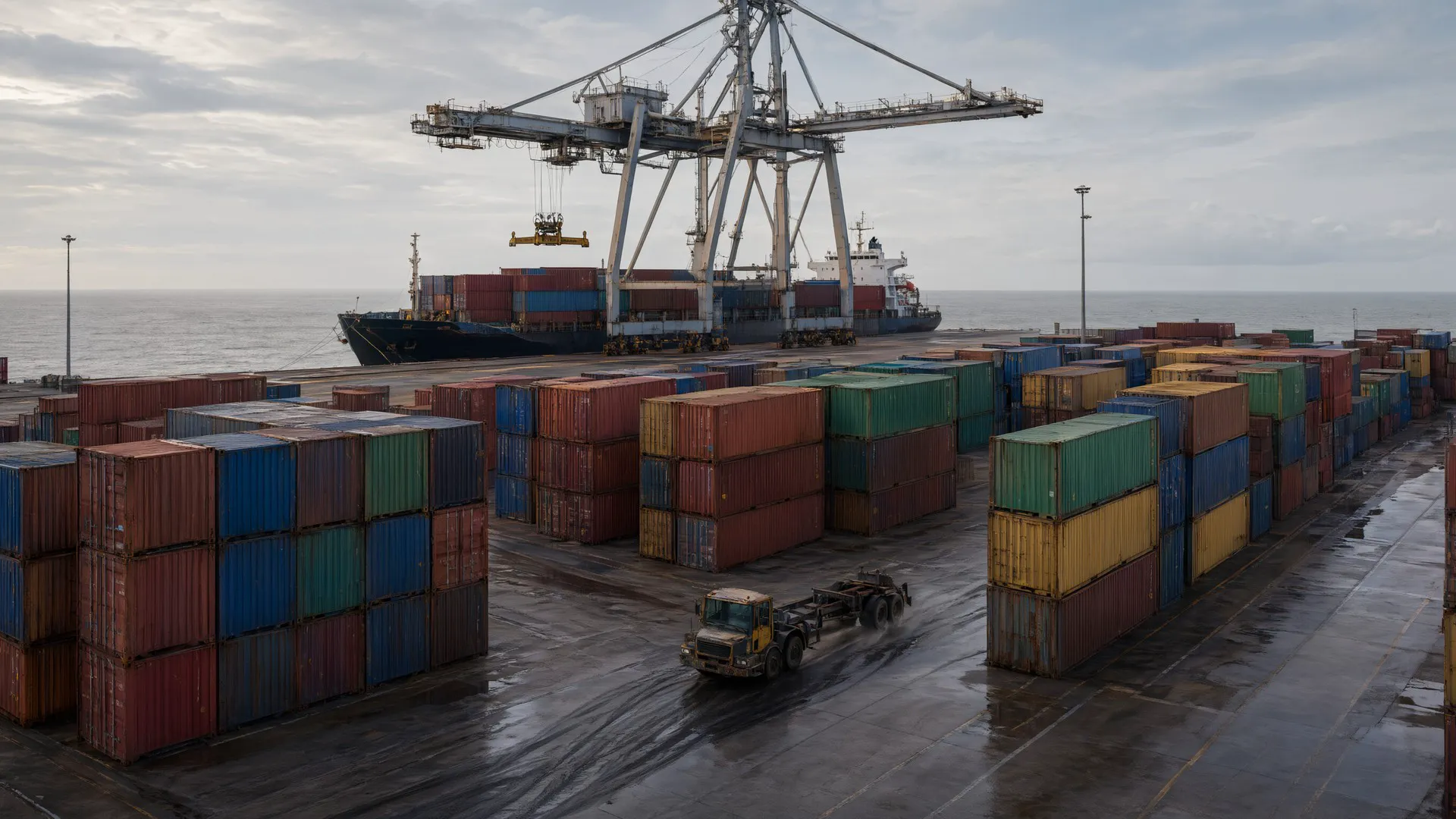
1. Three prices for one shipment, and why the quote you receive is not the bill
A Ghana-side agent quoted 20GP at $2,900 all-in on 13 October 2026, with destination THC inside the number. A Shenzhen forwarder asked for the same box that week quotes $3,000–4,350 port to port. Buy direct from a carrier on its published FAK tariff and you are looking at $600–1,300 more than the spot level for identical equipment. Three prices for one container, all quoted in the same week.
All three are correct. What differs is what each one covers, and the quickest way to lose money here is to compare a figure that includes destination handling against one that does not.
The $2,900 is neither a bargain nor a trick. Read the word "all-in" closely in that quotation: origin charges, ocean freight, terminal handling at Tema. Duty is not in it, VAT is not in it, the 1% examination fee is not in it, and delivery to Accra is not in it. On a $10,000 cargo assessed in the 20% duty band the tax block alone comes to $4,745 — more than the entire quotation. Any 20GP offer below $3,000 that advertises itself as DDP is either mislabelled or is priced against a cargo value nobody has declared yet.
| What the number covers | Spot, port to port | Carrier FAK | DDP all-in |
|---|---|---|---|
| Origin THC and export documentation | itemised separately | included | included |
| Ocean freight to Tema | yes | yes | yes |
| Destination THC and CFS handling | no | sometimes | included |
| Customs entry, duty, VAT, examination fee | no | no | included |
| Delivery to Accra or Kumasi | no | no | included |
| Who is importer of record | you | you | forwarder or its licensed partner |
| How long the number holds | seven to fourteen days | contract term | per shipment |
FAK is the trap pointing the other way. A carrier tariff is a rack rate for shippers without volume, and on a westbound Africa service it carries the carrier's schedule reliability premium inside it. You pay $600–1,300 per box for a number that does not move when the market moves — worth real money to an importer booking twelve containers a year on fixed dates, poor value to someone shipping twice a year and reading the bill afterwards.
Spot pricing has the opposite profile. Drewry's composite index stood at $4,429 per FEU on 29 October 2026, down 3% week on week, and carriers went into November with general rate increases that most analysts expected to fail on a lane where demand is flat. On a falling market a spot quote is an option you exercise late, not a commitment you make early.
One question does more work than the rate itself: ask for the quote in three columns (ocean, destination, tax), then ask which of the three moves if the container rolls a week. The ocean number barely moves inside a fortnight. The storage clock and the examination line do.
2. The shipping cost from China to Ghana that lands on your account: five layers from supplier gate to Accra warehouse
Ask four importers in Accra what the same container cost and you get four numbers, because each stopped at a different layer of one bill.
Start with what you paid the supplier, FOB. Freight and insurance come next, and together they produce the CIF value every Ghanaian assessment is built on. Then duty, under the ECOWAS Common External Tariff. Then VAT, which on this market is not the 15% written on the statute. Last come the levy stack, the terminal, the broker and the truck. Only the first two ever appear on a freight quotation.
| Layer | What sits in it | Who sets it |
|---|---|---|
| 1. Cargo value | FOB price on the supplier invoice | your purchase order |
| 2. Freight and insurance | ocean or air rate plus cover at 0.3–0.5% of cargo value | carrier, forwarder, insurer |
| 3. Duty | ECOWAS CET band 0%, 5%, 10%, 20% or 35%, applied to CIF | GRA Customs |
| 4. VAT | 20% effective on CIF plus duty | GRA Customs |
| 5. Levies, terminal, broker, truck | ECOWAS 0.5%, AU 0.2%, EXIM ≤0.75%, 1% examination, ~1% processing, THC, CFS, storage, delivery | GRA, GPHA, terminal, broker |
The tariff bands are not random. Raw materials enter at 5%, intermediate goods at 10%, finished consumer goods at 20%, and the sensitive list — textiles and clothing, poultry, some processed foods — at 35%. Most of what leaves Shenzhen and Guangzhou for Accra sits in the 20% and 35% columns, which is why two importers with identical freight bills can face tax bills 40% apart.
VAT is where the arithmetic surprises people who last looked at Ghana in 2025. From 1 January 2026, under the VAT Act 2025 (Act 1151), the 15% VAT, the 2.5% NHIL and the 2.5% GETFund levy are charged on a single base. The effective rate fell from 21.9% to 20%, and registered businesses can credit the NHIL and GETFund element as input VAT. Collection is unchanged: charged on CIF plus duty, settled before the container leaves the port.
The table worth photographing gives the whole tax block per $100 of CIF by duty band, including the 3.45% levy stack most quotations never mention.
| Duty band | Duty per $100 CIF | VAT 20% on (CIF + duty) | Levies at 3.45% | Total per $100 CIF | Tax as % of CIF |
|---|---|---|---|---|---|
| 0% | 0.00 | 20.00 | 3.45 | 23.45 | 23.45% |
| 5% | 5.00 | 21.00 | 3.45 | 29.45 | 29.45% |
| 10% | 10.00 | 22.00 | 3.45 | 35.45 | 35.45% |
| 20% | 20.00 | 24.00 | 3.45 | 47.45 | 47.45% |
| 35% | 35.00 | 27.00 | 3.45 | 65.45 | 65.45% |
Take a real consignment. A $10,000 CIF load of household goods in the 20% band pays $2,000 duty, $2,400 VAT and $345 in levies: $4,745, or 47.45% of CIF. The same $10,000 of clothing in the 35% band pays $3,500 duty, $2,700 VAT and the same $345 in levies: $6,545, or 65.45% of CIF. The gap between those two importers is $1,800 on identical freight, decided by which tariff line the supplier's goods description happens to fall under.
Two details decide whether that money comes back.
The first is registration. VAT registration now starts at GH¢750,000 turnover, up from GH¢200,000, so a growing importer can sit inside the taxable net without being registered. Clearance needs a TIN, and an individual ties that TIN to a Ghana Card. The entry is lodged by a licensed broker through ICUMS.
The second is the penalty clause for the unregistered. An importer without VAT registration prepays VAT at 20% of the customs value at the point of entry. That rate used to be 12.5%. On the $10,000 consignment above, the difference between the two rates is $750 of cash that leaves your account months before any input credit could return — and if you are not registered, no credit returns at all.
Before you argue about a $200 freight difference, get the HS code and the duty band in writing. A line that lands at 35% instead of 20% costs $1,800 more on a $10,000 cargo, which is more than this year's freight negotiation is worth.
3. Sea freight from China to Ghana: which load port quotes what, and how long the crossing runs
The 20ft container cost from China to Ghana varies by $1,400 between the cheapest and the dearest load port, 47% of the bottom rate, for a box that crosses the same ocean. That spread is not carrier greed: feeder density, barge and domestic legs, and how much of the vessel's capacity is committed to West Africa that month.
| Load port | Port-to-port transit to Tema | 20GP spot | 40GP / 40HQ spot | What puts the number there |
|---|---|---|---|---|
| Shenzhen (Yantian, Shekou) | 30–35 days | $3,000–3,900 | $4,400–5,300 | weekly direct West Africa calls, deepest box volume of any Chinese port on this trade |
| Guangzhou (Nansha) | 32–38 days | $3,050–3,950 | $4,500–5,400 | strong feeder links south to Shenzhen, fewer direct sailings, so some cargo is relayed |
| Shanghai | 32–42 days | $2,950–3,850 | $4,300–5,200 | the highest schedule frequency on the trade, which is why the bottom of the band sits here and not in Shenzhen |
| Ningbo | 35–40 days | $3,150–4,050 | $4,600–5,500 | same Yangtze delta cluster as Shanghai, marginally fewer Tema calls |
| Qingdao | 38–45 days | $3,300–4,250 | $4,800–5,800 | northern cluster, most boxes feed through Shanghai or Ningbo first |
| Tianjin | 40–46 days | $3,400–4,350 | $4,900–5,900 | longest positioning leg, thinnest direct coverage, most boxes relayed |
The transit column is port to port; add the rest yourself. A direct call runs 30–35 days. A relayed box through Tanjung Pelepas, Singapore, Colombo, Lomé or Tanger Med runs 40–55 days and saves the carrier $100–300 per container, part of which may come back to you. That is the trade you are making when a Tianjin quote comes in $700 under a Shenzhen one: a cheaper box and a schedule you cannot promise a customer against. How long shipping from China to Ghana takes breaks the day count down stage by stage if the delivery date matters more than the rate.
The equipment choice is where most of the avoidable money sits. A 20GP holds about 33 CBM. A 40HQ holds about 76 CBM. The price ratio between them is 1.47 at the bottom of the band; the capacity ratio is 2.30. Per cubic meter that is $90.91 in a 20GP against $57.89 in a 40HQ, so the bigger box is 36% cheaper per unit of volume. Importers fixate on the headline that a 40ft costs more. It does. It also carries 2.3 times as much.
Two 20GP boxes against one 40HQ makes the same point with cash instead of ratios: $6,000–8,700 for 66 CBM in two 20fts, against $4,400–5,900 for 76 CBM in one 40HQ. The saving is $1,600–2,800 and you gain ten cubic meters. The only reason to split into two 20fts is weight rather than volume: a 20GP tops out long before it fills if you are shipping dense cargo like tiles, machinery or bagged materials.
One caution: high-cube availability to Tema is thinner than 40GP, and in a tight month the premium for the extra foot of height can swallow the per-CBM advantage. Ask for both and compare on landed cost per CBM, never on the box rate.
4. LCL shipping from China to Ghana: the per-CBM price and the break-even almost nobody runs
LCL on this lane quotes $190–290 per cubic meter, and the number that matters is not the rate but the volume at which you should stop buying it.
Minimum billing is normally 1 CBM, which covers roughly 800 kg before the carrier switches to a weight basis. That single line catches furniture and machinery importers who assume volume is the only measure. A 1.2 CBM crate of machine parts at 1,400 kg does not bill at 1.2 CBM.
The break-even against a 20GP moves with the rate you are quoted, which is why "LCL is cheaper below 15 CBM" is a rule of thumb rather than a rule.
| LCL rate per CBM | Break-even volume vs a $3,000 20GP | Break-even vs a $4,350 20GP |
|---|---|---|
| $190 | 15.8 CBM | 22.9 CBM |
| $240 | 12.5 CBM | 18.1 CBM |
| $290 | 10.3 CBM | 15.0 CBM |
Freight alone, crossovers run from 10 to 23 CBM depending on which two rates you are comparing. Add destination CFS deconsolidation (LCL pays per CBM, FCL pays terminal handling per container) and the practical crossover tightens to 13–15 CBM. Above that line the container wins on money. Below it, LCL wins on money and loses on time: waiting for the box to close, then waiting for it to be stripped, adds 3–7 days to the same sailing.
Fifteen cubic meters is the number to hold in your head. At $250 per CBM that is $3,750, more than a 20GP that would have carried 33 CBM and sat in your yard instead of someone else's warehouse. The importer who ships 15 CBM LCL every month is paying a container rate for half a container and adding a week to every delivery.
What LCL genuinely buys is optionality on small, irregular orders. A first trial shipment of 3 CBM from a new supplier in Foshan should go LCL, and the $2,280 you keep against a $3,000 container is real money when you do not yet know whether the product sells. The mistake is letting that trial rhythm continue past the point where the volumes have grown.
5. Air freight cost from China to Ghana: chargeable kilos, weight bands, and what the invoice adds
Air freight from China to Accra bills on chargeable weight, which is the greater of the scale weight and the volumetric weight at 6,000 cubic centimeters to the kilo. A carton of 60 × 50 × 40 cm is 120,000 cubic centimeters and therefore 20 kg, whatever the scale says. Twenty such cartons bill at 400 kg even if the goods inside weigh 260 kg. Clothing, bedding, toys and flat-pack homeware are almost always billed on volume, and the supplier's carton dimensions decide your rate more than the airline does.
| Chargeable weight | Planning rate per kilo | What it is used for |
|---|---|---|
| 100 kg | $6.00–8.50 | sample runs, restocks, launch quantities |
| 300 kg | $5.60–7.80 | a first seasonal buy for one product line |
| 500 kg | $5.30–7.20 | replenishment against a live listing |
| 1,000 kg | $5.00–6.50 | full air pallet, high-value or fast-moving goods |
| DDP air, door to door | $7.50–10.50 | duty and delivery inside the rate, 8–12 days |
| Express courier | $9.00–15.00 | 3–5 days, documents and small parcels |
The rate is the easy part. Air freight also raises the tax base, because CIF includes the freight. Every extra dollar of air freight carries about 47 cents of duty, VAT and levies on a 20% duty line, so a $1,980 freight gap costs $2,920 in cash.
Put numbers on it. The same $18,000 order, 400 kg by air at $6.20 and 2 CBM by LCL at $250:
| Air, 400 kg | LCL, 2 CBM | |
|---|---|---|
| Freight | $2,480 | $500 |
| Insurance | $90 | $90 |
| CIF value | $20,570 | $18,590 |
| Duty, VAT and levies at 47.45% | $9,760 | $8,821 |
| Freight difference | +$1,980 | — |
| Tax difference | +$940 | — |
The real premium for flying is $2,920, not $1,980. That is the number to test against the value of arriving three to five weeks earlier.
Test it against the cost of capital and the cost of the stockout. At a 12% annual cost of capital, air freight only pays for itself on cargo worth more than roughly $630 per kilo; at 24%, the threshold falls to about $315 per kilo. Below those lines the freight is not buying capital efficiency. It is buying dates: a launch that cannot slip, a penalty you have already signed, a production line that stops without the part. Those are legitimate reasons to fly. "It gets here faster" is not a calculation.
Timing is less predictable than the rate card suggests. No freighter flies direct from mainland China to Accra: every kilo connects through Addis Ababa, Doha, Dubai, Istanbul or Luxembourg, and 400 kg door to door runs 5–8 days in practice. A Friday arrival typically clears on the following Tuesday, with the weekend inside the customs process; Wednesday and Thursday arrivals clear fastest. Air freight rates on this lane also move weekly rather than monthly: the TAC index was up 4.7% week on week and 26.4% year on year in the week of 19 October 2026, with IATA jet fuel up 113.7% year on year on 16 October. A seven-day-old air quotation is a reference, not an offer.
6. Import duty from China to Ghana, the Ghana EASYPASS requirement, and the Smart Port Note still on hold
Three compliance gates now stand between your supplier's gate and the Tema exit, and each one has a price and a delay attached. Two are in force. One is announced and postponed, the most expensive state of all because nobody can tell you what to budget for.
| Gate | What it costs | What happens if you skip it |
|---|---|---|
| GSA (Shippers' Authority) registration | GH¢150 per 12 months, about $12.74 | entry cannot be lodged in ICUMS; cargo sits at Tema |
| EASYPASS certificate of conformity | Route A about 0.35–0.50% of FOB, so $42–60 on a $12,000 order | no remedy at destination; verification is not permitted after arrival |
| Smart Port Note (SPN) | falls on the exporter's side | announced, then postponed on 21 January 2026; confirm per booking |
Start with the cheapest gate, because it stops everything. Registration with the Ghana Shippers' Authority became a clearance requirement under Act 1122 (2024), section 26(1), enforced through ICUMS from 3 August 2026. The fee is GH¢150 for twelve months. A company registers with its Certificate of Incorporation, an individual with a Ghana Card, and a licensed broker can pay the fee on behalf of an unregistered owner. Registration data is shared with GRA Customs. Thirteen dollars and a form, and yet shipments are sitting at Tema this month because nobody in the chain checked. The Authority publishes the requirement at shippers.org.gh.
EASYPASS is the gate that cannot be fixed afterwards. The Ghana Standards Authority launched the programme on 1 June 2026 and made it mandatory for shipments from 1 July 2026, judged by shipment date rather than arrival. Verification happens in the export country before loading, and destination inspection is explicitly not allowed: a container that sails without a certificate of conformity gets no second chance at Tema. It waits at Tema until somebody fixes the file, or it goes back.
The three routes price differently. Route A applies to any trader and any goods, charged at roughly 0.35–0.50% of FOB, which is $42–60 on a $12,000 order and $158–225 on a $45,000 one. Route B is for goods already registered with GSA at $400 per year covering the first 15 product lines, then $25 per line per year. Route C is an annual factory assessment at $1,200 per plant per year, which only makes sense if you ship continuously from one factory. The high-risk list covers electricals, food and drink, cosmetics, building materials, used goods, auto parts and textiles, which is most of what China sells into Ghana. Standards apply in a fixed order: Ghanaian standard first, then international, then European or other national standards, then manufacturer specification. Labels and instructions must be in English. Applications run through easypass.gsa.gov.gh.
The third gate is the one to hold loosely. The Smart Port Note was announced on 23 December 2025 under L.I. 2190, requiring one unique SPN per bill of lading for all cargo bound for Ghana including transshipment, issued and verified at the load port from 1 February 2026. On 21 January 2026 the Ghana Standards Authority postponed implementation and set no new date. The cost sits with the exporter, not the Ghanaian consignee. Treat it as a live possibility on every booking: ask your forwarder to confirm the current status per shipment, and do not build it into a landed cost model as though it were already charged.
The money in this section is small next to duty and VAT. The risk is not. A missing EASYPASS certificate strands a container that has already consumed its freight, and the storage clock at Tema starts the day it discharges.
7. The charges that start after the ship berths
Tema handles about 80% of Ghana's container traffic and sits 30 km from Accra, which makes it the port almost every importer means when they say "the port". Terminal 3, in full operation since November 2025, lifted nominal capacity from roughly 800,000 TEU to 3.7 million TEU across 127 hectares and four deepwater berths. Capacity was never the constraint in 2026. The landside was.
On 7 August 2026 the Ghana Ports and Harbours Authority confirmed serious landside congestion at Tema: import volumes up, empty containers piling in the yard, port access roads blocked. GSA put the year's throughput at about 2.5 million TEU in September. The transport minister told parliament that container volume growth was close to 100%, the largest increase in twenty years. Berth waiting peaked at a 5.8-day seven-day average in late June 2026, against 8.56 days at Abidjan and 3.5 at Dar es Salaam, then fell to a 3.57-day median in the week of 27 September 2026 — an 18% week-on-week improvement that still leaves Tema in the high-congestion bracket. GPHA has been moving empties out on extra sailings and clearing boxes that sat more than six months.
None of that touches your invoice until the container is on the quay; after that the clock runs daily.
| Tema port charges and demurrage clock | Free period | What it costs after |
|---|---|---|
| GPHA port storage | 7 days | $35 per day for a 20ft, $52.50 per day for a 40ft |
| Carrier free time, dry container | 7 days | detention and demurrage per the carrier's tariff |
| Carrier free time, reefer | 5 days | same, on a shorter clock |
| Bonded transit to a coastal neighbour | 21 days | guarantee exposure after that |
| Bonded transit to Burkina Faso, Mali or Niger | 28 days | guarantee exposure after that |
A 40ft that clears on day 12 instead of day 7 pays $262.50 in storage alone. Clear on day 17 and it is $525. A 20ft on the same timeline pays $175 and $350. It is the most predictable avoidable cost on the lane, and a function of how fast your documentation moves, not how fast the ship did.
Clearance runs 3–7 working days at Tema when the file is clean, five to seven in the ordinary case, 7–10 when a document is wrong — a certificate of conformity that does not match the invoice, a valuation query, a missing TIN link — and past 30 days once a valuation or tariff classification dispute starts. By then the storage bill is larger than the freight.
The professional fees are modest and worth paying. A licensed customs broker charges GHS 800–1,500, about $68–127 at the October rate, and the Container Administrative Charge is GH¢720 per container, about $61. Neither is where the money goes, though; the days are.
What to do: book the broker before the vessel sails, not after it berths. Send the commercial invoice, packing list, bill of lading draft, EASYPASS certificate and GSA registration confirmation in one file, one time. The importers paying $262.50 in storage are almost never the ones with the highest freight rates; they are the ones whose paperwork arrived in four separate emails over six days.
8. What sits on top of a Ghana quote: the lines that never appear in the headline rate
A quotation is a commercial document, not a cost model. Below is what a normal Ghana quotation leaves out, what it actually costs, and the question that gets it into writing before you commit.
| Line | Who pays | Order of magnitude | Question to ask |
|---|---|---|---|
| Origin THC and documentation | shipper, so usually you | per container, itemised | Is origin THC inside this number or billed at cost? |
| Destination THC and CFS | consignee | per container for FCL, per CBM for LCL | Does this rate include Tema THC and CFS stripping? |
| EASYPASS certificate of conformity | exporter | 0.35–0.50% of FOB | Who files EASYPASS, and is the CoC fee in your price? |
| GSA registration | importer | GH¢150 per year | Will you register us, or do we register ourselves? |
| Examination fee | importer | 1% of CIF | Is the 1% examination line in your duty estimate? |
| Storage and detention | importer | $35 or $52.50 per day after day 7 | What is the free time on this booking, in writing? |
| Duty and VAT | importer | 23.45–65.45% of CIF by band | Which HS code and duty band are you quoting against? |
| Inland delivery to Accra, Kumasi, Takoradi | importer | quoted per trip | Is delivery to my door or to the Tema gate? |
| Marine insurance | importer | 0.3–0.5% of cargo value | Is cover included, and at what declared value? |
| Currency | importer | USD/GHS around 11.77 on 9 October 2026 | Is this rate fixed in USD or settled at the day's cedi rate? |
Three sentences close most of these gaps in one email: which of the lines above are inside the price; the free time and the storage rate in writing; and which HS code the duty estimate assumes, because a band change from 20% to 35% is worth $1,800 on a $10,000 cargo.
The cedi deserves its own warning. Duty and terminal charges are paid in cedis, freight in dollars. When the cedi moves between quotation and payment, the landed cost you modelled in September is not the one you settle in November. Quote freight in USD, ask for the duty estimate in cedis at a stated rate, and treat any quotation that mixes the two without a date as an estimate.
9. Three shipments, three landed totals, and the line each importer underestimates
Arithmetic settles most of these arguments. Three orders follow, priced from supplier gate to an Accra warehouse, with duty at the tariff band each product actually attracts and clearance fees at GHS 1,500 plus the GH¢720 administrative charge. Insurance is 0.4% of cargo value in all three.
| Shipment | Mode | Freight | Duty | VAT | Levies and clearance | Landed total | % of FOB |
|---|---|---|---|---|---|---|---|
| 2 CBM clothing, $3,000 FOB, 35% band | LCL at $240/CBM | $480 | $1,222 | $943 | $309 | $5,954 | 199% |
| 8 CBM electronics, $12,000 FOB, 20% band | LCL at $240/CBM | $1,920 | $2,794 | $3,352 | $671 | $20,736 | 173% |
| 8 CBM electronics, $12,000 FOB, 20% band | 20GP at $3,000 | $3,000 | $3,010 | $3,612 | $708 | $22,329 | 186% |
| 28 CBM machinery, $45,000 FOB, 20% band | 20GP at $3,000 | $3,000 | $9,636 | $11,563 | $1,851 | $71,050 | 158% |
The clothing order is the one that reorganises an importer's thinking. Three thousand dollars of goods becomes a $5,954 landed cost, and $2,285 of that is tax at 65.45% of CIF. The most underestimated line is not the freight, which is $480 and visible. It is the 35% duty band, which the supplier will not mention and nobody checks until the entry is lodged. On clothing, the tax is nearly four times the freight.
Rows two and three are the same cargo shipped two ways, and they settle the LCL-versus-container argument for small volumes. At 8 CBM the container is $1,592 more expensive: you pay $3,000 for a box that would have carried 33 CBM, and every percentage tax compounds on a CIF that is $1,080 higher. The intuition that a container is always cheaper is wrong below the crossover.
The machinery order shows the opposite error. Landed cost is 158% of FOB, the lowest ratio of the three, not because machinery escapes tax but because freight is a small share of a high-value cargo. Here the underestimated line is the 1% examination fee and the levies: $1,851 on top of duty and VAT, mentioned in almost no quotation.
This table omits Tema terminal handling and CFS charges, which the terminal quotes per shipment and which move the LCL rows by a few dollars per CBM. They change the totals without changing the ranking.
10. Five levers that move the landed number, each with its own arithmetic
Five decisions move the landed number, and door-to-door DDP shipping from China to Ghana is the third of them, not the first: the two cheapest are made in China, before a customs file exists.
Lever one: consolidate suppliers in one Chinese warehouse. Two 6 CBM lots from two Foshan factories become one 12 CBM shipment. At $240 per CBM that is $2,880, within $120 of a full 20GP that carries 33 CBM. Consolidation rarely cuts the freight bill much; what it cuts is the number of clearance events, the number of destination CFS bills and the number of chances to lose a document. One export declaration instead of two is one fewer place for the HS code to be wrong.
Lever two: one 40HQ instead of two 20fts. $4,400–5,900 against $6,000–8,700, plus ten more cubic meters. It is the largest single saving available without changing your supply chain, and it only fails on weight.
Lever three: FOB versus DDP, understood as a cash question rather than a price question. DDP sea at $220–320 per CBM against LCL at $190–290 leaves a premium of about $30 per CBM at both ends of the range, and what that $30 buys is somebody else standing in the customs line: no TIN, no Ghana Card linkage, no 20% VAT prepayment, no GRA registration. Door-to-door DDP shipping to Ghana explains who carries the importer-of-record liability in that arrangement. There is a limit to the model: at $220–320 per CBM, DDP sea only closes on cargo with low value density. A cubic meter carrying $1,000 of electronics generates about $590 of tax by itself, which no per-CBM all-in rate can absorb, so that shipment gets priced individually instead.
Lever four: run EASYPASS before loading. On a $12,000 order the certificate costs $42–60 through Route A; a stranded 40ft at Tema costs $52.50 a day. The certificate is worth less than two days of a container on the quay.
Lever five: stay out of the December and pre-Chinese New Year booking window. Space tightens, rate increases get announced, and the quotes you collect in the last ten days of December are the ones least likely to hold. If your stock planning allows a November sailing, take it: the same container, the same transit, a rate that does not include a peak-season premium somebody decided to test.
11. Ghana shipping cost questions, answered every week
What does a 20ft container from China to Tema cost right now?
$3,000–4,350 port to port in November 2026, with Shenzhen at the bottom of that band and Tianjin at the top. Add $4,745 of duty, VAT and levies on a $10,000 cargo in the 20% band, and the all-in figure lands between $7,745 and $9,095.
What is the cheapest way to ship from China to Ghana for a 3 CBM order?
LCL at $190–290 per CBM, so $570–870 of freight, plus destination CFS handling. A 20GP at $3,000 is three to five times the money for the same cargo. The break-even sits between 10 and 16 CBM depending on which LCL rate you are offered.
What does customs clearance in Ghana cost on top of duty?
A licensed broker charges GHS 800–1,500, about $68–127, and the Container Administrative Charge is GH¢720, about $61. The examination fee is 1% of CIF. Those are the small numbers; the 20% effective VAT on CIF plus duty is the large one.
How long does shipping take from China to Ghana?
30–35 days port to port from Shenzhen, 40–46 from Tianjin, plus 3–7 days for LCL consolidation and stripping. Door to door to Accra typically lands at 40–55 days. Air is 5–8 days door to door with one connection.
Is EASYPASS my cost or my supplier's?
Route A is charged at 0.35–0.50% of FOB and sits on the exporter's side, so it belongs in your FOB negotiation, not your Ghana budget. What lands on you is the consequence of not having it: a container that cannot be cleared at Tema, with no destination inspection available.
Does a DDP rate include duty, VAT and EASYPASS?
A genuine DDP rate includes duty, VAT and delivery, with the forwarder or its licensed partner as importer of record. EASYPASS travels with the goods, not with the trade term, so a DDP shipment still needs a certificate of conformity issued before loading. Ask for the CoC reference before the container sails.
Will Tema congestion add to my bill?
Only through the clock. Berth waiting fell to a 3.57-day median in the week of 27 September 2026 from a 5.8-day peak in June, but storage still starts after seven free days at $35 per day for a 20ft and $52.50 for a 40ft. Congestion costs you money when it delays your document flow, not when it delays the ship.
How long is a shipping quote valid?
Seven to fourteen days for ocean spot rates on this lane, and about seven days for air. Ocean rates have been drifting down: the Drewry composite was $4,429 per FEU on 29 October 2026, 3% lower week on week, so a month-old quote is usually worse than a fresh one.
Can I ship less than 1 CBM?
You can, but most consolidators bill a 1 CBM minimum, and 1 CBM covers roughly 800 kg before the weight basis takes over. Below that threshold, courier at $9–15 per kilo is often the cheaper answer for samples and urgent spares.
12. Send three numbers and get a landed cost quote back the same day
Three numbers decide the quote: your packing list with carton dimensions, the city the cargo is going to, and the FOB value with the product description. Send those to our team and you get the price in the three parts that matter (freight, tax, delivery) rather than one number that hides which part moves when something changes. That structure makes a quotation comparable across forwarders, and it is how AllBestShipping prices this lane from Shenzhen, Guangzhou, Shanghai, Ningbo, Qingdao and Tianjin.
The invoice you are trying to predict is not the freight rate. It is freight, plus a tax block worth 23% to 65% of CIF, plus whatever the terminal charges while your paperwork catches up. Get all three in writing before booking.