Shipping Cost from China to UAE in November 2026: What Four Separate Bills Add Up To
Shipping cost from China to UAE no longer follows a rate sheet, because the strait that every Jebel Ali sailing used to transit has been closed to container ships since 28 February 2026. Ships now discharge at Khor Fakkan or Fujairah on the Gulf of Oman and the box finishes the journey by bonded road. The Persian Gulf container index closed at $6,533 per TEU on 30 October, up from $6,135 in early September, and a 40ft high cube all-in to Jebel Ali quotes at $8,000–9,000 against $1,650–3,300 for the same box in the same month of 2025. The number on your quotation is one of four bills. The other three arrive after the vessel berths.
Four bills decide what leaves your account: the ocean leg with its surcharge stack, the detour at a Gulf of Oman gateway, the duty and VAT assessed on your declaration, and the movement that ends at your own door. Shipping from China to UAE sits inside a relationship worth more than $100 billion a year in goods, and UAE non-oil foreign trade reached AED 1.94 trillion (about $527 billion) in the first half of 2026, so the lane is not slowing down — it is being re-priced at the last mile. If you read one section, read the eight questions in section 12, which cover the parts importers chase after the invoice lands.
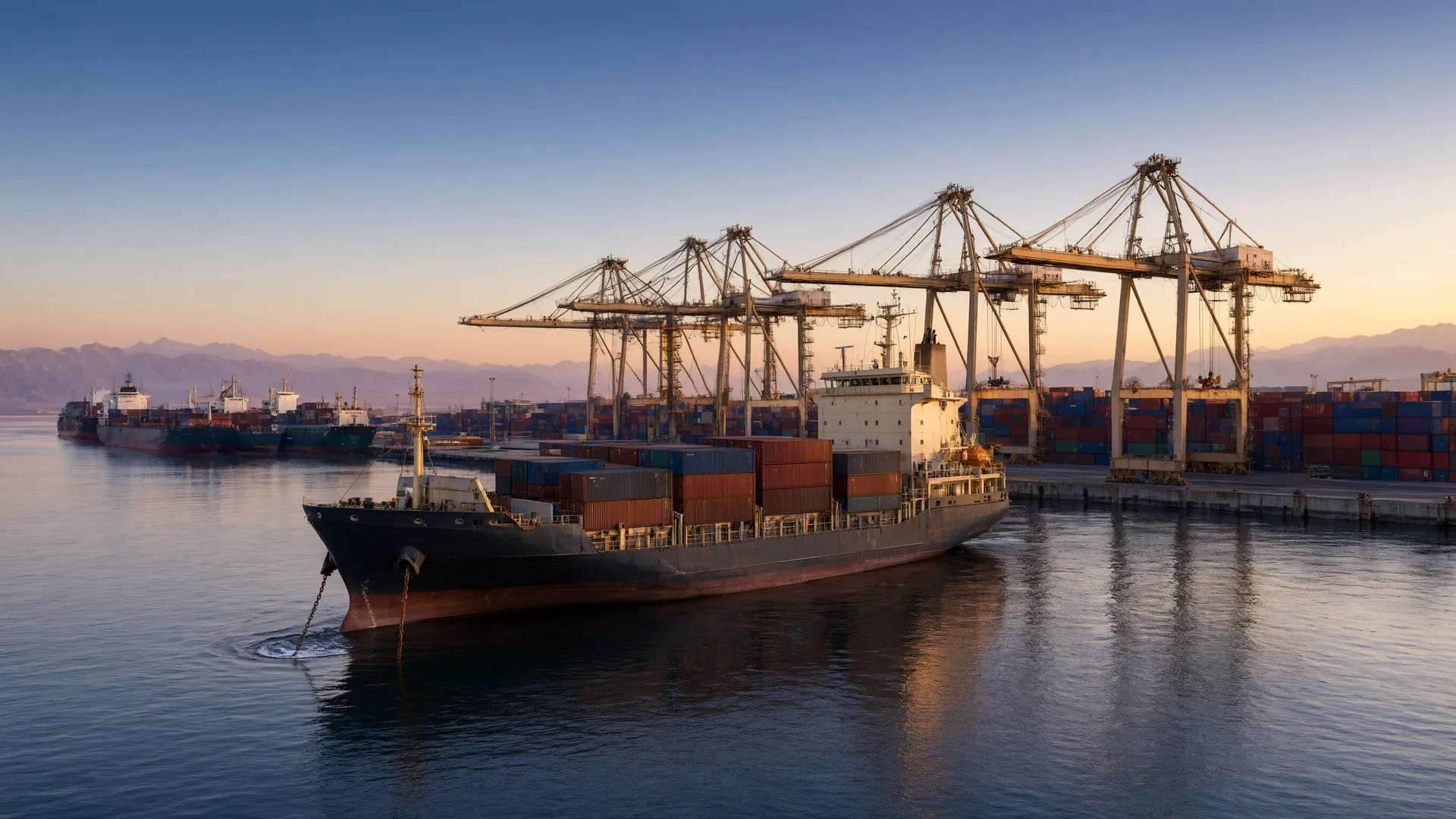
What shipping cost from China to UAE means in November 2026: four bills, not one
Take a 20ft container of machinery parts bought FOB Ningbo for $48,000 and delivered to Mussafah. Four invoices reach the importer before the goods do.
| Bill | Who issues it | What it contains | Recoverable? |
|---|---|---|---|
| 1. Ocean freight and its surcharge stack | Carrier, through your forwarder | Base freight, war risk surcharge, emergency conflict surcharge, peak season surcharge | No |
| 2. The detour | Carrier, terminal, haulier | Anchorage wait, bonded transfer to Jebel Ali, change-of-destination charge, storage, empty return | No |
| 3. Duty, VAT and the declaration | Dubai Customs, then FTA via your VAT return | 5% duty on CIF, 5% VAT on CIF plus duty, AED 70 to AED 90 in declaration fees | VAT only, and only if you are registered |
| 4. Inland movement | UAE haulier or 3PL | Jebel Ali or Khor Fakkan to your warehouse, second-emirate movement, waiting time | No |
The arithmetic matters less than the sequence. Buyers who budget one number, usually bill 1 because that is the number quoted, find the other three add 15% to 25% of cargo value on a consignment that clears normally. The four-bill figure below applies the mid-point of each band cited in this article to the same $48,000 container.
What changed in 2026 is the relative size of the bills, not how many of them there are. Ocean freight used to be the bill; it is now roughly two-thirds of what a UAE import costs before inland delivery. Duty and VAT are fixed by law and have not moved — 5% and 5% since 2018. The detour is entirely new, and it is the only bill a first-time importer has no mental model for.
The market state behind it, in five figures:
- Hormuz has been closed to container shipping since 28 February 2026. Lloyd's List Intelligence counted 116 non-Iranian-linked transits in 19–25 October, against 124 the week before, on a three-week average of 121.
- Jebel Ali handled 374,000 TEU in the second quarter of 2026, 90.1% below the same quarter a year earlier on DP World's audited interim results. First-half throughput was 3.1 million TEU, down 59.5%. A port that moved 15.55 million TEU in 2025 is running at roughly 28,800 TEU a week against about 299,000 a year earlier.
- Khor Fakkan, which handled about 8,000 TEU a week before the closure, was moving 65,000 TEU a week by early July on Gulftainer's own numbers, more than twice Jebel Ali's current volume.
- The Shanghai Containerized Freight Index closed at 3,687.35 on 30 October, its fourth consecutive weekly gain, with the Persian Gulf and Dubai component at $6,533 per TEU.
- Maersk has accepted bookings to "Jebel Ali (via landbridge)" since 12 August. The largest container port in the Middle East appears in a carrier's booking system as a road destination.
Drewry's port analyst Eirik Hooper has put the structural argument plainly: once carriers have rebuilt their networks around Salalah, Colombo, Vizhinjam, Khor Fakkan and Jeddah, there is no case for reinstating a Hormuz transit to serve cargo that never needed to enter the Gulf. Plan the next three quarters as if the detour stays, and treat a reopening as upside rather than a plan.
Bill one: the ocean leg, and what shipping from China to Dubai means when the box lands at Khor Fakkan
Sea freight cost from China to UAE and the container shipping cost behind it both start with a port that is no longer your delivery point. Your booking names Jebel Ali, your bill of lading may name Khor Fakkan, and the container may be discharged a third place. The rates below are what forwarders are quoting for the first half of November 2026.
| Line | Feb 2026 (pre-closure) | November 2026 | What moved it |
|---|---|---|---|
| SCFI Persian Gulf / Dubai | Pre-crisis baseline, 3–4× lower | $6,533/TEU (30 Oct close, +0.52% w/w) | Hormuz premium embedded in the index |
| 20GP all-in to Jebel Ali | $1,200–2,300 | about $5,400 | Base freight plus three surcharges |
| 40ft HQ all-in to Jebel Ali | $1,650–3,300 | $8,000–9,000 | Same, plus space scarcity |
| China to Khor Fakkan spot | — | $10,626/FEU, +479% since end-February | Workaround gateway premium |
| China to Jeddah spot | — | $10,870/FEU, +256% | Red Sea gateway absorbing extra volume |
| LCL | $55–130/CBM | $55–180/CBM, with bookings at the top | Consolidation queues and CFS cost |
Read the third and fourth rows together. The workaround gateway is now the expensive one: Khor Fakkan spot at $10,626 per FEU carries a 479% premium over the pre-closure baseline, while Jeddah, the port that took the rerouted Saudi volume, sits at $10,870. The gap between discharge points on a route that used to differ by a few hundred dollars is now more than $2,000 per container. Routing choice became a purchasing decision.
What you are actually buying at these levels is four stacked charges, and a quotation that shows one number hides three of them.
| Surcharge layer | Typical range | What drives it |
|---|---|---|
| War Risk Surcharge (WRS) | $500–1,500 per container | Gulf war-risk premiums at 3%–6% of hull value against 0.3%–1% for Red Sea routings |
| Emergency Conflict Surcharge (ECS) | $200–500 per container | Carrier recovery for the Hormuz disruption and security compliance |
| Peak Season Surcharge (PSS) | $750 per 20ft, $1,500 per 40ft | Q4 demand, pulled forward by the Golden Week lull |
| Emergency fuel | Carrier-specific | Longer transshipment chains and Cape routings |
Hapag-Lloyd introduced its war risk surcharge at $1,500 per TEU for standard containers and $3,500 per box for reefers and special equipment from 2 March 2026, which tells you where the ceiling sits; the $500 low end is what a contract customer with volume commits to. Ask for the four lines separately. Two quotes that differ by $1,500 per container usually differ only in how many layers each one quietly folded into the headline.
Two pricing traps sit behind most bad comparisons on this lane.
The first is the legacy rate. Several freight sites still publish "20GP $2,100–2,800 to Jebel Ali, 15–18 days transit". Those numbers describe a lane that carried ships through the strait. A forwarder who quotes them in November is either working from a 2025 rate sheet or means base freight only, surcharges excluded and has not said so. Ask which of the four layers is inside the number, and whether the discharge port in the rate is Jebel Ali or Jebel Ali via landbridge.
The second is the load-port spread. On a normal lane, Yantian and Ningbo and Qingdao quote $400 to $900 apart, so origin choice is a real cost lever. Today the bottleneck sits at the discharge end, not the load end: the premium for a Khor Fakkan call swamps any saving from a cheaper gateway in China. Container shipping from China to UAE still starts with the same six ports, but the port you sail from matters less this quarter than the port where the box comes off.
For a Dubai consignee in Al Quoz or Jebel Ali Free Zone, the practical consequence is a delivery date set by the Gulf of Oman coast. Shipping from China to Dubai now means booking a discharge at Khor Fakkan or Fujairah, matching your customs entry to the port that actually releases the box, and planning the last 130 to 190 km of road as part of the ocean leg. For Abu Dhabi and Al Ain the road is longer again, which is where bill four starts.
Bill two: anchorage waits, bonded trucking and the charges that arrive with a changed bill of lading
The detour in 2026 is priced twice: once as a war risk surcharge on Gulf shipping, and once as time at anchor. Only the first of those appears on your quotation. The second arrives as detention, storage, a change-of-destination charge or a re-issued delivery order.
Kuehne+Nagel's port data as of 30 October, reported on 3 November, puts average vessel waits at 7.25 days at Khor Fakkan and 8.86 days at Fujairah, against roughly three days at Sharjah. Vessels calling Khor Fakkan arrived an average of 7.4 days behind schedule over 30 days and departed 5.7 days late, which carries the delay into the next port on the rotation. Linerlytica described regional congestion as a record in the same week, and MSC is deploying ships of around 24,000 TEU on an expanded Far East–Middle East service calling there. A 24,000 TEU ship discharging several cargo groups in one window is not a crane problem; it is a yard and truck-slot problem.
The numbers that decide your landed cost are not the waits, though. They are the transfers.
| Gateway | Average vessel wait | Bonded transfer to Jebel Ali / Sharjah / Abu Dhabi | What it does to your schedule |
|---|---|---|---|
| Khor Fakkan | 7.25 days | 12–15 days (about five days before congestion) | Ocean arrival stops predicting delivery date |
| Fujairah | 8.86 days | 12–15 days | Same, plus a second road leg for Dubai-bound cargo |
| Sharjah | about 3 days | Local, hours rather than days | The cheapest gate if your consignee is in Sharjah |
| Jebel Ali (via landbridge) | Set by the feeder or road slot | Inbound by road, not by sea | Bookable, but the port of discharge is a road point |
Twelve to fifteen days of transfer against five days before is the number to plan production around. Your ocean arrival milestone has stopped being a delivery forecast. If a container is discharged on 14 November, the realistic handover at a Jebel Ali or Abu Dhabi warehouse is 26 November to 29 November — before clearance, before any inspection.
The carrier advisories tell you how quickly the ground moved. Maersk published five operational updates in four weeks.
| Date (2026) | Advisory | What changed for a UAE importer |
|---|---|---|
| 31 Aug | Update 44 | Reefer bookings suspended to most Gulf ports; emergency freight rates of $1,800–3,800 per container |
| 9 Sep | Update 45 | Most dry bookings to and from Gulf ports suspended; Hormuz traffic near 10 ships a day |
| 11 Sep | Update 46 | Selected Khor Fakkan cargo discharged at Fujairah; three landbridge corridors paused; $500 cost-recovery surcharge |
| 16 Sep | Update 47 | Empty containers no longer returned to usual depots in seven markets; pick-up charges at non-preferred locations |
| 23 Sep | Update 49 | Landbridge pause reconfirmed; air fuel surcharge of at least 15% of the transport rate; suspension lists extended by cargo type |
Two of those lines cost money in ways importers do not expect. The first is the change of final destination: when a box booked to Khor Fakkan is discharged at Fujairah and moved under bond to Jebel Ali, the port of discharge on the bill of lading changes, and your customs entry, delivery order, haulier booking and empty-return instruction all have to match the new one. That is an administrative cost before it is a financial one, and it lands one booking at a time rather than through a single schedule update.
The second is the empty return. A container that has to go back to a depot other than the one near your warehouse carries a pick-up charge, and in a market where transfers take twelve to fifteen days, the return trip can eat the free time you thought you had. Standard free time on this lane is five to seven days. Push for ten to fourteen at the point of booking, in writing, and note the depot address on the delivery order.
Add the segments and the honest port-to-door number looks nothing like the 15–25 days still published on most China–UAE rate pages: 14–20 days at sea from South China to the Gulf of Oman, 7–9 days at anchor, 12–15 days of bonded transfer, then 3–7 days for clearance and delivery. That is 36 to 51 days, and it is the figure to give your customer — not the sailing time.
Bill three: duty, VAT and the eight-digit code that decides both
UAE customs duty and VAT on imports from China is the one bill you can calculate before you book anything, and it is also the bill most first-time importers get wrong in the same direction: they apply 5% twice to the invoice value and stop. The published rule is 5% duty on CIF, with import VAT at 5% calculated on CIF plus the duty. On general cargo that compounds to 10.25% of CIF, not 10%.
| Element | Rate or fee | Base | Note |
|---|---|---|---|
| Customs duty | 5% | CIF value (goods + freight + insurance) | Alcohol 50%, tobacco 100%; 417 goods exempt on the approved schedule |
| Import VAT | 5% | CIF value plus duty | Recoverable through your VAT return if you are registered |
| Import declaration (Dubai) | AED 70 dutiable, AED 80 non-dutiable | Per declaration | Plus AED 20 Knowledge and Innovation fee |
| Free zone to mainland declaration | AED 70 dutiable, AED 80 non-dutiable | Per movement | Filing to local from free zone |
| Late supporting documents | AED 5 per day | After 30 days from declaration | Invoice, packing list, certificate of origin, permits |
| Wrong HS code, no duty loss | AED 500 | Per case | Published Dubai Customs fine |
Work it on a real consignment: a CIF value of AED 10,000 attracts AED 500 of duty, the VAT base becomes AED 10,500, and the import VAT is AED 525. That is AED 1,025 in tax on a ten-thousand-dirham shipment, before a single handling charge.
Now the part that surprises people in a detour market. Because duty and VAT are charged on CIF, and CIF includes the ocean freight, every dollar of surcharge you absorb is taxed at 10.25% on top. A container whose freight rose by $5,000 carries about $512 of extra duty and VAT. The bill-one problem does not stay in bill one.
The classification question has a wrinkle worth knowing, because most competitor pages state the opposite. The UAE has been moving to a 12-digit integrated customs tariff in phases, and plenty of guides now tell importers that 12-digit codes are mandatory. Dubai Customs extended the flexibility to keep declaring under 8-digit HS codes in Phase 1 until further notice in Notice 02/2026, issued on 30 January 2026. Both statements can be true at once: the tariff is being phased in, and your broker can still file 8-digit today. What this means practically is that a mis-declared classification is your error, not the system's. Confirm the code with your broker against the current tariff before the vessel berths, not after.
Three other charges sit inside this bill and are easy to miss:
- Product conformity. ECAS and, for many categories, MoIAT registration, plus Dubai Municipality approval for food and cosmetics. These carry their own certificates and fees, and they gate clearance rather than the tax calculation.
- VAT cash flow. Recoverable is not free. Import VAT is paid at clearance and recovered on the next return, which on a $48,000 container is about $2,520 sitting outside your business for a month or a quarter.
- Non-registered importers. If you are below the VAT registration threshold or buying through an individual, the 5% VAT is not recoverable at all. That single fact turns a "10.25% tax" assumption into 10.25% of pure cost and pushes the landed figure up by roughly five points of cargo value.
Bill four: the inland leg, and why the same box costs more once it reaches Abu Dhabi
The last bill is the smallest and the one that most often decides whether the shipment is profitable, because it is priced per trip, per hour or per waiting day rather than per container. A box discharged at Khor Fakkan and delivered in Dubai is one bonded movement of roughly 130 to 190 km. The same box delivered in Mussafah adds a second leg and, with it, a second set of handover risks.
| Consignee location | Typical route after discharge | What to budget for |
|---|---|---|
| Dubai (Al Quoz, JAFZA, Dubai South) | Khor Fakkan or Fujairah by bonded road, or Jebel Ali via landbridge | One movement, one delivery order, one empty-return trip |
| Sharjah and Ajman | Often direct from Khor Fakkan | Shortest inland leg in the country; the cheapest gate for these emirates |
| Abu Dhabi, Mussafah, KEZAD | Khor Fakkan or Jebel Ali, then a second inter-emirate leg | Two movements, two appointments, waiting time at both ends |
| Al Ain and the interior | Same as Abu Dhabi plus a longer final leg | Truck availability, not distance, is the constraint |
Three practical rules apply wherever you are delivering.
First, the customs entry has to match the port that actually releases the cargo. A container discharged at Khor Fakkan and cleared as a Jebel Ali arrival is a discrepancy waiting for an inspection, and the fix costs days. Give your broker the discharge port from the carrier's arrival notice, not the port on your purchase order.
Second, waiting time is now a line item. When transfers run twelve to fifteen days, hauliers quote shorter windows and charge for standing time, and a warehouse that cannot take delivery on the booked day pays twice — once for the truck and once for the container sitting on it.
Third, free-zone deliveries behave differently from mainland deliveries. If your stock is going into JAFZA, DMCC or KIZAD and staying there, bill three does not happen yet; the duty and VAT wait until the goods leave for the mainland. That deferral is worth real money on slow-moving or re-exported stock, and it is the subject of section 9.
Less than a container: what a cubic metre costs now, and the load that should have shipped as an FCL
LCL shipping cost per CBM from China to UAE quotes at $55 to $180 per cubic metre in November 2026, and the figure that decides your bill is the one the consolidator measures rather than the one on your packing list.
Two rules govern that measurement. The first is the weight-or-measure rule: LCL is billed on revenue tons, which is the greater of cubic metres and metric tonnes, so a dense cargo such as tiles, hardware or machine parts at 1.2 tonnes per cubic metre pays on weight rather than space. The second is that fixed charges do not scale with volume. Documentation, bill of lading, destination CFS handling and delivery order are charged per shipment. On a four-cubic-metre consignment those fixed lines can approach the freight itself; on twenty cubic metres they disappear into the rounding.
The straight comparison between LCL and a container has changed more than any other line in this article, because container all-in rates roughly tripled while per-CBM rates did not. The old rule of thumb — consolidate until about 15 CBM, then book a 20ft — no longer holds. Run the arithmetic at a 20GP all-in of $5,400 and a 40ft HQ at $8,500:
| LCL rate per CBM | 10 CBM | 15 CBM | 20 CBM | 25 CBM | 30 CBM | Volume where a 20GP wins | Volume where a 40HQ wins |
|---|---|---|---|---|---|---|---|
| $90 | $900 | $1,350 | $1,800 | $2,250 | $2,700 | above 60 CBM | above 94 CBM |
| $120 | $1,200 | $1,800 | $2,400 | $3,000 | $3,600 | above 45 CBM | above 71 CBM |
| $150 | $1,500 | $2,250 | $3,000 | $3,750 | $4,500 | above 36 CBM | above 57 CBM |
| $180 | $1,800 | $2,700 | $3,600 | $4,500 | $5,400 | above 30 CBM | above 47 CBM |
A 20ft holds about 28 cubic metres usable. At every LCL rate below $193 per cubic metre, LCL is cheaper than a 20GP for any load that fits in one, which is the entire range a 20GP can carry. The 20ft only pays when you are shipping dense cargo that fills it on weight, or when your consolidator quotes above $193.
The 40ft high cube is where the crossover still bites. Fifty-eight cubic metres usable on a light load, 68 on paper, and at $150 per CBM the container wins from about 57 CBM upward. If you are shipping furniture or homeware at 45 CBM, LCL at $150 is $6,750 against $8,500 for the box — and you keep the flexibility of not filling it.
Three things to check before you accept an LCL number:
- What the consolidator measures. Ask for the CBM and the revenue tons in writing, with the carton dimensions. A 12-carton pallet at 1.2 × 1.0 × 0.9 m measures 12.96 CBM by dimension and 2,160 chargeable kilos at the 1:6,000 volumetric convention, so it bills on volume — but a denser version of the same pallet bills on weight.
- Destination CFS and delivery order. These are not in the per-CBM rate and they are where the invoice grows.
- Consolidation timing. In a capacity-short market, LCL rollovers are common because consolidators hold a box until it is full. If your delivery date is fixed, LCL is the wrong tool this quarter regardless of price.
Air freight cost per kg to DXB and DWC, and the fuel surcharge added on 23 September
Air freight cost from China to UAE per kg sits at $4 to $8 for general cargo in November 2026, and the invoice is decided by the chargeable kilo rather than the actual one.
Chargeable weight is the greater of actual weight and volumetric weight, with volumetric calculated as length × width × height in centimetres divided by 6,000. A carton of 60 × 50 × 40 cm bills at 20 kg regardless of how much it weighs, so light, bulky goods — packaging, textiles, foam, assembled furniture components — pay several times their physical weight.
The bands below are indicative for general cargo into Dubai in November 2026, and they sit inside the published lane range.
| Weight break | Indicative rate per kg | Typical use |
|---|---|---|
| 45–99 kg | $7.00–8.00 | Samples, spares, launch stock |
| 100–299 kg | $6.00–7.20 | Restocks for a single SKU |
| 300–499 kg | $5.00–6.30 | Seasonal top-ups |
| 500–999 kg | $4.40–5.60 | Replenishment where the sea date has slipped |
| 1,000 kg and above | $4.00–4.60 | Emergency bridge while a container is at anchor |
Two add-ons sit on top. One is fuel: Maersk introduced an air fuel surcharge of at least 15% of the transport rate on 23 September 2026, and other carriers run their own. The second is that air cargo into Dubai frequently arrives at DWC or is trucked from Sharjah, so the airport code on your air waybill is not always the airport you thought you booked — and the inland leg from DWC to Dubai South or Al Quoz is a separate line.
Air still wins on one calculation in this market, and not because it is fast. With containers sitting 7 to 9 days at anchor plus 12 to 15 days of bonded transfer, a 900 kg restock that flies in 3 days and clears in 2 arrives three to five weeks before the same cargo would by sea. On a $36,000 consignment, air at $5.20 per kg plus 15% fuel comes to $5,382 against roughly $5,400 for a 20GP — the same money, four weeks earlier, on a tenth of the volume.
DDP all-in prices: what the single number covers, and the four things it does not
DDP shipping cost from China to UAE is quoted as one figure ($3.00 to $5.80 per kilo by air in one Q4 2026 published band, and from around $850 for a 20ft by sea in the same source), and that single number is exactly why it is hard to compare against a freight quote.
A genuine DDP price covers supplier pickup, export clearance, freight, UAE clearance, duty, VAT and delivery to your door. It is the right product for a first shipment, for an importer without a UAE trade licence or customs code, and for marketplace sellers who need stock at a fulfilment centre rather than at a port. It is also the product where the most money hides.
| What the all-in price usually excludes | Why it matters to you |
|---|---|
| Recoverable VAT | If your DDP seller clears on their own TRN, the 5% VAT inside the price is theirs to reclaim, not yours. A registered importer comparing DDP against FOB is comparing two different tax positions |
| Detention, storage and change-of-destination charges | In a market with 12–15 day transfers, these can exceed the margin the DDP seller built in, and they get passed back |
| Product conformity and registration | ECAS, MoIAT, Dubai Municipality approvals are certificates, not freight. Most DDP quotes exclude them |
| A second emirate | Door prices typically end in Dubai. Abu Dhabi, Al Ain and the northern emirates are often re-quoted |
| Classification risk | The duty rate inside a DDP price is only as good as the HS code used. If it is wrong, the liability follows the importer of record on paper, which may not be you until it is |
Five questions separate a real DDP quote from a number: who is the importer of record on the declaration, which HS code and duty rate is inside the price, is the 5% VAT included and on whose TRN, what happens to a container that waits nine days at anchor, and what does delivery outside Dubai add. A supplier who answers all five in writing is quoting a service. A supplier who answers two is quoting a price.
Free zone or mainland: the 5% and 5% you defer, and what the deferral really costs
Free zone or mainland import cost in UAE turns on two percentages, the 5% duty and the 5% VAT, that you either pay at arrival or defer until the stock physically leaves the zone for the local market.
The mechanic is straightforward. Goods entering JAFZA, DMCC, KIZAD or a designated zone do not trigger duty on arrival. Duty falls due when stock moves to the mainland: a declaration of import to local from free zone, AED 70 for dutiable goods, AED 80 for non-dutiable, plus the AED 20 Knowledge and Innovation fee, then 5% duty on CIF and 5% VAT on CIF plus duty. Goods re-exported out of the country never become a mainland import at all.
That deferral is worth 10.25% of CIF. On the $48,000 container in section 1, it is about $4,920 of cash you do not pay until you sell the stock. Whether it beats your zone costs (licence, minimum storage, handling per pallet) is a spreadsheet question, and the only way to lose is to assume the zone is free.
Four rules decide whether the free zone saves you money or costs you more:
- Sell into the mainland and you pay anyway. The deferral is a timing benefit, not an exemption. If 90% of your stock goes to mainland customers, you have added a declaration and a movement to almost every order.
- Re-export is the real saving. If a meaningful share of your cargo goes onward to Africa, the CIS or the wider Gulf, the portion that never enters the mainland never pays duty or VAT.
- Batch your exits. Every movement out is its own declaration with its own fee. Ten small exits cost ten times the fixed fees of one large one.
- Know the penalties. Goods that reach mainland customers without a declaration are the main exposure, and the Dubai Customs fine table lists a free zone non-re-export penalty of 10% of CIF value. A wrong HS code that causes no loss of duty carries a AED 500 fine.
One practical note for marketplace sellers: if your fulfilment centre (Amazon.ae or noon) sits on the mainland, free-zone stock has to be declared out before it can be delivered. Ask the marketplace which side of the fence the receiving warehouse is on before you choose the zone.
Three orders, four bills each, and the line that breaks the budget
Three consignments, priced with the mid-point of every band in this article. The inputs are illustrative; the arithmetic is the part worth copying, because it shows which bill grows out of proportion to the cargo.
| A. Trial order | B. Full container | C. Air restock | |
|---|---|---|---|
| Cargo | 4 CBM textile accessories, 620 kg | 20GP machinery parts, 16,800 kg | 900 kg cosmetics |
| Route | Guangzhou to Al Quoz, Dubai | Ningbo to Jebel Ali, then Mussafah | Guangzhou CAN to DXB, then Al Quoz |
| Cargo value | $9,600 | $48,000 | $36,000 |
| Bill 1 — freight and surcharges | $480 (4 CBM at $120) | $5,400 (all-in 20GP) | $5,382 ($4,680 plus 15% fuel) |
| Bill 2 — detour and terminal | $75 (destination CFS and delivery order) | $500 (cost-recovery and change of destination) | — (airport handling included) |
| Bill 3 — declaration, duty, VAT | $25 + $480 duty + $504 VAT | $25 + $2,400 duty + $2,520 VAT | $25 + $1,800 duty + $1,890 VAT |
| Bill 4 — inland | $245 | $420 (second leg to Mussafah) | $245 |
| Paid out | $1,809 | $11,265 | $9,342 |
| Cost if VAT is recoverable | $1,305 | $8,745 | $7,452 |
| As a share of cargo value | 13.6% | 18.2% | 20.7% |
| If VAT is never recovered | 18.8% | 23.5% | 25.9% |
The container looks like the efficient option, and it is on cost per kilo, but it carries the highest absolute exposure to bill 2, because a single change of discharge port costs $500 before anything is stored. The air shipment carries the highest percentage of cargo value, not because air is expensive in the abstract but because duty and VAT are assessed on a $36,000 CIF base that arrives in four days.
The line importers underestimate is rarely the one they ask about. Trial-order buyers ask about freight per CBM and are ambushed by fixed destination charges. Container buyers ask about the ocean rate and are ambushed by the detour. Air buyers accept the per-kilo rate and are ambushed by the CIF-based tax bill, which is the same 10.25% whether the goods travelled for three days or forty.
Where the money comes back, and what each saving costs you elsewhere
Six levers move the landed number, and every one of them trades something.
Fill the box before you book a box. At $150 per CBM, a 45-CBM LCL shipment is $6,750 against $8,500 for a 40ft HQ, so the container loses until about 57 CBM. The trade-off is that LCL consolidations roll in a capacity-short market, so a full container buys schedule certainty as well as space.
Choose the discharge gateway your consignee can reach. A Sharjah warehouse served from Khor Fakkan waits about three days at the port instead of 7.25, and skips the Dubai-bound bonded leg. The trade-off is fewer sailings and less carrier choice, which is why this only works when your supplier can flex a week.
Pre-clear before the vessel berths. The 12–15 day transfer clock starts at discharge, and clearance can run in parallel with it rather than after it. Documents submitted early turn a 36–51 day port-to-door window into the bottom of that range. The trade-off is paying duty before you have the goods in hand.
Route re-export stock through a free zone. Deferring 10.25% of CIF is worth about $4,920 on a $48,000 container. The trade-off is licence cost, minimum storage, a declaration per exit, and the 10%-of-CIF penalty risk if stock reaches mainland customers without one.
Negotiate the surcharge stack, not the headline. Because duty and VAT are charged on CIF, every $1,000 removed from freight saves $1,000 plus about $102.50 in tax. The trade-off is that a carrier who cuts WRS is usually compensating elsewhere, so compare the four lines, not the total.
Keep an air bridge for the stock that pays for it. On the $36,000 cosmetics consignment, air cost $5,382 against roughly $5,400 for a 20GP, the same money for four extra weeks of trading. Below about 500 kg and above about $40 per kilo of cargo value, that trade usually wins. Above 1,000 kg on low-value goods, it rarely does.
Questions UAE importers ask before they book
How much does it cost to ship from China to UAE in November 2026?
A 20GP all-in to Jebel Ali runs about $5,400, a 40ft HQ $8,000–9,000, LCL $55–180 per CBM and air $4–8 per kilo, with the Persian Gulf index at $6,533 per TEU on 30 October. Add 10.25% of CIF for duty and VAT on general cargo, plus declaration fees, plus the inland leg.
How long does sea freight take from China to UAE now?
Door to door, 36–51 days: 14–20 days at sea from South China to a Gulf of Oman gateway, 7–9 days at anchor, 12–15 days of bonded transfer to Jebel Ali, Sharjah or Abu Dhabi, then 3–7 days for clearance and delivery. Port-to-port sailing time of 15–25 days is still quoted widely and no longer describes the journey.
What is the cheapest way to ship from China to UAE?
For light cargo below about 28 CBM, LCL wins at any consolidator rate under $193 per CBM. For dense cargo, a 20GP filled on weight usually beats both. For under 500 kg of high-value stock, air at $4–8 per kilo plus 15% fuel frequently costs less in total than a sea shipment that arrives three weeks late. The cheapest option is usually the one whose discharge gateway your consignee can actually collect from.
Is the 12-digit HS code mandatory in the UAE now?
Not yet enforced as a hard gate. The UAE is phasing in a 12-digit integrated tariff, and Dubai Customs extended the flexibility to keep declaring under 8-digit HS codes in Phase 1 until further notice in Notice 02/2026, issued on 30 January 2026. File the code your broker confirms against the current tariff, and treat classification accuracy as your responsibility either way.
Can I recover the 5% VAT on imports from China?
Only if you are VAT-registered in the UAE and importing under your own TRN. Import VAT is paid at clearance and reclaimed through your return, so it is cash flow rather than cost. If you buy on DDP terms from a seller who clears on their own TRN, the recoverable VAT inside the price is not yours to claim — which is why a DDP price and an FOB price are not comparable for a registered importer.
Is shipping cost from China to Abu Dhabi the same as to Dubai?
No. Both usually discharge at Khor Fakkan, Fujairah or Jebel Ali, but Abu Dhabi, Mussafah and KEZAD consignees need a second inter-emirate leg, a second appointment and a second set of waiting-time charges. Budget for two movements rather than one, and expect the container's free time to be consumed by the first.
What does Amazon FBA shipping cost from China to UAE involve?
The cost structure is the same four bills with two additions: prep and appointment compliance, plus a declaration if the fulfilment centre sits on the mainland rather than in a free zone. Amazon.ae's main inbound centre is DXB3 at Dubai South, and since the 2026 policy change non-compliant inbound is refused rather than remediated, with inbound defect fees rising sharply. Prep — FNSKU labels over barcodes, pallet dimensions, four-side pallet labels and a carrier appointment — is cheaper than a refused shipment.
We are a small business with no UAE trade licence. How do we ship from China to UAE at all?
Through DDP, where the seller or forwarder acts as importer of record and delivers to your door, or by taking a free zone licence and clearing in your own name. DDP is faster to start and hides the duty rate inside one number; a licence costs more upfront and puts the VAT recovery, the classification and the free-zone deferral in your hands. Neither is wrong — they just put the four bills in different names.
Send three numbers and get a landed-cost figure back
Every figure above moves weekly, and the only number that matters is the one for your cargo in the week it sails. Send us the product and HS code, the carton dimensions and weight, the city you are delivering to, and whether you are VAT-registered — and we will come back with the four bills separated, the discharge gateway that fits your delivery date, and the duty and VAT calculated on the CIF that applies this month. Talk to our Dubai and Shenzhen teams or see how we run sea freight on this corridor, and read the full breakdown of what this lane costs for the mode-by-mode price list behind these four bills. AllBestShipping is a Shenzhen-based forwarder working this corridor daily, with space protection on the Khor Fakkan and Jebel Ali routings and clearance coordinated through Dubai brokers. Start at allbestshipping.com.