Rail Freight from China to Germany: What the 2026 Route Costs, Segment by Segment
Rail freight from China to Germany is gated by compliance rather than capacity, and the gatekeeper is the party prepared to act as importer of record and file the customs declaration at Malaszewicze, where a €120m Polish customs debt is being pushed onto the operators that handled the boxes. Chengdu to Duisburg averaged 22.4 days station to station across 90 measured trains, a 40ft box moves at $7,470–9,130 in November 2026, and 85–90% of China–Europe rail freight enters the EU at that one crossing.
This guide follows one container from factory gate to German inland terminal and prices each leg, because the 2.3× quote spread comes from the legs and the paperwork rather than from the train. Shipping From China to Germany covers the sea and air alternatives. Cumulative China–Europe train trips passed 140,000 on 22 October 2026, and China was Germany's largest trading partner again in 2025 at €251bn. If you read one section, read section 4, where the transit rules and the insurance exclusion come from the primary texts.
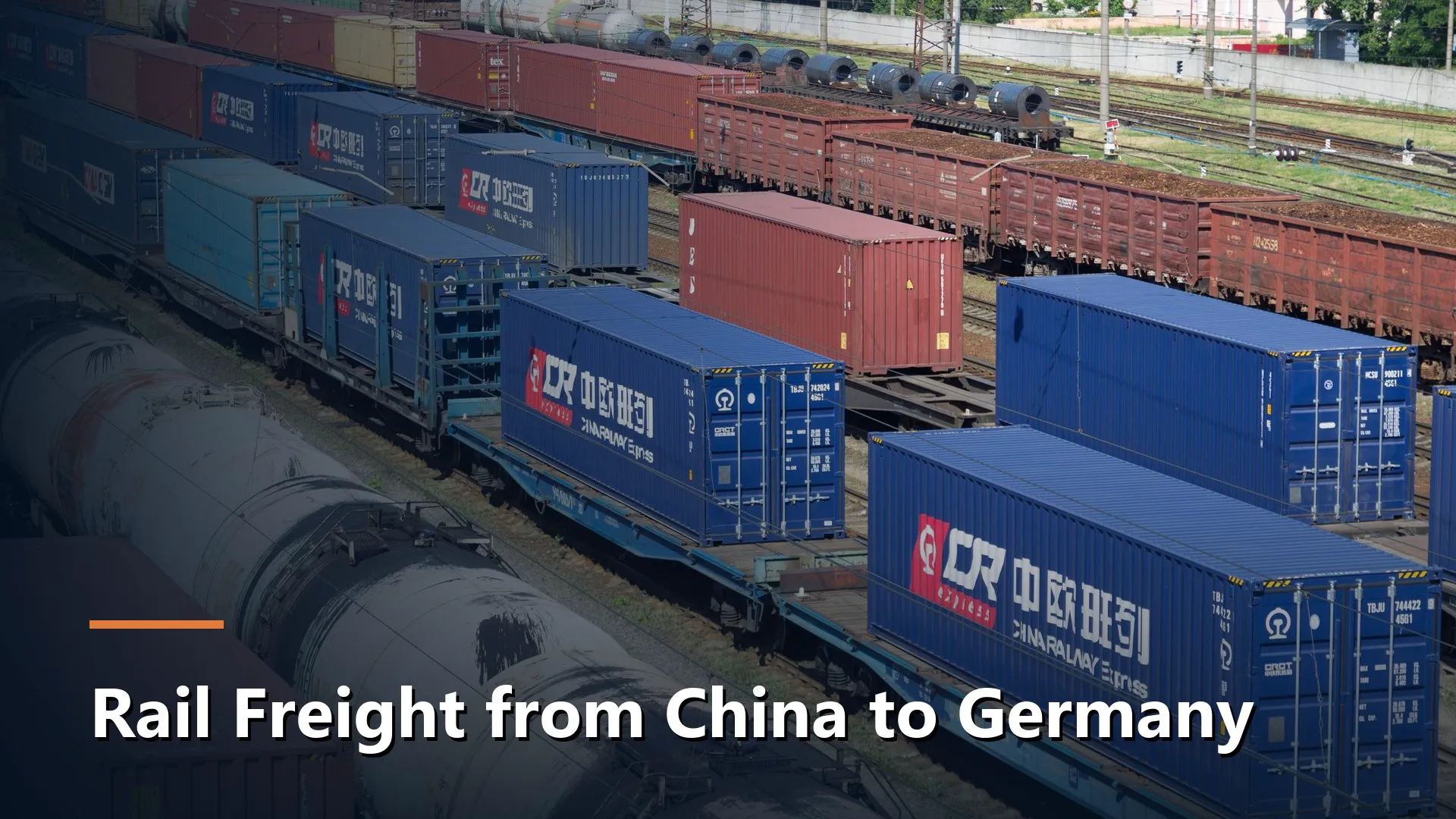
Three prices hide behind one rail quote
A 40ft to Duisburg quotes at $4,600 and at $10,400 in the same quarter, and neither is a mistake. They are different products: a November 2026 forwarder rate to a German terminal on a named public train, against the October 2026 market average for carrier-owned equipment, station to station, from Index1520 and ERAI issue 42.
Product | What the figure covers | Source and month | 40ft |
|---|---|---|---|
Public block train to the EU border | Xi'an to Malaszewicze, no EU leg, no delivery | Route table cited in dantful, August 2026 | $7,400–8,200 |
Forwarder FAK to a German terminal | Through rate, carrier-owned box, origin handling | Sino Shipping rate table, November 2026 | $7,470–9,130 |
DDP all-in to a German address | Duty, import VAT and delivery, forwarder as importer of record | Great Hensen, Q2 2026 | $6,800–8,500 |
Market average, carrier-owned equipment | Station to station, no inland leg | Index1520 / ERAI issue 42, October 2026 | ~$10,400 |
Undated 2026 reference rate | Basis not published | CSL, 2026 | $4,500–6,200 |
Container leasing ran at $1,500–1,700 per box in September 2026, per dantful, because box owners favoured US-bound flows. And ERAI West, $4,084 per FEU on 19 October 2026, covers only Dostyk to Brest, about 39% of the $10,400 average, so inland legs and equipment make up the rest. Ask which train, which terminal, whose container, and whether the EU leg sits inside the number; what it costs to ship from China to Germany splits the same layers for sea and air.
Leg one: the factory floor to the rail terminal
The first fifty kilometres do not change: a truck collects, cargo is consolidated at a rail terminal, and the export declaration is filed in China before the lift. What changes is the booking unit. You are buying space on a named train with a fixed cut-off, so a late carton misses the departure instead of rolling to the next vessel.
Origin | Departures per week | German terminals served |
|---|---|---|
Xi'an | 4 timetabled westbound, 3 eastbound | Duisburg; about 30% of national volume |
Chongqing | 4–6 | Duisburg, Hamburg |
Chengdu | 6–7 | Nuremberg, Duisburg, Hamburg |
Zhengzhou | 3–4 | Hamburg, Duisburg, Munich |
Yiwu | 4–5 commercial, 1 per fortnight timetabled | Duisburg |
Wuhan | 2–3 | Duisburg, Hamburg |
Those are July 2026 counts. Duisburg receives trains several times a day and Hamburg roughly 8–10 a week, behind 96 scheduled routes at 120 km/h linking 132 Chinese cities, with 22 fixed-timetable services joining 9 Chinese cities to 6 European ones. What we book here is rail freight services from China, working back from the train's gate time to the factory collection.
Leg two: where the China-Europe Railway Express changes gauge
China runs on 1,520 mm broad gauge and the EU on 1,435 mm standard gauge, so every container is lifted at least once at the frontier, and that lift rather than the 9,900 km behind it decides the date. The October 2026 snapshot put more than 4,100 containers awaiting transshipment at Dostyk and about 3,400 at Altynkol.
Crossing | Pair | Transshipment time |
|---|---|---|
Alashankou | Dostyk | 5–7 days, the steadiest of the four |
Khorgos | Altynkol | 7–10 days |
Manzhouli | Zabaykalsk | 7–14 days |
Erenhot | Zamyn-Üüd | about 15 days |
Alashankou handled an average of 25 trains a day in October 2026, with a record of 36, across 130 routes, which is why it holds its times better than Khorgos. A decision in Shenzhen on a Tuesday carries a two-week consequence, and the gap between a 5-day and a 15-day lift is wider than between two German terminals.
Leg three: transit through Russia, the sanctions file and what you have to prove
The transit through Russia and Belarus is legal for Chinese cargo, but the insurance exclusion is what decides whether your box moves. The European Commission's FAQ on the transit of listed goods via Russia sets the test: goods may cross Russia if they do not originate in Russia and were not exported from Russia, and the operator must show the journey began and ended outside Russia, that nothing was sold, processed or changed owner in transit, and that the goods are clearly identified.
The 21st package, adopted on 23 July 2026 as Regulation (EU) 2026/1848, exempted transactions necessary for rail transport between Russia and the Union. The compliance risk moved onto the operator, and the tracks did not close.
Insurance is where importers get caught. PZU Group condition C200/2025, effective 1 November 2025, excludes cargo that departs from, is destined for, sits in, or transits Belarus, Russia or Ukraine, even under a worldwide contract. Get the routing named in the policy schedule before the box leaves.
Volume shows what the market has decided. EU–China rail trade fell from €32.4bn in 2021, or 4.7% of bilateral trade, to €17bn in 2025, or 2.2%, on IARI's November 2026 reading of Eurostat data, yet rail still carries about 15% of EU vehicle exports to China. The Middle Corridor absorbed part of that shift, with container transit up 64% in January to September 2026, but Hellmann puts it at about 35 days, 13–17 more than a northern train.
Leg four: Malaszewicze, the border crossing and a €120m customs debt
Malaszewicze, paired with Brest, is where 85–90% of China–Europe rail freight enters the EU. Terminal capacity is 16 train pairs a day, of which about 10 are used. Capacity is no longer the constraint that matters.
KAS, the Polish customs service, working with OLAF, found tariff-code fraud on imports cleared between 2021 and 2026, including e-bikes declared as sports bikes. Where importers were insolvent the claims were redirected, joint and several, to the forwarders, rail operators, customs agents and storage operators that had touched the entries. The debt is reported at about €120m, with 54 cases from 2021–2022 covering 54 containers of e-bikes. Poland's regulator, UTK, warned on 30 October 2026 that joint liability could push operators into insolvency, and CLECAT, FIATA, CER and UIRR have asked DG TAXUD to clarify liability. That leaves one booking question: who will be your declarant, and on what terms.
Three channels share that frontier and only one of them carries your box. The rail crossing was working in the final week of October, tight on space and dwell. The road crossings at Połowce and Sławatycze have been suspended for freight since mid-September 2026, and Terespol–Brest trucks waited 12h57m to enter Poland on 13 November, which kills road diversion without touching the train. The closure everyone remembers ran from 12 to 24 September 2025, and the pattern since has been volatility, so assume the status quoted in November is not the one you get in February.
Leg five: Duisburg and the rail terminal where the trains arrive
Duisburg is the rail terminal most China trains reach first. It handles about 30% of China–Europe rail freight volume, a figure the city's China affairs commissioner gave to Xinhua on 22 October 2026, and rail time from Malaszewicze is 1–2 days, or 2–3 to Munich, Mannheim or Milan.
The customs mechanic decides how that last leg runs. Either the box travels under T1 transit from Malaszewicze and clears at an inland office near the terminal, or it clears at the border and moves as a Union good. The first keeps working capital moving and needs a guarantee; the second ties up duty and VAT earlier. Either way the EU importer holds the EORI, the carrier files the ICS2 entry summary (mandatory for rail operators since 1 September 2025), and the importer of record is whoever is named on the declaration.
What the train costs, leg by leg
A rail shipment into Germany carries six invoices before it reaches your door.
Leg | Who bills you | What stops it |
|---|---|---|
Factory to rail terminal | Haulier, or the terminal if you consolidate | Cut-off time, export documents |
Chinese rail and export declaration | Rail operator through the forwarder | Space on the named train |
EAEU transit, Dostyk or Altynkol to Brest | Through rate, indexed by ERAI West | Gauge-change queue |
Malaszewicze handling | Polish terminal operator | Dwell and storage after free time |
EU rail leg to the German terminal | EU rail operator | Path allocation |
Terminal handling and delivery | Terminal and haulier | Trucking slots, customs release |
Mode | Lane and basis | Freight cost | Month and source |
|---|---|---|---|
Rail, 40ft | China to Germany, station to station | $7,470–9,130 | Sino Shipping, November 2026 |
Rail, 40ft | Market average, carrier-owned box | ~$10,400 | Index1520, October 2026 |
Sea, 40ft | Shanghai–Rotterdam, index | $3,522 | Drewry WCI, 15 October 2026 |
Air | China to North Europe, per kg | $4.35–4.80 | Freightos, 28 October 2026; TAC, September 2026 |
The rail premium over sea is $4,778 at $8,300 against $3,522, or 2.36×, for roughly 18 days saved, about $265 a day before duty. Per unit of cargo it looks milder: at 60 CBM of usable space, $7,470–9,130 is $125–152 per CBM, and at the $10,400 average $173.
Transit time in 2026, measured instead of quoted
A quoted day range is a sales document. A measured distribution is what you plan against. The CDRD set published on 24 October 2026 covers 1,079 trains, and two lanes in it matter for Germany.
Lane | Trains measured | Average | Fastest | 90% within |
|---|---|---|---|---|
Chengdu to Malaszewicze | 114 | 17.4 days | 13 days | 22 days |
Chengdu to Duisburg | 90 | 22.4 days | 17 days | 27 days |
The fast end of this market has a published timetable behind it: train X8151 runs Xi'an to Duisburg over 9,908 km four times a week, Tuesday, Wednesday, Friday and Saturday, at 11–12 days station to station. A standard block train on the same corridor quotes at 16–25 days because it waits for the gauge change, which explains why one page says 12 days and the next says 25 for the same 9,900 km. Add 3–6 days for collection, clearance and delivery, and the door figure lands where how long shipping from China to Germany takes puts the rest of the lane.
LCL by rail, and the cubic metre where a 40ft wins
Rail LCL prices per cubic metre, on a W/M basis where one cubic metre or 1,000 kg counts, whichever is greater.
Source | Rate per CBM | Month | Note |
|---|---|---|---|
CSL | $130–160 | 2026 | Xi'an or Yiwu to Duisburg, W/M rule |
dantful | $140–220 | October 2026 | Station to door |
Jieyi Logistics | $170–220 | November 2026 | Germany destination |
At $8,300 for a 40ft against LCL at $180–220 per CBM, break-even sits between 38 and 46 CBM; at the $10,400 average it moves out to 47–58 CBM. The per-kilo DDP products work to a different arithmetic: at $2.56 per chargeable kg and 167 kg to the cubic metre the effective cost is about $427 per CBM, 2.5 to 3 times the per-CBM cost of a 40ft, so those lines fit sub-pallet volumes, not a 20 CBM order.
Import VAT, EORI and the German compliance stack a rail container still has to clear
Import VAT at 19%, the duty rate, the EORI holder and the €2 EU handling fee that started on 1 November 2026 on distance sales are all settled at the border rather than on the train. Duty runs 0–17% by HS code and VAT is charged on the CIF value plus duty, 7% for books and food. On a €40,000 consignment in a 5% duty band that is €2,000 of duty and €7,980 of VAT. A registered importer recovers the VAT and does not recover the duty.
Two EU measures this year hit distance sales, not containers. The €3 flat duty per item from 1 July 2026 comes from Council Regulation (EU) 2026/382 as implemented by Delegated Regulation (EU) 2026/1022, replacing the abolished €150 exemption until 1 July 2028. The €2 Union handling fee from 1 November 2026 comes from Delegated Regulation (EU) 2026/2152, charged per distinct item on goods sold in distance sales into the EU. A B2B container import to a German business is not a distance sale, so it pays neither; a DDP rail line selling to consumers pays both.
GPSR has required an EU responsible person for consumer products since 13 December 2024, LUCID registration under VerpackG is needed before packaged goods ship, and the EU ETS phase-in finished at 100% on 1 January 2026, with traction electricity priced through the same scheme.
Cargo that belongs on a train, and cargo that never does
Rail sits between sea and air on cost and time, so value density decides whether that position helps you.
At 60 CBM and 20,000 kg, sea at $3,522 a 40ft costs about $59 per CBM and $0.18 per kg. Rail at $8,300 is $138 and $0.42. Air at $4.35 per kg is about $726 per CBM, so it belongs under 200 kg or on a stock-out. For cargo worth $30 per kg with a $4 air premium, air wins any restock; at $3 per kg, rail is your top option and sea carries it.
Which lithium battery cargo can move by rail freight into Europe?
RID 2025 acceptance covers Class 9 broadly, including UN 3480 and UN 3481 lithium-ion cells and batteries plus UN 3551 and UN 3552 sodium-ion, while Class 1 explosives and Class 7 radioactive material are restricted or need prior agreement.
Construction material, bulk plastics and low-grade steel pay for speed they do not need. Project cargo and out-of-gauge pieces do not fit the loading gauge. The train suits consumer electronics, machinery, auto parts and marketplace inventory in the €8–30 per kg band.
What a rail quote excludes
Nine lines sit outside the headline rate on most quotations.
Origin rail terminal charges, including loading and any CFS handling
The rail security surcharge, which no operator publishes as a tariff
Border dwell and storage once free time at the gauge change ends
EU terminal handling at Duisburg, Hamburg, Munich or Mannheim
Inland delivery from the terminal to your address
Cargo insurance for a routing that transits Russia or Belarus
Import duty and 19% VAT, unless the quote is explicitly DDP
Storage and demurrage at destination after free time
Re-consignment if you change the delivery address after departure
Rail freight from China to Germany: questions importers ask
How long does rail freight from China to Germany take door to door, and why do forwarders quote 12 days and 25 days for the same lane?
Twelve days is the timetable product: Xi'an to Duisburg on X8151. Twenty-five days is a standard block train waiting for the gauge change, plus collection and delivery. The measured middle is 22.4 days, 90% within 27, so plan on 20–30 days door to door.
Is the Malaszewicze border open right now, and what happens to my container if Poland closes it again?
It was working in the last week of October 2026, tight on space and dwell, and the documented closure before that ran from 12 to 24 September 2025. Ask for today's reading rather than the one in the brochure; if it closes, boxes wait at Brest or reroute through the Middle Corridor, which adds 13–17 days.
Why is one forwarder quoting $4,600 per 40ft to Duisburg and another $10,400 for the same container?
They are not the same container. The $4,600 is a November 2026 public-train rate to a German terminal; the $10,400 is the October 2026 market average for carrier-owned equipment, with leasing alone adding $1,500–1,700 per box.
Is it legal to ship Chinese goods to Germany by rail through Russia and Belarus, and what do I have to prove?
Yes, on the Commission's reading: transit is not prohibited where the goods do not originate in and were not exported from Russia. You have to prove the journey began and ended outside Russia, that nothing was sold or processed in transit, and that the goods are clearly identified. Regulation (EU) 2026/1848, in force 24 July 2026, kept the corridor usable.
Does my cargo insurance actually cover a rail shipment that transits Russia and Belarus?
Not automatically. PZU Group condition C200/2025, effective 1 November 2025, excludes cargo transiting Belarus, Russia or Ukraine even under a worldwide contract unless agreed in writing. Get the routing named in the policy schedule before the box leaves China.
Can I ship LCL by rail to Germany, and at how many cubic metres does a 40ft container become cheaper?
Yes. LCL runs at $130–220 per CBM depending on the source and month. At $180–220 per CBM and an $8,300 container the crossover sits between 38 and 46 CBM, and at the $10,400 average between 47 and 58 CBM.
Can I send lithium batteries or other dangerous goods to Germany by rail, and what changes in winter?
Class 9 is broadly accepted under RID 2025, including UN 3480 and UN 3481 lithium-ion and UN 3551 and UN 3552 sodium-ion, while Class 1 and Class 7 need prior agreement. The list itself is not seasonal; the buffer you need is, because the gauge-change queue sets the date.
Who acts as importer of record for a rail shipment into Germany, and what does German customs require?
The EU importer of record holds the EORI and is named on the declaration; a non-EU company can hold an EORI and clear in its own name, and a forwarder can clear as indirect representative. The carrier files the ICS2 entry summary, duty runs 0–17% and VAT is 19% on CIF plus duty.
Ship with a plan instead of a day range
The gauge change and the Polish border are outside your control. What you book is not, and it decides which risk lands on you. Send three things: the lane, meaning the Chinese origin city and the German delivery postcode or terminal; the cargo, meaning HS code, gross weight, cubic metres and invoice value; and the target arrival date at the door, not the departure date. With those three, AllBestShipping returns a routing plan naming the train, the German terminal, the customs route (T1 to an inland office or clearance at the border), the border status on the day it is issued, and the four priced legs as separate lines, so the number you compare is the number you are invoiced.