Air Shipping from China to Nigeria: The Permit Sets the Flight Date, Not the Rate
Air shipping from China to Nigeria flies inside the lane that made China Nigeria's biggest trade partner in West Africa, and the airline bill is the smallest reason a Lagos consignment costs what it does. Nigeria took $13 billion of goods from China in 2025, 36.7% more than the previous year and 27.8% of a $46.7 billion import bill, and in November 2026 that cargo pays $10–13 a kilo at 1,000 kg, $12–16 at 300 kg and $17–23 at 100 kg, airport to airport into Lagos.
The rest of the bill is the permit that must be activated before the aircraft may unload, the naira-per-kilo charges at the shed, and duty and VAT assessed on a value that already contains the air freight. We book this lane weekly, and the figures here are what we quote against, starting with shipping from China to Nigeria as a whole. The single window has logged 3,596 electronic air cargo manifests from 27 airlines since 27 March 2026, so if your product is regulated, read that section before the price.
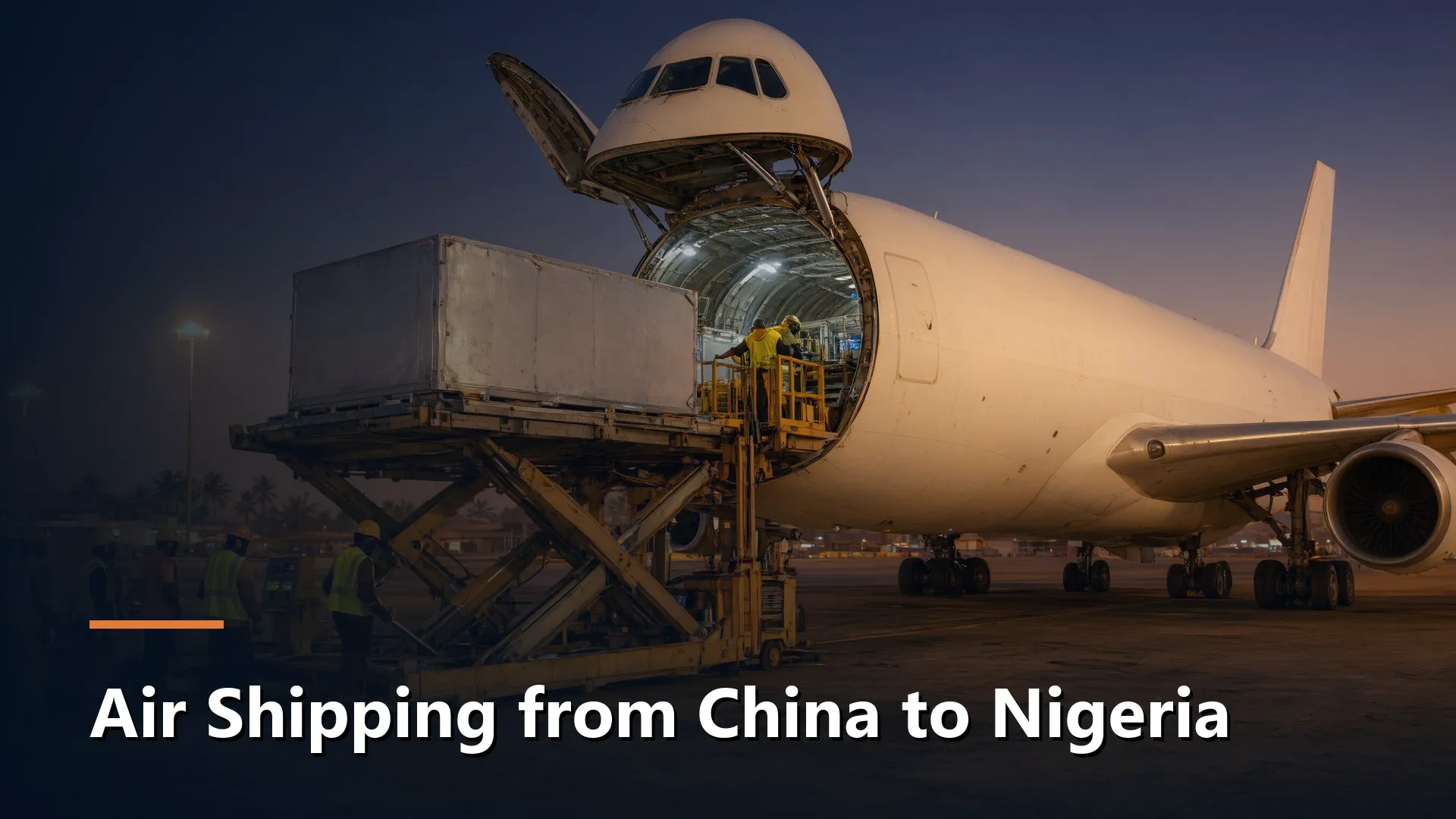
What a kilo of air freight to Lagos actually buys
The shipping cost from China to Nigeria per kg out of Guangzhou runs from $17.60 at 100 kg to $10.30 at the tonne, and the airline bill is the only part of it anyone quotes. All rates are airport to airport, freight and origin charges.
| Source (month) | 100 kg | 300 kg | 1,000 kg |
|---|---|---|---|
| Guangzhou CAN to Lagos LOS (September 2026, republished 16 November) | $17.60–22.80/kg | $12.27–15.93/kg | $10.30–13.30/kg |
| Shenzhen SZX to Lagos LOS (September 2026) | $17.20–22.40/kg | $12.00–15.67/kg | $10.10–13.00/kg |
| Guangzhou consolidator (November 2026) | — | — | $8.20/kg |
| General air, reviewed rate (15 November 2026) | $11.50/kg | $11.50/kg | $11.50/kg |
| Guangzhou normal air (from 2 November 2026) | $10.60 + ₦1,500/kg | $10.60 + ₦1,500/kg | $10.60 + ₦1,500/kg |
Three different products sit on that table, which is why the columns do not line up. The $8.20 is a thousand-kilo freight-only rate with no breaks. The $11.50 is a flat card with no airport charges. The $10.60 is how Chinese–Nigerian consolidators invoice: dollars for the flight, naira for the clearing, with ₦1,500 a kilo about $1.13 at ₦1,330 to the dollar, so nearer $11.73 all in.
The freight itself buys space on a connecting flight. There is no scheduled nonstop China–Nigeria cargo service: every consignment changes aircraft once, through Istanbul, Dubai, Addis Ababa or Doha, and the only historical nonstop stopped flying in late 2023. That one transfer is why 5 to 8 days counts as transit rather than flight time, and why a booking with air freight from China is a dated slot on someone else's aircraft.
Weight breaks, explained as money: why 260 kg bills at the 100 kg rate
Every airline prices capacity on a 45/100/300/500/1,000 kg ladder, so shipping from Shenzhen to Nigeria at 100 kg and at 1,000 kg are two products wearing the same name. The band rate applies to the whole consignment, which beats any negotiation on the rate.
| Chargeable weight | Band billed | Rate per kg | What you pay |
|---|---|---|---|
| 260 kg, billed honestly | 100 kg | $17.60–22.80 | $4,576–5,928 |
| 260 kg, declared up to the next break | 300 kg | $12.27–15.93 | $3,681–4,779 |
Declaring 300 kg for a 260 kg consignment costs $895 less at the low end than paying the 100 kg rate for the weight you have. You buy 40 kilos of air you will never use, and they are the cheapest 40 on the invoice.
Chargeable weight is whichever is larger: what the carton weighs, or length × width × height in centimeters divided by 6,000, which is the same as cubic meters × 167. A 120 × 100 × 100 cm carton is 1.2 CBM, or 200 chargeable kilos whether it weighs 90 or 190. Two flights of 130 kg bill the 100 kg rate twice, so "send it in two lots" is about a thousand dollars of safety.
Since 27 March 2026 the papers are the schedule: NSW, SONCAP, B'Odogwu
Customs clearance from China to Nigeria changed shape on 27 March 2026, when the National Single Window went live and SONCAP stopped being a certificate you could carry to the airport. SONCAP applications and SON Import Permits are now processed only on nsw.gov.ng, and a certificate issued on the old SON portal has to be activated on the single window before it will support a Form M, a PAAR or cargo release, per the Standards Organisation's own notice on Mandatory Migration of SONCAP and Import Permit Processes to the National Single Window. A valid-looking PDF that has not been activated is, at the shed, a piece of paper.
The declaration platform is B'Odogwu, the Unified Customs Management System; NICIS II, the name in older guides, is what it replaced. Customs' May 2026 standards commit to half a working day for PAAR and assessment, and AEO, which replaced Fast Track on 1 February 2026, averages around 43 hours.
The sequence that costs money is the one no rate card prints. Form M is opened by the importer's own bank before shipment. PAAR is generated against that Form M, the invoice and the air waybill, so it usually arrives after the cargo manifests and often after it has flown. Neither can be backdated: the aircraft lands Wednesday, the PAAR issues Friday, and Thursday's storage is yours. Our China export and Nigeria import clearance desk files the Chinese export declaration against the same file, which is the only way both ends stay on one timetable.
The shed at MMIA: ₦15 a kg, two to five days, and a queue behind the permit
Shipping from China to Lagos ends at a shed with a ₦15-a-kilo port charge, a handling tariff nobody publishes and a storage clock that starts at discharge rather than at collection.
| What the invoice has that the quote did not | Who bills it | Charged on | Size on 300 kg |
|---|---|---|---|
| FAAN cargo port charge | Airport authority, at the shed | Chargeable weight | ₦4,500 (≈$3.38) |
| Handling agent's terminal tariff | The ground handler | Chargeable weight, in and out | Set by the handler, unpublished |
| Storage | Terminal, from day of discharge | Chargeable weight per day | Depends on the PAAR |
| Clearing agent's fee | Broker or forwarder's Lagos desk | Often a naira-per-kilo line | ₦1,500/kg (≈$338) |
| Truck to your warehouse | Haulier | Per trip, not per kilo | Lagos metro, or 700 km |
The Federal Airports Authority of Nigeria settled its cargo port charge at ₦15.00 a kilo in February 2026, up from ₦7.00. On 300 kg that is ₦4,500, about $3.38, which is not the problem. The handling tariff is the problem: NAHCO and SAHCO set their own per-kilo rates, publish no schedule, and charge in and out, so a 200-kilo carton pays twice.
Storage is where the bill grows: free time at the shed is short, and the rate climbs by the day. The clock starts at discharge, which is why a PAAR applied for on landing is expensive: the goods pay rent while a document that cannot be backdated is generated. Clearance is 2 to 5 working days once permits are ready, while national cargo dwell across all modes averages 18 to 21 days.
Why November 2026 is a peak month: fuel, Gulf capacity and a 34% jump
November 2026 is expensive for reasons that have nothing to do with Nigerian demand. Demand on the Africa–Asia lane fell 11.9% year on year in August 2026, the third straight decline, while African carrier capacity grew 14% at a load factor of only 36.5%. Capacity is looser than it was, and the price went up anyway: this lane gets priced on fuel and on the Gulf hubs it passes through.
| Driver | Value | In force | Effect on 300 kg |
|---|---|---|---|
| Qatar Airways Cargo fuel surcharge | $0.54 per chargeable kg | From 19 October 2026 | +$162 |
| China–Africa fuel surcharge range | $0.40–0.90 per kg | Republished monthly | +$120 to +$270 |
| Worldwide air cargo rates | +25% year on year | September 2026 | Market-wide |
| Rates ex-Africa / ex-Middle East and South Asia | +27% / +52% year on year | September 2026 | The hubs are the pinch |
| Jet fuel | +79.2% year on year (IATA, August); +108% (TAC, 2 October) | August–October 2026 | The root cause |
A $0.54 surcharge on 300 chargeable kilos is $162; on a 2,000 kg consolidation it is $1,080, and Gulf hub capacity is still about 17% below late-February 2026 levels. One forwarder's own rate cards show the move: $6.10 a kilo in October against $8.20 in November, up 34% — one company's card, not an index.
Our own August 2026 Nigeria cost guide quotes air at $6.00–9.50 a kilo, 3 to 7 days; read that band as August and this article's $10–13 at the tonne, $17–23 at 100 kg as November, after the fourth-quarter surcharges landed.
Abuja and Kano: the $1.20–$1.40 premium and when it is worth paying
How long to ship from China to Nigeria depends on which airport the aircraft lands at, and the northern gateways charge $1.20 to $1.40 a kilo more at the 100 kg break to skip a road leg. Abuja is a direct cargo gateway in its own right, not a truck stop at the end of a Lagos clearance.
| Gateway pair | 100 kg | 300 kg | 1,000 kg | Transit | Premium over Lagos |
|---|---|---|---|---|---|
| Guangzhou CAN to Lagos LOS | $17.60–22.80 | $12.27–15.93 | $10.30–13.30 | 5–8 days | — |
| Shanghai PVG to Abuja ABV | $18.80–24.20 | $13.07–16.93 | $10.90–14.10 | 5–8 days | +$1.20–1.40 / +$0.80–1.00 / +$0.60–0.80 |
| Guangzhou CAN to Kano KAN | $18.20–23.60 | $12.67–16.47 | $10.60–13.70 | 5–9 days | +$0.60–0.80 / +$0.40–0.54 / +$0.30–0.40 |
On 300 kg the gap is $240 to $300 — less than a truck plus a second clearance agent, and less than the three to five days cargo trucked from Lagos to Kano takes. Above roughly 300 kg, northern cargo should fly to the northern gateway. Below 100 kg that reverses, because the fixed costs at either end swamp the freight difference.
The only inland number published on this lane is a forwarder's "other states" DDP rate of $16.58 a kilo against $14.88 into Lagos on a January 2026 basis. Kano has the thinnest capacity of the three, at 5 to 9 days.
Air or sea: the crossover, done with cubic metres instead of opinions
The cheapest way to ship from China to Nigeria stops being the ocean once the goods are worth more than the freight, and the honest way to see it is to price both in kilos.
| Mode | Rate | Per kg | Transit |
|---|---|---|---|
| LCL shipping from China to Nigeria | $230 per CBM (November 2026) | $1.38 | 36–42 days |
| Air, 1,000 kg | $8.20 per kg (November 2026) | $8.20 | 5–8 days |
| Air, 100 kg | $17.60–22.80 per kg (September 2026) | $17.60–22.80 | 5–8 days |
At $8.20 a kilo air is $1,369 per cubic metre, six times the sea rate; at $11.50 it is $1,920, eight times.
Take 300 kg by air at $12 a kilo: $3,600, landing in about a week. The same goods in 6 CBM by LCL cost $1,380 and land in five to six weeks. Air costs $2,220 more and buys about 35 days; at a 20% annual cost of capital that is repaid only once the consignment is worth about $116,000.
The test is what a month of waiting costs you in money you can name. Our sea freight from China to Nigeria page carries the ocean rates this section prices against, including the August–September 2026 bands.
What 7.5% VAT is charged on — and why the air bill changes it
The shipping cost from China to Nigeria is assessed on a customs value that already contains the air freight, which is the line two competing quotes never show you. Duty is charged on CIF (goods, insurance and freight), so every dollar the airline collects reaches the customs desk again, marked up by the duty rate, surcharged at 7%, then taxed at 7.5%.
| Line | Basis | 300 kg by air, goods $8,000 | Same goods by sea |
|---|---|---|---|
| Freight | Per kg or per CBM | $3,600 (300 kg at $12) | $1,380 (6 CBM at $230) |
| CIF value | Goods + insurance + freight | $11,640 | $9,420 |
| Import duty | 5–35% of CIF; 20% used here | $2,328 | $1,884 |
| Surcharge | 7% of duty | $162.96 | $131.88 |
| VAT | 7.5% of CIF + duty + surcharge | $1,060 | $858 |
| Total tax | $3,551 | $2,874 | |
| Share of goods value | 44.4% | 35.9% |
The air-versus-sea decision is not a $2,220 decision but a $2,897 one, because air's freight drags $677 of extra duty and VAT behind it. The 20% is an assumption: the range is 5% to 35% by HS line, and the only rate that applies is the one on your own row — the duty, surcharge, VAT and levy columns sit on the Nigerian Trade Information Portal's commodity and tariff page, keyed to a 12-digit code.
The CISS levy is missing from that arithmetic on purpose. It is charged on CIF, but the rate is quoted differently in two places on the same portal, so read the column on your own row instead of trusting a broker's percentage. A good forwarder supplies a landed-cost sheet keyed to your HS code and actual freight, which is what the full China–Nigeria shipping cost breakdown does line by line.
DDP by air to Nigeria: who is the importer of record
DDP by air quotes at $9 to $16 a kilo across this market, with Lagos door delivery at $14.88 and other states at $16.58 on a January 2026 basis. Under DDP the forwarder, or its Nigerian company, is the importer of record.
The importer of record owns the declaration and every consequence of it: the Form M is in their name, the PAAR against their filing, the duty on the value they declared — and when customs decides that value is low, which happens routinely to electronics and branded goods, the difference is a new bill addressed to them. The question worth asking is what happens on revaluation, not which DDP quote looks cheaper. Put three things in writing: the declared value basis, who pays a revaluation difference, and who pays storage from a late PAAR.
Batteries, power banks and the goods air cannot carry
Lithium batteries fly, at a premium that reflects handling rather than distance. General air at $11.50 a kilo with 7 to 12 days is the comparator; battery cargo quotes at $13.50 a kilo with 14 to 20 days, and a second published card puts it at $15.50 plus the ₦1,500 clearing line, with 15 to 25 working days.
Acceptance depends on chemistry, watt-hour ratings, packing and each carrier's own variations. Declare it as what it is — an undeclared power bank found at screening takes the whole consignment off the flight.
Food, drugs, cosmetics and medical devices need NAFDAC registration, and that runs in months, not days. Without it, the fastest aircraft in the schedule lands your cargo in a bonded shed to wait for a document the flight had nothing to do with.
Seven checks before you book a November allocation
- Chargeable weight before you ask for a price. Measure the cartons, divide by 6,000 and use the larger number.
- The band you bill at. Know whether you are at 260 kg or 300 kg, and price the next break up. That is worth $895.
- SONCAP or an Import Permit, activated on the single window. Not issued — activated. An unactivated certificate supports nothing.
- Who holds the Form M. Under DDP it is the forwarder's Nigerian entity, and that decides who receives a revaluation bill.
- Which airport the rate is for. Lagos, Abuja and Kano are three different prices.
- Space, booked early. Lagos and Abuja carry less capacity than the European lanes; a normal week needs five to seven days of notice.
- The naira side, itemized. FAAN's ₦15 a kilo, the handling tariff, storage, the delivery order and the broker — then check the April 2026 prohibition list against your HS code.
Frequently asked questions about air cargo to Lagos and Abuja
Do I need Form M before the cargo flies, and where does PAAR fit?
Form M is opened by the importer's own bank before shipment. PAAR is generated against the Form M, the invoice and the air waybill, so it usually arrives after the cargo manifests and cannot be backdated.
My product is NAFDAC-regulated — can air freight still work?
Only if the registration already exists. Registration runs in months, not days, and an unregistered shipment cannot be released however fast it flew.
Can I ship lithium batteries or power banks by air to Lagos?
Yes, as regulated dangerous goods: about $13.50 a kilo and 14 to 20 days against $11.50 and 7 to 12 days for general cargo.
How many days from landing at MMIA to collecting the cargo?
Clearance is typically 2 to 5 working days with documents ready, closer to two for trusted traders, plus storage from the day of discharge.
Is the 7.5% VAT charged on the freight as well as the goods?
Yes. VAT is assessed on CIF, so a $3,600 air bill on $8,000 of goods raises the duty base by the same amount and the VAT on top.
What is the shipping cost from China to Nigeria (door-to-door) by air under DDP?
Published DDP air rates run from about $9 to $16 a kilo, with Lagos at $14.88 and other states at $16.58 on a January 2026 basis.
What is the fastest shipping from China to Nigeria, and is there a direct flight?
No scheduled nonstop cargo service exists; every consignment connects once through Istanbul, Dubai, Addis Ababa or Doha, which is why transit reads 5 to 8 days.
Is there Amazon FBA shipping from China to Nigeria?
No, because there is no Amazon marketplace in Nigeria. Jumia, Konga and own-store sellers need door-to-door DDP to a named address instead.
Book the flight after the permit, not before
The sequence that decides what an air shipment to Nigeria costs is not the sequence most importers follow. The expensive part is the order of operations — certificate activated on the single window, Form M opened at the bank, PAAR applied for against an air waybill that exists, cargo released before storage compounds.
Book the flight last, because everything upstream of it runs on a clock. Send a quote with the airport pair, the chargeable weight and the HS code, and we will tell you which of the five naira lines are missing. AllBestShipping runs this lane out of Shenzhen and Guangzhou every week, and our air desk will price the break above yours as well.