Shipping from Shenzhen to Australia: The Complete Guide (2026)
Shipping from Shenzhen to Australia is the lifeline for thousands of Australian businesses, from e-commerce startups to established retailers. As Shenzhen continues to solidify its reputation as the "Silicon Valley of Hardware" and a global manufacturing powerhouse, the trade lane connecting this southern Chinese metropolis to Australian ports has become one of the busiest and most critical in the Asia-Pacific region.
In our decade of experience managing logistics on this route, we've seen everything from smooth sailings to last-minute customs hurdles. We know that for you, it's not just about moving boxes—it's about keeping your supply chain predictable and profitable.
But let’s face it: international logistics can be a minefield. Whether you are grappling with the complexities of the China-Australia Free Trade Agreement (ChAFTA), trying to calculate the landed cost including GST and duties, or worrying about strict biosecurity regulations like the BMSB measures, there is a lot to manage.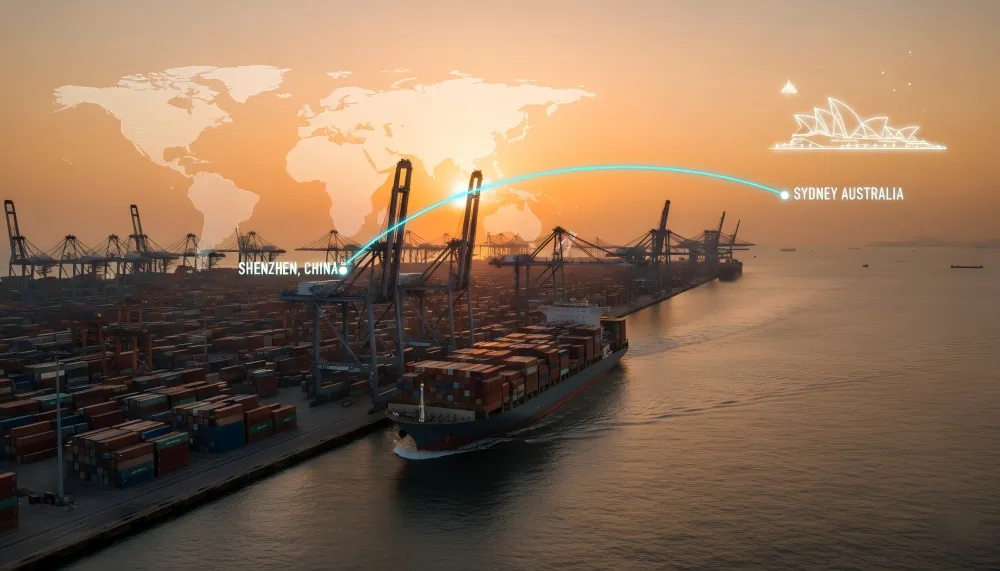
This comprehensive guide is designed to cut through the noise. We will walk you through every aspect of shipping from Shenzhen to Australia in 2026—covering the best shipping methods, transit times, cost structures, and the essential documentation you need to clear Australian customs smoothly. By the end of this article, you will have the actionable knowledge to optimize your supply chain and reduce your shipping costs.
1. Best Shipping Methods from Shenzhen to Australia
Choosing the right shipping method is the first and most important decision you will make. It balances three key factors: cost, speed, and volume. Since Shenzhen is a coastal city with world-class port infrastructure (like Yantian and Shekou) and a major international airport (SZX), you have a full spectrum of options available.
1.1 Sea Freight (Ocean Freight)
For most importers, Sea Freight from China to Australia is the default choice. It is the most cost-effective method for transporting large volumes of goods where time is not the primary constraint. Australian ports—Sydney, Melbourne, Brisbane, Fremantle, and Adelaide—are well-connected to Shenzhen, with multiple weekly sailings.
Understanding Shenzhen's Ports
Shenzhen isn't just one port; it's a complex of terminals. Knowing the difference can save you trucking costs:
- Yantian Port (East Shenzhen): The largest container terminal. It mostly serves long-haul routes to Europe and North America but has significant capacity for Australia. It is closer to factories in Longgang and Huizhou.
- Shekou & Chiwan Ports (West Shenzhen): Located in Nanshan district. These are closer to factories in Dongguan and Guangzhou. Many intra-Asia and Australia services call here.
- Da Chan Bay: A newer port in West Shenzhen, often less congested.
FCL (Full Container Load)
FCL is the gold standard for high-volume shipping. If your cargo volume is over 15 cubic meters (CBM), booking a full container is usually cheaper and safer than sharing one.
- 20GP Container: Ideal for heavy goods (minerals, metals, machinery). It holds about 33 CBM but is often weight-limited (up to 28 tons).
- 40GP Container: The standard for general cargo, holding around 67 CBM.
- 40HQ (High Cube): Perfect for voluminous but light goods (furniture, textiles, e-commerce stock), holding up to 76 CBM.
Advantages of FCL:
- Lower Risk: Your goods are sealed in Shenzhen and not opened until they reach your warehouse in Australia, minimizing handling damage.
- Faster Processing: No need to wait for consolidation or deconsolidation at the ports.
- Predictable Scheduling: Major carriers like COSCO, OOCL, Maersk, and MSC have fixed weekly schedules.
LCL (Less than Container Load)
If you are just starting out (read How to Ship from China for basics) or shipping smaller quantities (typically 1 to 15 CBM), our LCL Shipping Guide explains how LCL allows you to share container space with other shippers. Your freight forwarder will collect your goods, consolidate them at a Shenzhen warehouse, and pack them into a container.
Things to Watch Out For:
- Volumetric Weight: LCL is often charged based on the greater of actual weight or volumetric weight. (1 CBM = 1000 KG standard).
- Destination Charges: While the ocean freight might look cheap (sometimes $10/CBM), destination port charges in Australia for LCL can be high (up to $150/CBM) due to deconsolidation fees. *Always ask for a "Door to Door" quote to see the full picture.*
1.2 Air Freight
When speed is of the essence, Air Freight bridges the gap. Shipping from Shenzhen Bao'an International Airport (SZX) to major Australian airports (SYD, MEL, BNE) drastically reduces transit time.
Best For: High-value electronics, seasonal fashion, urgent replenishment stock, or goods weighing between 150kg and 500kg.
Routes:
- Direct: CZ (China Southern) often flies direct or via Guangzhou.
- Transshipment: CA (Air China), HU (Hainan Airlines) might route via Beijing or Haikou for cheaper rates.
The "Chargeable Weight" Rule: Airlines charge based on the higher of actual weight or volumetric weight (Length x Width x Height in cm / 6000).
- Example: A box of pillows might weigh 10kg but take up space equivalent to 30kg. You pay for 30kg.
1.3 Express Shipping (Courier)
For samples, documents, or very small shipments (under 150kg), express couriers like DHL, FedEx, UPS, and TNT offer a seamless Door-to-Door Shipping service.
- Speed: Unbeatable. You can often get goods from a factory in Shenzhen to a doorstep in Sydney in 3-5 days.
- Convenience: Customs Clearance is usually handled by the courier company (for low-value shipments < AUD 1000, no formal entry is needed), making it a "set and forget" option.
- Cost: This is the most expensive method per kilogram, but for small packages, the convenience outweighs the cost.
1.4 DDP Shipping (Door to Door)
DDP (Delivered Duty Paid) has exploded in popularity, especially among businesses using Amazon FBA Shipping and small business owners who don't want to deal with logistics.
In a DDP arrangement, your freight forwarder handles the entire journey:
- Pickup from the Shenzhen supplier.
- Export clearance in China.
- International transport (Sea or Air).
- Import clearance in Australia (including paying GST and Duty).
- Final delivery to your door or Amazon fulfillment center.
Why choose DDP? It gives you a guaranteed landed price upfront. You don't need to worry about unexpected bills from the Australian Border Force or arranging local trucking. However, note that for goods valued over AUD 1000, we still recommend you be the importer of record to reclaim GST if you are a registered business.
2. Shipping Time: How Long Does It Take?
Transit time varies significantly depending on the mode of transport and the specific route. Shenzhen's strategic location in Southern China means it is relatively close to Australia compared to northern ports like Qingdao or Dalian.
Here is a realistic breakdown of transit times for 2026:
| Shipping Mode | Route | Port-to-Port Time | Door-to-Door Estimate |
|---|---|---|---|
| Sea Freight | Shenzhen to Sydney | 12 - 15 days | 20 - 25 days |
| Sea Freight | Shenzhen to Melbourne | 15 - 18 days | 23 - 28 days |
| Sea Freight | Shenzhen to Brisbane | 13 - 16 days | 21 - 26 days |
| Sea Freight | Shenzhen to Fremantle | 20 - 25 days | 30 - 35 days |
| Sea Freight | Shenzhen to Adelaide | 18 - 22 days | 28 - 33 days |
| Air Freight | SZX to SYD/MEL/BNE | 1 - 3 days | 3 - 7 days |
| Express | Shenzhen to Australia | N/A | 3 - 5 days |
Note: "Door-to-Door Estimate" includes time for pickup, export clearance, ocean/air transit, import clearance, and final delivery.
Shipment Lifecycle: A Real-World Timeline
Let's look at a typical Sea Freight (LCL) shipment from Shenzhen to Sydney:
- Day 1: Goods ready. Forwarder arranges pickup.
- Day 2: Goods arrive at Shenzhen warehouse. Measurement and weight check.
- Day 3-4: Export customs declaration and loading into container.
- Day 5: Container gated in at Yantian Port.
- Day 7: Vessel departs Shenzhen.
- Day 19: Vessel arrives at Port Botany (Sydney).
- Day 20-22: Container discharged, moved to deconsolidation warehouse. Import customs clearance processing.
- Day 23: Cargo available for pickup.
- Day 24: Final delivery to your warehouse.
3. Shipping Costs from Shenzhen to Australia (2026 Guide)
Understanding the cost structure is vital for your profitability. Shipping rates are volatile and influenced by global economic factors, fuel prices, and seasonal demand.
Factors Influencing Your Costs
Seasonality:
- Peak Season (Sep - Dec): As retailers stock up for Black Friday and Christmas, space becomes tight, and prices soar.
- Chinese New Year (Jan/Feb): Factories rush to ship before closing, causing a spike in demand. Pro tip: Book your shipments at least 3 weeks in advance during these periods.
Fuel Surcharges (BAF/FSC): Ocean carriers and airlines adjust these monthly based on oil prices.
Exchange Rates: Fluctuations between CNY, USD, and AUD can impact your final invoice.
General Rate Increases (GRI): Carriers may implement across-the-board rate hikes at the beginning of a month.
Cost Calculation Example
Let's compare costs for a shipment of 500kg, 2 CBM of furniture fittings.
Option A: Sea Freight (LCL)
- Ocean Freight:
100 USD - Local Charges (Shenzhen): $150 USD
- Destination Charges (Sydney): $350 USD (Port fees, deconsolidation)
- Trucking: $150 USD
- Total: ~$750 USD (excluding Duty/GST)
- Time: 25 Days
Option B: Air Freight
- Air Rate:
2,250 USD - Local Charges: $100 USD
- Destination Charges: $150 USD
- Trucking: $100 USD
- Total: ~$2,600 USD
- Time: 5 Days
Conclusion: Sea freight is ~70% cheaper but 5x slower.
4. Customs Clearance, Duties, and Taxes in Australia
Australia has some of the strictest border controls in the world. Navigating the Australian Border Force (ABF) and Department of Agriculture, Fisheries and Forestry (DAFF) requirements is critical to avoiding delays and fines.
4.1 Import Duties and GST
Unlike some countries with high de minimis thresholds (like the USA's $800), Australia applies taxes to most commercial imports over AUD 1000.
Import Duty: Generally 0% to 5% of the FOB value, depending on the product's HS Code.
Goods and Services Tax (GST): A flat 10% tax.
- Crucial Formula: GST is calculated on the Value of Taxable Importation (VoTI).
- VoTI = (Customs Value + Duty + International Transport & Cargo Insurance + Wine Tax).
- Note: You are paying tax on the shipping cost too, not just the goods value!
Import Processing Charge (IPC): A fixed fee charged by the government for processing your declaration (roughly
200 AUD depending on the mode and value).
4.2 The ChAFTA Advantage (Zero Tariffs)
The China-Australia Free Trade Agreement (ChAFTA) is a game-changer. It eliminates tariffs on the vast majority of goods imported from China.
- How to Claim: You must provide a valid Certificate of Origin (COO). This can be a specific ChAFTA COO or a Form A. According to the Department of Foreign Affairs and Trade (DFAT), accurate documentation is non-negotiable.
- Action: Ask your supplier in Shenzhen to apply for this document before the goods depart. It can save you that 5% duty, which adds up on large orders.
4.3 Biosecurity: The BMSB Season
If you take away one thing from this section, let it be this: Biosecurity is strictly enforced.
- Timber and Wooden Packaging: Any wood (pallets, crates) must be treated (fumigated) and certified free of bark and pests. You need a Packing Declaration stating whether wood is used.
- Brown Marmorated Stink Bug (BMSB): From September 1st to April 30th, Australia enforces strict measures against this pest. High-risk goods (machinery, vehicles, bricks, etc.) shipped as sea freight must be treated (usually heat treatment or fumigation) before arrival. Failure to comply can result in the entire container being exported back to China at your expense. We recently helped a client avoid a $5,000 re-export fee by identifying their cargo as "target high risk" before it left Shenzhen.
5. Essential Documents for Shipping
Documentation errors are the #1 cause of shipping delays. Ensure you have this "Golden Packet" ready:
Commercial Invoice: Must be in English, listing the seller, buyer, detailed description of goods, HS Codes, Incoterms (e.g., FOB Shenzhen), and the true transaction value. Do not undervalue goods—ABF audits are thorough.
Packing List: Details the net weight, gross weight, dimensions, and packaging type for each carton.
Bill of Lading (B/L): The official transport document.
- Sea Freight: Ocean Bill of Lading (Original or Telex Release).
- Air Freight: Airway Bill (AWB).
Certificate of Origin (COO): To claim ChAFTA duty preferences.
Packing Declaration: A mandatory document for sea freight to Australia, declaring the type of packing material (e.g., "No wood packing used" or "Timber is ISPM 15 compliant").
MSDS (Material Safety Data Sheet): Required if you are shipping goods with batteries, chemicals, or liquids.
6. Choosing the Right Incoterms: FOB vs. EXW vs. CIF
Incoterms define who pays for what. The three most common for Shenzhen-Australia trade are:
| Incoterm | Meaning | Who Pays China Costs? | Who Pays Freight? | Who Pays AU Costs? | Recommendation |
|---|---|---|---|---|---|
| EXW (Ex Works) | Factory Pickup | Buyer (You) | Buyer (You) | Buyer (You) | Good if you have a strong forwarder like AllBestShipping who can handle China pickup. |
| FOB (Free on Board) | Port Delivery | Seller (Supplier) | Buyer (You) | Buyer (You) | Best Choice. Supplier handles export; you control the freight. |
| CIF (Cost, Insurance, Freight) | Port Destination | Seller | Seller | Buyer | Avoid. Supplier often uses cheap, slow freight and you get hit with hidden fees at arrival. |
7. Why Choose a Freight Forwarder in Shenzhen?
You might wonder, "Should I use a forwarder in Australia or China?" While Australian forwarders are great for destination services, using a Shenzhen-based forwarder like AllBestShipping offers distinct advantages:
- Local Expertise: We are on the ground in Shenzhen. We speak the language, know the local port procedures at Yantian and Shekou, and can communicate directly with your suppliers in their time zone to sort out pickup issues instantly.
- Cost Savings: Local rates in China are often more competitive. We have direct contracts with carriers (COSCO, OOCL, Maersk, CZ, CA) departing from Shenzhen.
- Warehousing & Consolidation: We provide Warehouse Services in Shenzhen. You can have samples from three different factories sent to our warehouse, inspected, repackaged, and shipped as one lot—saving you hundreds in minimum shipping fees.
- Flexibility: Whether you need to change a label, reinforce a carton, or split a shipment, it is much easier to do it in Shenzhen before the goods leave.
AllBestShipping specializes in Shipping from China to Australia. We understand the nuances of BMSB regulations and ChAFTA documentation, ensuring your shipment isn't just fast and cheap, but also compliant.
8. FAQ: Common Questions About Shipping from Shenzhen to Australia
Q: What is the cheapest shipping method from Shenzhen to Australia? A: For shipments over 2 CBM, Sea Freight (LCL) is usually the cheapest. For large shipments (over 15 CBM), Sea Freight (FCL) offers the best economy of scale. For very small items (under 20kg), standard post or courier might be cheaper.
Q: Can I ship batteries or electronics from Shenzhen to Australia? A: Yes, Shenzhen is the electronics capital of the world! However, lithium batteries are classified as dangerous goods. You must provide an MSDS and UN38.3 test report. Ensure your forwarder has experience handling DG cargo to avoid it being rejected by the airline or shipping line.
Q: How do I track my shipment? A: Once your shipment is booked, AllBestShipping will provide you with a tracking number (for courier) or a Container/Booking number (for sea/air). You can track this on our website or the carrier's site. We also provide proactive updates at key milestones (departed, arrived, cleared).
Q: Do I need insurance? A: Absolutely. Carrier liability is very limited (often just a few dollars per kg). Cargo Insurance is inexpensive (usually a small percentage of the goods' value) and protects you against total loss, damage, or General Average claims.
Q: What are the prohibited items? A: You cannot ship drugs, weapons, counterfeit goods, or certain biological materials (seeds, soil, meat). Australia has very strict quarantine laws—always declare food or plant materials.
9. Conclusion
Shipping from Shenzhen to Australia is a well-trodden path that offers immense opportunities for businesses to access high-quality products at competitive prices. However, success lies in the details—choosing the right mode of transport, preparing accurate documentation, and staying compliant with Australian customs and biosecurity laws.
Don't let logistics be the bottleneck in your business growth. Whether you are shipping your first pallet or your hundredth container, having a reliable partner makes all the difference.
Ready to ship? Contact AllBestShipping today for a transparent, competitive quote. Let us handle the complexities of logistics so you can focus on growing your business in Australia.