Shipping from Guangzhou to Germany: The Complete 2026 Guide (Sea, Air, Rail & DDP)
Shipping from Guangzhou to Germany is one of the busiest trade corridors for European importers sourcing from China's Pearl River Delta manufacturing belt. Yet most guides treat "China to Germany" as a monolith, ignoring the unique logistics decisions Guangzhou-based shippers face: Should you export from Nansha Port or truck to Shenzhen? Is Baiyun Airport competitive for air cargo? Can you even access the China-Europe Railway from Guangzhou?
In this guide, you'll get clear, actionable answers. We break down every shipping method — sea freight, air freight, rail freight, and DDP door-to-door — with real 2026 cost estimates, transit times, and route-specific advice you won't find in generic "China to Germany" articles. Whether you're moving a full container of furniture, a pallet of electronics, or your first Amazon FBA shipment, this guide is built for your Guangzhou origin.
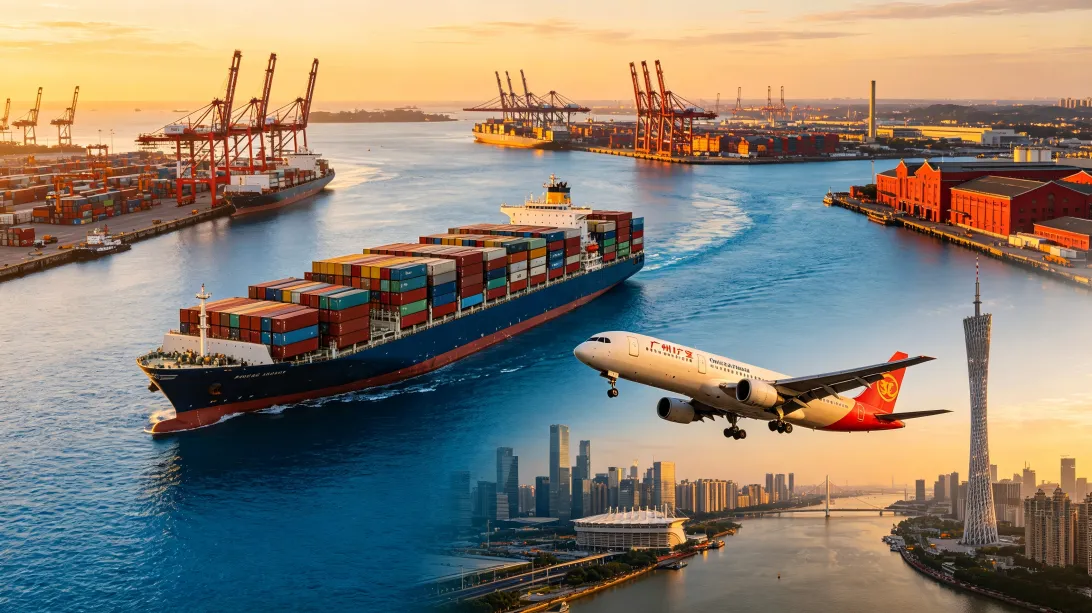
Shipping Methods at a Glance: Choose the Right Mode for Your Cargo
Not all cargo is the same. The best shipping method depends on what you're moving, how fast you need it, and what you're willing to spend. Here's the fastest way to decide.
| Priority | Best Method | Transit Time | Typical Cost Range | Best For |
|---|---|---|---|---|
| Fastest | Air Freight | 3–7 days door-to-door | $5.5–$9.5/kg | Urgent electronics, samples, high-value goods |
| Cheapest for Bulk | Sea Freight FCL | 30–36 days | $4,400–$8,200 per container | Furniture, machinery, large-volume orders |
| Best Balance | Rail Freight | 18–25 days total | $2.5–$5.5/kg (LCL) | Mid-urgency B2B replenishment, auto parts |
| Most Convenient | DDP Door-to-Door | Varies by mode | All-inclusive quote | First-time importers, Amazon FBA sellers, SMEs |
The decision matrix is simple: Match your cargo volume + deadline + budget to the method above. For a deeper breakdown of each mode, read on.
Sea Freight from Guangzhou to Germany: FCL, LCL & Route Optimization
Sea freight from Guangzhou to Germany remains the dominant choice for bulk cargo. It offers the lowest per-unit cost and handles everything from industrial machinery to furniture. But the key decision isn't just "sea or air" — it's which Guangzhou port to use, whether to book FCL or LCL, and which German port gives you the fastest inland connection.
FCL (Full Container Load)
When your cargo fills most or all of a container, FCL is the clear winner. You get exclusive use of the container, faster port handling, and lower risk of damage from other shippers' goods.
| Container Type | Internal Volume | Typical Cargo | Best For |
|---|---|---|---|
| 20GP | ~28 CBM | Machinery, auto parts, dense goods | Small to medium shipments |
| 40GP | ~58 CBM | Mixed cargo, furniture, appliances | Medium-volume importers |
| 40HQ | ~68 CBM | Light/bulky goods, textiles, e-commerce | Maximizing volume per container |
| 45HQ | ~78 CBM | Oversized or high-volume cargo | Large-scale B2B orders |
2026 FCL Rate Estimates (Guangzhou Nansha → Hamburg):
| Route | 20GP | 40HQ |
|---|---|---|
| Nansha → Hamburg | $4,400–$5,200 | $7,000–$8,200 |
| Nansha → Bremerhaven | $4,500–$5,400 | $7,200–$8,400 |
| Nansha → Wilhelmshaven | $4,400–$5,200 | $7,000–$8,200 |
Rates fluctuate based on fuel surcharges, peak season demand, and carrier capacity. Book 2–3 weeks ahead for the best rates. According to the World Shipping Council, global container shipping capacity remains tight in 2026, making advance booking especially critical for South China origins.
When does FCL beat LCL? The break-even point is roughly 12–14 CBM. If your cargo exceeds this volume, a 20GP container is almost always cheaper than paying per-CBM LCL rates — plus you avoid consolidation handling fees at both ends.
Nansha Port vs. trucking to Shenzhen: Guangzhou's deep-water port, Nansha, offers direct sailings to Hamburg and transshipment connections to Bremerhaven and Wilhelmshaven. However, some shippers truck cargo to Shenzhen Yantian or Shekou for more carrier options and slightly faster schedules. For most Guangzhou-origin cargo, Nansha is sufficient and saves inland trucking cost.
LCL (Less than Container Load)
LCL shipping from Guangzhou to Germany lets you share container space with other shippers. It's the practical choice for cargo between 1–15 CBM.
- Rate: $85–$140 per CBM from Guangzhou
- Best for: Sample orders, small-volume imports, mixed-SKU shipments
- Considerations: LCL involves more handling (consolidation at origin, deconsolidation in Germany). This adds 3–5 days to overall transit and slightly increases damage risk. Pack fragile goods accordingly.
Pro tip: For shipments below 2 CBM, compare LCL against air freight. Once you add LCL handling fees, terminal charges, and deconsolidation costs, air freight sometimes wins on total landed cost for very small cargo.
Major Routes & Transit Times
| Route | Mode | Transit Time | Notes |
|---|---|---|---|
| Nansha → Hamburg | Direct | 30–36 days | Most frequent schedules; best for northern Germany |
| Nansha → Bremerhaven | Transshipment | 32–38 days | Major auto/machinery import hub |
| Nansha → Wilhelmshaven | Direct | 30–35 days | Deep-water port; growing FCL volume |
Air Freight from Guangzhou to Germany: Speed, Costs & When It Makes Sense
When speed is non-negotiable, air freight from Guangzhou to Germany is your answer. It's the preferred method for high-value electronics, urgent samples, perishables, and inventory replenishment during stockouts.
Guangzhou Baiyun Airport (CAN) as Your Origin Hub
Guangzhou Baiyun International Airport (CAN) is South China's second-largest cargo airport and a major hub for freight bound to Europe. It offers both direct freighter services and belly-hold capacity on passenger flights. For Guangzhou-area suppliers, CAN eliminates the need to truck cargo to Shenzhen or Hong Kong — saving a day and reducing handling risk.
That said, for specialized or oversized cargo, trucking to Shenzhen Bao'an (SZX) or Hong Kong (HKG) opens access to a wider range of airlines and routing options.
Frankfurt (FRA) — Europe's Air Cargo Gateway
Frankfurt Airport (FRA) is Europe's busiest air cargo hub and the primary arrival point for China-Germany air freight. Direct flights from CAN to FRA operate daily, with total door-to-door transit of 3–6 days.
| Route | Flight Time | Total Door-to-Door | Best For |
|---|---|---|---|
| CAN → Frankfurt (FRA) | 1–2 days | 3–6 days | Central/southern Germany distribution |
| CAN → Munich (MUC) | 1–2 days | 4–7 days | Southern Germany, Austria corridor |
| CAN → Leipzig/Halle (LEJ) | 1–2 days | 4–7 days | DHL hub; eastern Germany |
2026 Air Freight Costs by Weight Tier
| Weight Tier | Rate per kg | Notes |
|---|---|---|
| 45–100 kg | $7.5–$9.5 | Minimum charges apply |
| 100–300 kg | $6.5–$8.5 | Standard B2B range |
| 300–1,000 kg | $5.5–$7.5 | Volume discounts begin |
| 1,000+ kg | $4.5–$6.5 | Negotiable with forwarder |
Chargeable weight = max(actual weight, volumetric weight).
Chargeable Weight Explained
Airlines charge by chargeable weight — whichever is greater: the actual weight of your cargo, or its volumetric weight.
Formula: L × W × H (cm) ÷ 6,000 = Volumetric Weight (kg)
Example: A box of Guangzhou electronics measures 60 × 50 × 40 cm and weighs 18 kg. - Volumetric weight = (60 × 50 × 40) ÷ 6,000 = 20 kg - Actual weight = 18 kg - Chargeable weight = 20 kg (volumetric wins)
This is why light, bulky items (foam, packaging materials, empty plastic containers) are expensive to ship by air. For dense cargo like metal parts, actual weight usually governs.
Pro insight from our team: In our experience managing Guangzhou-to-Europe shipments over the past decade, roughly 30% of air freight quotes from this origin are underestimated because shippers don't account for volumetric weight. We always run the calculation before booking — it's a simple step that prevents budget surprises at the airline's counter.
Rail Freight from Guangzhou to Germany: The Middle Ground Reality
Rail freight has emerged as a compelling middle ground between sea and air — but here's what most guides won't tell you: Guangzhou is not a major departure city for the China-Europe Railway.
Can You Ship Rail Directly from Guangzhou?
The honest answer is no. The primary China-Europe rail terminals are in Xi'an, Chengdu, Chongqing, Wuhan, and Zhengzhou — not Guangzhou. However, this doesn't mean rail is off the table for South China shippers.
What we've learned: In our decade of managing China-Europe logistics, we've found that the "last mile to the rail hub" is where many forwarders drop the ball. Cargo sits in Guangzhou warehouses for 5–7 days waiting for consolidation, when it should be on a truck to Chengdu within 48 hours. That delay alone can turn an 18-day rail promise into a 25-day reality. We schedule dedicated trucking lanes from Guangzhou to Chengdu and Xi'an twice weekly to close that gap.
The solution: Your forwarder trucks cargo from Guangzhou to the nearest rail hub (typically Chengdu or Xi'an, 2–3 days by road). From there, it boards the Yixin'ou / New Eurasia Land Bridge route through Kazakhstan, Russia, Belarus, and Poland into Germany.
Total transit from Guangzhou to Germany by rail: 18–25 days (including trucking to hub + rail transit + German inland delivery).
Major Rail Routes to Germany
| Origin Hub | Destination | Rail Transit Time | Total from Guangzhou |
|---|---|---|---|
| Xi'an | Duisburg | 16–18 days | 19–21 days |
| Chengdu | Hamburg | 18–20 days | 21–23 days |
| Chongqing | Duisburg | 16–19 days | 19–22 days |
Cost Comparison & Best Use Cases
| Service Type | Rate | Best For |
|---|---|---|
| Rail FCL (40HQ) | $7,000–$9,500 per container | Mid-urgency bulk cargo |
| Rail LCL | $2.5–$5.5 per kg | Smaller cargo, faster than sea LCL |
When rail beats sea and air: - You need cargo faster than sea (30+ days) but air is too expensive - You're shipping automotive parts, electronics, or industrial components - Your German buyer values lower carbon footprint than air freight - Peak season sea congestion makes space unreliable
DDP Door-to-Door Shipping from Guangzhou to Germany: A Step-by-Step Journey
DDP shipping from Guangzhou to Germany (Delivered Duty Paid) is the most hands-off option. Your forwarder handles everything: pickup, export customs, international freight, German import customs, duty/VAT payment, and final delivery to your door.
What's Included in DDP
- Factory or warehouse pickup in Guangzhou, Foshan, or Dongguan
- Consolidation at forwarder warehouse (if multi-supplier)
- Export customs declaration and documentation
- International freight (sea, air, or rail)
- German import customs clearance
- Duty and VAT (19%) payment
- Inland trucking to your warehouse, office, or Amazon FBA center
Day-by-Day: From Guangzhou Factory to German Door
| Day | Activity | Location |
|---|---|---|
| 1–2 | Factory pickup, goods verification | Guangzhou / Foshan / Dongguan |
| 3–4 | Consolidation, labeling, export customs | Nansha Port or Shenzhen |
| 5–35 | International transit (varies by mode) | At sea / in air / on rail |
| 36–38 | German customs clearance | Hamburg / Bremerhaven / Frankfurt |
| 39–40 | Inland trucking, final delivery | Berlin / Munich / Cologne / FBA warehouse |
DDP Transit Times by Mode
| Mode | Door-to-Door Time | Best For |
|---|---|---|
| DDP Air | 6–10 days | Urgent, high-value, small cargo |
| DDP Rail | 22–28 days | Balanced cost and speed |
| DDP Sea (LCL) | 35–50 days | Cost-sensitive, planned inventory |
| DDP Sea (FCL) | 32–42 days | Bulk orders, full containers |
Who Should Use DDP?
- First-time importers who don't know German customs procedures
- SMEs without an in-house logistics team or German customs broker
- Amazon FBA sellers who need direct delivery to German warehouses without customs complexity
- Buyers who want predictable total cost — no surprise VAT or duty bills upon arrival
Shipping Costs from Guangzhou to Germany: 2026 Estimates & Scenarios
The most common question we hear: "How much will it cost to ship from Guangzhou to Germany?" The answer depends on your cargo volume, weight, and urgency. Here's a comprehensive breakdown.
Cost Comparison by Mode
| Mode | Cost Range | Basis | Best For |
|---|---|---|---|
| Sea FCL (20GP) | $4,400–$5,200 | Per container | Large, heavy, non-urgent |
| Sea FCL (40HQ) | $7,000–$8,200 | Per container | Bulky, light goods |
| Sea LCL | $85–$140/m³ | Per cubic meter | 1–15 CBM shipments |
| Rail FCL (40HQ) | $7,000–$9,500 | Per container | Mid-urgency, containerized |
| Rail LCL | $2.5–$5.5/kg | Per kg | Smaller cargo, faster than sea |
| Air Freight | $5.5–$9.5/kg | Chargeable weight | Urgent, high-value |
| Express Courier | $8–$15/kg | Per kg | Small parcels, documents |
| DDP (all-inclusive) | Custom quote | Per shipment | Hassle-free, predictable cost |
Scenario-Based Recommendations
| Scenario | Recommended Mode | Estimated Cost | Why |
|---|---|---|---|
| 1 CBM of mixed goods to Hamburg | Sea LCL | $85–$140 | Cheapest for small volume; air would be $300+ |
| 500 kg of electronics, needed in 10 days | Air Freight | $3,250–$4,250 | Speed justifies cost; rail would miss deadline |
| 1 full container of furniture | Sea FCL (40HQ) | $7,000–$8,200 | Lowest per-unit cost; no urgency |
| Auto parts, needed in 3 weeks | Rail LCL | $1,250–$2,750 | Faster than sea; cheaper than air |
| First import, no German broker | DDP Sea | All-inclusive quote | Zero customs hassle; predictable budget |
Hidden Costs to Watch
- Fuel surcharges: Adjusted monthly by carriers; can add 5–15% to base freight
- Peak season premiums: Aug–Nov; book 3–4 weeks early to avoid surcharges
- Customs inspection fees: Random German customs inspections cost €150–€500
- German inland trucking: Hamburg to Berlin/Munich adds €300–€800 depending on distance
- Palletization/labeling: EU-standard pallets (1200×800 mm) and FNSKU labels for FBA
German Customs Clearance: What Guangzhou Shippers Must Know
German customs (Zollverwaltung) is notoriously strict. Even minor documentation errors can result in cargo detention, storage fees, and delayed deliveries. If you're shipping from Guangzhou to Germany, preparation is everything.
Required Documents Checklist
| Document | Purpose | Common Mistakes |
|---|---|---|
| Commercial Invoice | Declares value for duty/VAT assessment | Value mismatch with packing list |
| Packing List | Details of each package, weight, dimensions | Missing HS codes per item |
| Bill of Lading (B/L) or Air Waybill (AWB) | Proof of shipment; cargo title document | Incorrect consignee name |
| Certificate of Origin | Preferential tariff claims | Missing or wrong format |
| EORI Number | Mandatory EU importer identification | Not obtained before shipment arrives |
| CE Certification | Product compliance for EU market | Fake or incomplete CE marks |
| HS Code Classification | Determines duty rate and regulations | Misclassification triggers penalties |
EORI Number — Your EU Import Passport
An EORI (Economic Operators Registration and Identification) number is mandatory for all businesses importing into the EU. Without it, German customs will not process your clearance — full stop.
- How to apply: Visit www.zoll.de (German customs portal) or apply through your EU member state's customs authority
- Processing time: 3–5 business days
- Cost: Free
- Valid for: All EU member states (one EORI covers Germany, France, Netherlands, etc.)
If you don't have an EORI and don't want to obtain one, DDP shipping is your only practical option — your forwarder handles clearance using their own or a partner's EORI.
German VAT (19%) & Customs Duties
| Tax Type | Rate | Applies To |
|---|---|---|
| Standard VAT | 19% | Most goods (calculated on CIF value + duty) |
| Reduced VAT | 7% | Food, books, medical goods |
| Customs Duty | 0–17% | Varies by HS code (typical EU-China MFN rates) |
| Anti-Dumping Duty | 40–70% | Solar panels, bicycles, certain steel products |
Important: The 19% VAT is applied to the CIF value + customs duty. For a $10,000 shipment with 5% duty, VAT = ($10,000 + $500) × 19% = $1,995.
CE Marking & Product Compliance
CE marking is mandatory for electronics, machinery, toys, and medical devices entering the EU. Before shipping from Guangzhou:
- Verify your supplier has valid CE certification (not just a printed logo)
- Request the Declaration of Conformity and test reports
- Ensure the CE mark is physically affixed to the product or packaging
German customs actively inspects CE compliance. Shipments without proper certification can be destroyed or returned at the importer's expense. For authoritative guidance on EU product compliance, refer to the European Commission's CE marking guidelines.
Common Mistakes That Delay Clearance
- HS code misclassification: A wrong code can trigger unnecessary inspections or incorrect duty rates
- Invoice/packing list discrepancies: If the invoice says 100 units but the packing list shows 98, customs flags it
- Missing EORI: The #1 cause of clearance delays for first-time importers
- Incorrect CE documentation: Especially common with electronics from Guangzhou wholesalers
Amazon FBA Shipping from Guangzhou to Germany
Germany is Amazon's largest EU marketplace, and Amazon FBA shipping from Guangzhou to Germany is one of the fastest-growing segments we handle. But FBA inbound requirements are strict — miss a labeling rule or pallet standard, and Amazon rejects your shipment.
German Amazon FBA Warehouse Locations
| Code | Location | Region | Best For |
|---|---|---|---|
| FRA1 / FRA3 | Bad Hersfeld | Central | General merchandise, high volume |
| CGN1 | Koblenz | West | Western Germany, Netherlands corridor |
| DUS2 | Dortmund | West | Industrial goods, bulk shipments |
| HAM2 | Winsen | North | Northern Germany, Scandinavian transit |
| LEJ1 | Leipzig | East | DHL hub proximity, eastern EU |
| MUC3 | Augsburg | South | Southern Germany, Austria access |
| BER3 | Berlin | Northeast | Capital region, fast-growing market |
FBA Inbound Requirements
- FNSKU Labeling: Every unit must carry an Amazon FNSKU label (format: X00-...). This is not your manufacturer's barcode.
- EU-Standard Pallet: 1200 × 800 mm (Euro pallet). Amazon does not accept Asian-standard 1100 × 1100 mm pallets.
- Max Pallet Height: 180 cm including pallet itself
- DDP to FBA: This is the preferred method for China-based sellers. Your forwarder clears customs, pays VAT, and delivers directly to the Amazon warehouse — you never touch the cargo in Germany.
FBA Prep Services in Guangzhou
AllBestShipping offers FBA prep services at our Guangzhou-area warehouse before your cargo ever leaves China:
- FNSKU labeling and barcode verification
- Polybagging and suffocation-warning labels
- Palletization to EU 1200×800 mm standards
- Carton labeling with Amazon shipment IDs
- Carton weight/dimension verification to avoid Amazon rejections
This saves you from costly rework in Germany or rejected shipments that sit in Amazon holding areas.
How to Choose the Right Incoterm for Your Guangzhou Shipment
Incoterms 2020 define who pays for what at each stage of the shipment. The wrong choice can cost you thousands or leave you stranded at German customs. Here's how to choose based on your situation.
| Incoterm | What You Pay For | What Supplier Pays For | Best For |
|---|---|---|---|
| EXW (Ex Works) | Everything: pickup, export, freight, import, delivery | Nothing — goods sit at their factory | Experienced buyers with strong forwarder relationships |
| FOB (Free On Board) | Freight, insurance, import customs, delivery | Delivery to port, export customs | Buyers with German customs broker; cost control priority |
| CIF (Cost, Insurance, Freight) | Import customs, inland delivery | Freight to German port + insurance | Caution: hidden freight markups common |
| DDP (Delivered Duty Paid) | Nothing — all-inclusive price | Everything: pickup to your door | First-time importers, SMEs, Amazon FBA sellers |
Scenario-Based Recommendations
- You're buying from a Guangzhou wholesale market (EXW): Your forwarder must handle pickup, consolidation, and export. Make sure they have local trucks and warehouse capacity in Guangzhou.
- Your supplier offers FOB Nansha: Good option if you have a German customs broker and want to shop for competitive freight rates. You control the international leg.
- Your supplier quotes CIF Hamburg: Be cautious. The freight cost is buried in their product price — and it's often marked up 20–50% above market rates. Get a separate freight quote to compare.
- You're new to importing or selling on Amazon Germany: Choose DDP. The slightly higher upfront cost eliminates customs surprises, VAT bills, and clearance delays.
Why Choose AllBestShipping for Guangzhou-to-Germany Freight
At AllBestShipping, we don't just move boxes — we solve the end-to-end logistics puzzle for importers sourcing from South China. Headquartered in Shenzhen with deep coverage across the Pearl River Delta, we pick up from Guangzhou, Foshan, Shenzhen, and Dongguan daily. We also provide dedicated shipping from China to Germany services for businesses looking for broader China-origin options beyond Guangzhou.
Our philosophy: We believe in transparent, flexible logistics solutions without hidden fees. We objectively evaluate the strengths and weaknesses of sea, air, and rail — and we never shy away from explaining the limitations of each mode. If rail isn't the right fit for your timeline, we'll tell you. If DDP isn't cost-effective for your volume, we'll recommend FOB instead. Our job is to match the right solution to your specific cargo, budget, and deadline — not to upsell the most expensive option.
What Sets Us Apart
| Feature | How We Deliver |
|---|---|
| Guangzhou-Area Pickup | Daily trucks from Guangzhou, Foshan, Dongguan to our consolidation hub |
| Transparent Pricing | Itemized quotes — no hidden fuel surcharges or "handling fees" |
| Real-Time Tracking | Track from factory pickup through German customs to final delivery |
| German Customs Expertise | EORI registration guidance, VAT consultation, HS code verification |
| Amazon FBA Ready | Direct delivery to all German FBA warehouses with full prep services |
| Multi-Supplier Consolidation | Free warehouse storage; verify, group, and ship from multiple Guangzhou-area suppliers |
| All Modes, One Partner | Sea FCL/LCL, air freight, rail freight, DDP door-to-door — all under one roof |
Whether you're shipping your first pallet or your hundredth container, we tailor the solution to your cargo, budget, and timeline. Get a free, no-obligation quote for your Guangzhou-to-Germany shipment today. For businesses with broader sourcing needs, explore our full shipping from China services covering all major manufacturing hubs.
FAQ: Shipping from Guangzhou to Germany
Q: How long does shipping from Guangzhou to Germany take? A: It depends on the method. Sea freight takes 30–36 days, air freight 3–7 days, rail freight 18–25 days (including trucking to the rail hub), and DDP door-to-door adds 2–5 days on top of the base transit time.
Q: What is the cheapest way to ship from Guangzhou to Germany? A: For bulk cargo, sea freight FCL is cheapest — around $4,400–$5,200 for a 20GP container. For small shipments under 2 CBM, compare sea LCL ($85–$140/m³) against air freight; sometimes air wins when you factor in LCL handling fees.
Q: Can I ship from Guangzhou to Germany without a German company? A: Yes, but you need an EORI number to clear customs. If you don't have one, choose DDP shipping — your forwarder clears customs and pays VAT on your behalf.
Q: Do I need to speak Chinese to arrange shipping from Guangzhou? A: No. A professional freight forwarder like AllBestShipping handles all communication with Chinese suppliers, ports, and customs in both English and Chinese. You only need to speak with your forwarder.
Q: What is the cheapest way to ship 1 CBM from Guangzhou to Hamburg? A: Sea LCL at approximately $85–$140 per CBM is your cheapest option. Air freight for 1 CBM of typical cargo would cost roughly $300–$500.
Q: Can I ship electronics from Guangzhou to Germany by air? A: Yes. Guangzhou Baiyun Airport (CAN) has direct cargo capacity to Frankfurt. Electronics are one of the most common air freight categories from Guangzhou. Ensure your supplier provides CE certification for EU compliance.
Q: How do I consolidate goods from multiple Guangzhou suppliers? A: Use your forwarder's Guangzhou warehouse. Suppliers deliver to one address; your forwarder verifies quantities, inspects quality, and consolidates everything into one shipment. This is standard practice for buyers sourcing from multiple Canton Fair or wholesale market vendors.
Q: Is rail freight from Guangzhou reliable in winter? A: Generally yes, though minor delays of 2–3 days can occur at border crossings due to weather. Overall reliability is high, and rail is significantly more weather-resilient than road freight through Central Asia.
Q: What happens if my shipment is held at German customs? A: German customs may hold cargo for document verification, random inspection, or CE compliance checks. If your paperwork is correct, most holds resolve in 1–3 days. If documents are missing or incorrect, delays can stretch to weeks. This is why accurate HS codes, EORI registration, and CE documentation are critical.
Q: Can AllBestShipping ship directly to Amazon FBA in Germany from Guangzhou? A: Yes. We offer DDP door-to-door delivery to all German Amazon FBA warehouses, including FRA1, DUS2, HAM2, and others. We also provide FBA prep services in Guangzhou — labeling, polybagging, and EU-standard palletization — before your cargo leaves China.
Conclusion: Your Guangzhou-to-Germany Shipping Checklist
Shipping from Guangzhou to Germany doesn't have to be complicated. Here's your action plan:
- Determine your cargo volume and deadline. Under 2 CBM and urgent? Consider air. Over 14 CBM? Book FCL sea. Mid-urgency? Rail is your sweet spot.
- Choose your Incoterm based on experience. New to importing? Go DDP. Have a German customs broker? FOB or CIF may save money.
- Verify German customs readiness. Do you have an EORI number? Is your CE documentation valid? Are your HS codes accurate?
- Book ahead during peak season. Chinese New Year, pre-Christmas, and post-Canton Fair periods tighten capacity. Book 3–6 weeks early.
- Request a tailored quote. Every shipment is different. A professional forwarder can match the exact mode, route, and service level to your needs.
Ready to ship from Guangzhou to Germany? Contact AllBestShipping for a free, tailored logistics quote — sea, air, rail, or DDP, we've got your cargo covered from the Pearl River Delta to your German doorstep.
Disclaimer: The cost estimates and transit times provided in this guide are based on 2026 market conditions and are intended for general planning purposes only. Actual rates vary by carrier, season, cargo type, and specific routing. For binding quotations and legal advice on customs compliance, please consult directly with a licensed freight forwarder or German customs broker.