Air Shipping from China to Italy: The Complete 2026 Guide (Air Freight Cost per Kg, Transit Time, Customs & DDP Door-to-Door)
Air shipping from China to Italy is the fastest way to move high-value or time-sensitive cargo. However, for many B2B importers and Amazon FBA sellers, unclear pricing and complex Italian customs can make the process stressful.
Drawing on over a decade of experience, this guide covers everything you need: air freight from China to Italy cost per kg, chargeable weight calculations, Italian customs clearance, and DDP door-to-door solutions. By the end, you will know exactly how to plan your shipment with no hidden destination fees.
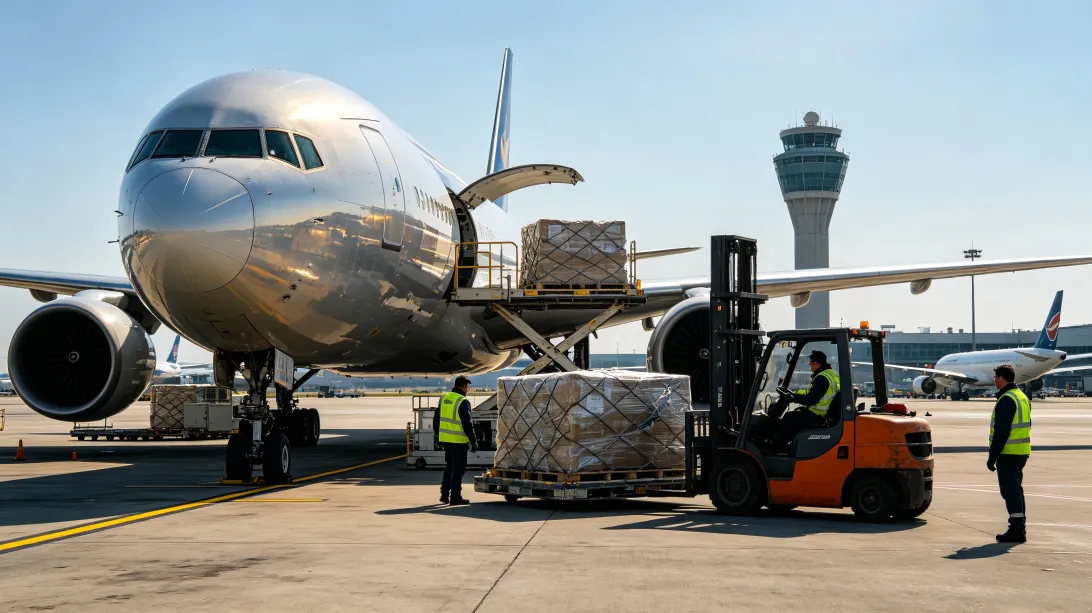
Quick Answer: How Much and How Long to Air Ship from China to Italy?
| Question | Typical Range (2026) | Notes |
|---|---|---|
| How long does air shipping take from China to Italy? | 5–10 days door-to-door | Airport-to-airport: 2–4 days; add pickup, customs, and last-mile delivery |
| What is the air freight from China to Italy cost per kg? | $5.50–$8.50/kg for general cargo | Varies by weight break, origin airport, and current fuel surcharges |
| When is air shipping the right choice? | Urgent, high-value, seasonal, or stockout-prevention shipments | Use the value density rule: if your cargo is worth >$10/kg, air freight usually pays for itself |
Choose the Right Service: Courier vs Air Freight vs DDP Door-to-Door
Not all "air shipping" is the same. The service type you choose affects your cost, speed, paperwork burden, and who pays Italian duties and VAT. Here is how the three main options compare.
Express Courier vs Air Freight China to Italy
| Factor | Express Courier (DHL/UPS/FedEx) | Air Freight (Forwarder-Booked) |
|---|---|---|
| Speed | 1–3 business days | 5–10 days door-to-door |
| Cost | $20–$40/kg | $5.50–$8.50/kg |
| Best For | Small parcels (<21 kg), samples, urgent documents | Shipments >45 kg, bulk inventory, regular restocking |
| Tracking | Detailed, real-time | Real-time via AWB; forwarder provides updates |
| Customs | Broker included; duties/VAT billed to recipient | You or your forwarder arrange customs clearance |
| Size/Weight Limits | Strict; oversize surcharges apply | Flexible; palletized cargo accepted |
In our experience: We regularly see importers default to DHL for 80 kg shipments because "it feels easier." But at $25/kg, that is $2,000. Air freight at $6.50/kg cuts the transport cost to $520 — a $1,480 difference. For recurring shipments, that adds up fast.
Airport-to-Airport vs Door-to-Door
Airport-to-airport means the forwarder moves your cargo from the origin airport (e.g., Shanghai Pudong) to the destination airport (e.g., Milan Malpensa). You handle pickup in China, export customs, import customs in Italy, duty/VAT payment, and last-mile delivery. This gives you maximum control but requires local logistics contacts on both ends.
Door-to-door means the forwarder handles everything from your supplier's factory to your warehouse in Italy. This includes pickup, export customs, air freight, import customs, duty/VAT, and final delivery. It is the most hassle-free option, especially for businesses without an Italian customs broker.
DAP vs DDP: Who Pays Duties and VAT?
DAP (Delivered at Place) means the forwarder delivers to your door, but you are responsible for Italian import customs, duties, and VAT. You need an EORI number and either a customs broker or the expertise to clear customs yourself.
DDP (Delivered Duty Paid) means the forwarder pre-pays duties and VAT on your behalf and includes them in the all-in quote. You do not need an EORI number or a customs broker. This is the safest choice for first-time importers and SMEs. From 2026, the forwarder offering DDP must have a valid Italian VAT number to act as the importer of record.
"Cheapest Air Shipping from China to Italy" Reality Check
If you see a quote at $4.50/kg, ask what is included. The cheapest headline rate often excludes fuel surcharges, security fees, origin/destination handling, and customs clearance. A true "all-in" door-to-door DDP quote for general cargo in 2026 typically ranges from $7.50–$12.00/kg, depending on weight, origin, and destination. At AllBestShipping, we provide transparent, itemized quotes so you know exactly what you are paying for.
2026 Air Cargo Rates China to Italy: Cost Benchmarks and an All-In Landed Cost Breakdown
Understanding air cargo rates China to Italy requires looking beyond the base rate per kilogram. The total landed cost includes origin charges, air freight, surcharges, destination handling, customs clearance, duties, VAT, and last-mile delivery. Here is what we are seeing in the market as of mid-2026.
How Air Freight Pricing Works: Chargeable Weight
Airlines charge by chargeable weight — the greater of actual gross weight (in kg) or volumetric weight. If you ship lightweight but bulky goods, the airline will charge based on volume, which can be much higher than the actual weight. (See the detailed calculation formula and examples in the next section).
2026 Cost Benchmarks by Weight Band
| Chargeable Weight | Est. Rate/kg (2026) | Total Est. Cost (100 kg Example) | Notes |
|---|---|---|---|
| Under 45 kg | $8.00–$10.50 | $800–$1,050 | Minimum charges apply; courier may be competitive |
| 45–100 kg | $6.50–$8.00 | $650–$800 | Sweet spot for small B2B shipments |
| 100–300 kg | $5.50–$7.00 | $550–$700 per 100 kg | Best value for regular restocking |
| 300–1,000 kg | $4.80–$6.50 | Negotiable bulk rates | Consolidation or direct airline contracts |
| >1,000 kg | $4.20–$5.50 | Charter or contract rates | Full charter or block space agreements |
Rates fluctuate weekly. Always request an all-in quote inclusive of fuel, security, and handling surcharges.
Surcharges: The Hidden Layer of Cost
The base rate is just the beginning. In the current market, surcharges can add 30–50% to the base rate. Here are the main ones to watch:
| Surcharge | Typical Range | Notes |
|---|---|---|
| Fuel Surcharge (FSC) | $1.50–$3.00/kg | Fluctuates with oil prices; updated weekly by airlines |
| Security Surcharge | $0.20–$0.50/kg | Mandatory screening at origin airport |
| Terminal Handling Charge (THC) — Origin | $25–$60 per shipment | Airport handling and documentation |
| Terminal Handling Charge (THC) — Destination | $40–$80 per shipment | Italian airport unloading and processing |
| AWB Fee | $25–$50 per shipment | Air waybill issuance |
| Peak Season Surcharge | $0.50–$1.50/kg | Active Oct–Nov and pre-Chinese New Year (Jan–Feb) |
| Dangerous Goods Surcharge | $1.00–$3.00/kg | For lithium batteries, chemicals, etc. |
What we saw in Q2 2026: Fuel surcharges spiked in April–May due to Middle East routing disruptions, adding $2.00–$2.50/kg to some lanes. Importers who booked all-in rates with their forwarder in March avoided the surprise. Those who waited paid the difference. For businesses looking at alternative European destinations, we also offer competitive air freight from China solutions across the continent.
All-In Landed Cost Table: What Buyers Should Ask to See
| Cost Component | Typical Range | Who Pays (DDP) | Who Pays (DAP) |
|---|---|---|---|
| Pickup in China | $30–$150 | Forwarder | You or your supplier |
| Export customs clearance | $30–$80 | Forwarder | You or your supplier |
| Origin handling + THC | $25–$60 | Forwarder | You or your supplier |
| Air freight (chargeable weight) | $5.50–$8.50/kg | Forwarder | You or your supplier |
| Fuel + security surcharges | $1.50–$3.50/kg | Forwarder | You or your supplier |
| Destination handling + THC | $40–$80 | Forwarder | You or your supplier |
| Italian customs clearance | $80–$200 | Forwarder | You |
| Import duty | 0–12% of CIF value | Forwarder | You |
| Italian VAT (IVA) | 22% of (CIF + duty) | Forwarder | You |
| Last-mile delivery | $50–$300 | Forwarder | You |
| Cargo insurance (optional) | 0.15–0.30% of cargo value | You | You |
Our recommendation: Always ask for an itemized, all-in door-to-door quote before booking. If a forwarder gives you a single number without line items, expect surprises. At AllBestShipping, our quotes break down every dollar — no hidden fees, no post-arrival invoices. We also offer competitive air freight from China services for businesses shipping to other European and global destinations.
How to Reduce Total Cost Without Increasing Risk
- Consolidate multiple suppliers into one shipment to hit higher weight breaks and lower per-kg rates.
- Optimize packaging to reduce volumetric weight — use right-sized cartons, remove excess "air," and control pallet height.
- Book 2–3 weeks ahead of peak season to lock in lower rates and secure space.
- Choose the right origin airport — Shenzhen and Hong Kong often offer competitive rates for South China suppliers due to high cargo volume and carrier competition.
- Negotiate contract rates if you ship regularly; forwarders can secure 10–20% discounts with committed volume.
How to Calculate Volumetric Weight for Air Shipping (China to Italy)
One of the most common surprises for first-time air shippers is discovering that their 50 kg shipment is charged as 120 kg because of volumetric weight. Here is how to calculate it yourself — and three real-world examples.
The Formula
Volumetric Weight (kg) = (L cm × W cm × H cm) ÷ 6,000
Chargeable Weight = the greater of Actual Gross Weight or Volumetric Weight.
Example 1: Small, Dense Cartons (Actual Weight Wins)
You are shipping 5 cartons of metal hardware from Shenzhen to Milan.
| Dimension | Per Carton | Total (5 cartons) |
|---|---|---|
| Size | 40 × 30 × 25 cm | — |
| Actual weight | 12 kg | 60 kg |
| Volumetric weight | (40×30×25) ÷ 6,000 = 5 kg | 25 kg |
| Chargeable weight | 60 kg (actual weight is greater) | 60 kg |
Result: You pay for 60 kg. This is a "dense" shipment — actual weight drives the cost.
Example 2: Lightweight Bulky Goods (Volumetric Weight Wins)
You are shipping 3 cartons of foam inserts from Guangzhou to Rome.
| Dimension | Per Carton | Total (3 cartons) |
|---|---|---|
| Size | 60 × 50 × 40 cm | — |
| Actual weight | 8 kg | 24 kg |
| Volumetric weight | (60×50×40) ÷ 6,000 = 20 kg | 60 kg |
| Chargeable weight | 20 kg (volumetric weight is greater) | 60 kg |
Result: You pay for 60 kg — 2.5× the actual weight. This is where packaging optimization matters most.
Example 3: Mixed Cartons on a Pallet (Consolidation Changes Everything)
You are consolidating 8 cartons from two suppliers onto one pallet from Shanghai to Milan.
| Supplier | Cartons | Size | Actual Weight | Volumetric Weight |
|---|---|---|---|---|
| A | 4 | 50 × 40 × 30 cm | 10 kg each | 10 kg each |
| B | 4 | 60 × 40 × 35 cm | 6 kg each | 14 kg each |
| Total | 8 | — | 64 kg | 96 kg |
| Chargeable weight | — | — | — | 96 kg |
Result: Volumetric weight wins at 96 kg. If you had shipped these separately, Supplier B's cartons would have been charged at 14 kg each (56 kg total) + Supplier A's 40 kg = 96 kg. Consolidation on one AWB does not change the math, but it does reduce per-shipment minimum charges and documentation fees.
Packing Tips That Reduce Chargeable Weight
- Use right-sized cartons — do not ship a half-empty box.
- Remove "air" inside products — deflate, fold, or nest items where possible.
- Control pallet height — airlines measure the outer dimensions of the pallet, including wrap and straps.
- Choose lightweight but protective materials — replace heavy foam with air cushions or bubble wrap where feasible.
- Consolidate intelligently — pairing dense and light cargo on the same pallet can balance the total chargeable weight.
Door-to-Door Transit Time Breakdown: From Factory Pickup to Final Delivery in Italy
If you are searching for "shipping time by air from China to Italy," the honest answer is 5–10 days door-to-door for most shipments in 2026. But the real value is understanding where those days go — and which stages are most likely to cause delays.
Phase-by-Phase Timeline
| Phase | Duration | What Is Happening |
|---|---|---|
| Pickup and consolidation | 0.5–1 day | Forwarder collects from supplier(s); cargo arrives at origin warehouse |
| Export customs clearance | 0.5–1 day | Documentation review, declaration submission, customs release |
| Security screening and flight booking | 0.5–2 days | X-ray/screening; cargo waits for next available flight or consolidation |
| Main flight + transshipment | 1–2 days | Direct flight: 11–14 hours; indirect via EU hub adds 1–2 days |
| Import customs clearance Italy | 0.5–2 days | Declaration, duty/VAT assessment, inspection (if triggered) |
| Last-mile delivery | 1–3 days | Trucking from Milan/Rome/Bologna airport to final destination |
| Total Door-to-Door | 5–10 days | Industry standard for typical conditions |
What Delays Air Shipments Most Often
| Delay Cause | Why It Happens | Prevention |
|---|---|---|
| Incomplete export documentation | Missing invoice, packing list, or HS code | Use forwarder's checklist; double-check before pickup |
| Customs inspection at origin | Random screening or flagged HS code | Ensure accurate, consistent documentation |
| Flight capacity crunch | Peak season or reduced belly-hold space | Book 2–3 weeks ahead; consider freighter services |
| Italian customs hold | Missing EORI, incorrect HS code, or valuation dispute | Prepare EORI in advance; verify HS code with forwarder |
| Duty/VAT payment delay | Importer not ready to pay | Use DDP to avoid payment delays |
| DG approval pending | Lithium batteries or chemicals missing MSDS/UN38.3 | Submit DG documents 3–5 days before booking |
| Remote delivery address | Courier remote area surcharge or limited trucking | Confirm delivery feasibility with forwarder upfront |
How to Keep Air Freight Predictable
- Plan around cut-off times — most origin warehouses have a daily cut-off (e.g., 16:00 for next-day flights). Missing it pushes you to the next flight.
- Pre-clear before arrival — submit Italian customs documentation electronically before the flight lands. This can reduce clearance from 2 days to 4–6 hours.
- Use the correct HS code and invoice description — vague descriptions like "electronics" trigger inspections. Be specific: "Bluetooth wireless earbuds, HS 8518.30.20."
- Book direct flights where possible — transshipment via Frankfurt or Amsterdam adds handling risk and 1–2 days.
Best Airports and Routing: China Hubs to Italy (MXP/FCO/BLQ/BGY/VCE)
Choosing the right origin and destination airports can save you money, time, and customs headaches. Here is how the major hubs compare.
Common Origin Airports in China
| Airport | IATA | Best For | Key Advantage |
|---|---|---|---|
| Shanghai Pudong | PVG | Nationwide suppliers; Yangtze River Delta | Largest cargo volume in China; broadest airline choice; competitive Europe rates |
| Shenzhen Bao'an | SZX | South China suppliers (Guangdong, Fujian) | Proximity to manufacturing hubs; fast export customs; strong Europe freighter network |
| Guangzhou Baiyun | CAN | South China alternatives; Central China | Efficient customs; good for consolidated cargo; competitive pricing |
| Hong Kong | HKG | Premium service; flexible scheduling | World's busiest cargo airport; free trade policies; no Chinese export customs for transshipments |
| Beijing Capital | PEK | Northern China suppliers | Direct flights to Europe; good for high-value, time-critical shipments |
Pro tip from our Shenzhen office: If your supplier is in Guangdong province, routing through Shenzhen or Hong Kong can save 1–2 days of inland trucking versus Shanghai. For time-sensitive fashion or electronics restocking, that margin matters. Hong Kong also bypasses Chinese export customs for transshipped cargo, which can speed up documentation by half a day. If your supplier is specifically in the Shenzhen area, check our dedicated guide on shipping from Shenzhen to Italy for more localized routing advice.
Main Italy Gateways
| Airport | IATA | Serves | Key Advantage |
|---|---|---|---|
| Milan Malpensa | MXP | Northern Italy; EU distribution | Italy's largest cargo airport; advanced logistics infrastructure; 1-hour truck to Milan city |
| Rome Fiumicino | FCO | Central and Southern Italy | Central hub with good EU connections; ideal for Rome, Naples, and southern regions |
| Bologna Guglielmo Marconi | BLQ | Northern Italy; regional distribution | Strategic for Emilia-Romagna industrial region; efficient customs |
| Bergamo Orio al Serio | BGY | Express carriers; e-commerce | Growing cargo hub; strong DHL/UPS/FedEx presence |
| Venice Marco Polo | VCE | Northeast Italy | Serves Veneto region; efficient customs; good for regional distributors |
Airport selection by region: - Milan, Turin, Genoa, Northern EU: Milan Malpensa (MXP) is your default. It is Italy's cargo powerhouse with the fastest customs processing. - Rome, Naples, Florence, Southern Italy: Rome Fiumicino (FCO) cuts inland delivery time by 1–2 days compared to MXP. - Bologna, Modena, Parma (industrial belt): Bologna (BLQ) is closer to the manufacturing heartland of Northern Italy.
Routing Patterns: Direct vs Via EU Hubs
Direct flights from China to Italy (e.g., PVG→MXP, CAN→FCO) take 11–14 hours and minimize handling risk. Transshipment via EU hubs (Frankfurt, Amsterdam, Vienna) is common for consolidated cargo and can offer lower rates, but adds 1–2 days and increases handling risk. For high-value or fragile cargo, direct flights are worth the premium.
Italy Customs Clearance Checklist (Air Freight): EORI, HS Codes, Duties, and VAT
Italian customs is where the most expensive delays happen. Not in the air — at the airport, when your cargo sits waiting for paperwork. Understanding the process before you ship eliminates 90% of these headaches.
Who Is the Importer in Italy?
Under DAP, you are the importer of record and must handle duties, VAT, and customs brokerage. Under DDP, your forwarder (like AllBestShipping) acts as the importer, handling all clearance and taxes. This makes DDP the safest and simplest choice for most SMEs and first-time importers.
EORI Number Italy: What It Is and Who Needs It
The EORI (Economic Operators Registration and Identification) number is mandatory for any business importing into the EU, including Italy. Without it, your customs declaration cannot be submitted.
- What it is: A unique identifier assigned by EU customs authorities to track imports and exports.
- How to get one: Non-EU businesses apply through the Italian Customs (Agenzia delle Dogane) website. The process typically takes 4–8 weeks, so start before your first shipment.
- Format: Italian EORI numbers start with "IT" followed by your VAT number or a unique identifier.
HS Code Classification: How Mistakes Cause Holds
Italian customs uses HS codes to classify goods and determine duty rates. A wrong HS code can trigger:
- Reclassification — customs reclassifies your goods at a higher duty rate
- Inspection — your shipment is held for physical examination (adds 2–5 days)
- Penalties — fines for misdeclaration, especially if customs suspect undervaluation
Common HS code ranges for China-to-Italy imports:
| Product Category | Typical HS Code Range | Duty Rate | VAT |
|---|---|---|---|
| Electronics (phones, laptops) | 8517, 8471 | 0% | 22% |
| Textiles and apparel | 6101–6209 | 6.5–12% | 22% |
| Footwear | 6401–6405 | 8% | 22% |
| Machinery and parts | 8401–8487 | 2–4.5% | 22% |
| Furniture | 9401–9403 | 0–3.5% | 22% |
| Toys | 9503 | 0–4.7% | 22% |
A note on accuracy: These duty ranges reflect the EU's standard tariff schedule for Chinese-origin goods under the current Most Favoured Nation (MFN) regime. Always verify your specific HS code in the EU TARIC database before budgeting, as anti-dumping duties or sector-specific tariffs can push rates significantly higher for certain product categories.
Duties and Taxes: How Italian VAT (IVA) Is Applied
All imports into Italy are subject to:
- Import duty: 0–12% depending on HS code (see table above)
- Italian VAT (IVA): 22% applied to the CIF value + duty
Example calculation for a $5,000 shipment of electronics (0% duty):
| Step | Calculation | Result |
|---|---|---|
| CIF value | $5,000 | $5,000 |
| Import duty (0%) | $5,000 × 0% | $0 |
| VAT base | $5,000 + $0 | $5,000 |
| VAT (22%) | $5,000 × 22% | $1,100 |
| Total duties & taxes | $0 + $1,100 | $1,100 |
For a $5,000 shipment of textiles (12% duty):
| Step | Calculation | Result |
|---|---|---|
| CIF value | $5,000 | $5,000 |
| Import duty (12%) | $5,000 × 12% | $600 |
| VAT base | $5,000 + $600 | $5,600 |
| VAT (22%) | $5,600 × 22% | $1,232 |
| Total duties & taxes | $600 + $1,232 | $1,832 |
This is on top of your freight and logistics costs. If you are not prepared for it, cash flow can take a hit. This is why many SMEs choose DDP terms — the forwarder pre-pays duties and VAT, and you settle one all-inclusive invoice.
Documents Checklist for Italian Customs
| Document | Required | Notes |
|---|---|---|
| Commercial invoice | Yes | Must show accurate value, currency, Incoterms, and detailed product description |
| Packing list | Yes | Must match invoice line items; show weights and dimensions per carton |
| Air waybill (AWB) | Yes | MAWB for master shipment; HAWB for individual consignments |
| EORI number | Yes (for DAP) | Not needed if using DDP with forwarder's VAT number |
| HS code classification | Yes | Verify in EU TARIC database before shipping |
| Certificate of origin | Sometimes | Required for certain preferential duty claims |
| CE compliance certificates | Sometimes | Mandatory for electronics, machinery, toys, medical devices |
| MSDS / UN38.3 | Sometimes | Required for lithium batteries and dangerous goods |
Compliance and "Red Flag" Triggers for Inspections
Italian customs algorithms assign shipments to three channels:
- Green channel: No inspection. Cleared in 4–8 hours. Assigned to low-risk, regular importers with complete documentation.
- Yellow channel: Document review. Takes 1–2 days. Customs verifies invoice values, HS codes, or certificates.
- Red channel: Physical inspection. Takes 2–5+ days. Your cargo is opened and examined.
Red flag triggers: - First-time importer status - High-value shipments (>$10,000) - Vague or inconsistent invoice descriptions - Undervaluation suspicion (price significantly below market) - Missing CE certificates for regulated products - Sensitive HS codes (textiles, footwear, electronics with high duty risk)
How to minimize inspection risk: - Use specific, accurate invoice descriptions (not "goods" or "miscellaneous") - Declare accurate market value with supporting documentation - Ensure HS code consistency across invoice, packing list, and AWB - Include all required certificates (CE, REACH, RoHS where applicable) - Work with an experienced forwarder who knows Italian customs patterns
Special Cargo and Risk Management: Lithium Batteries, DG, High-Value Goods, and Insurance
Not all cargo is "general goods." If you are shipping lithium batteries, chemicals, high-value electronics, or fragile items, the rules change.
Air Freight China to Italy for Lithium Batteries / DG Cargo
Lithium batteries are classified as dangerous goods (DG) under IATA regulations. Shipping them by air requires:
- UN38.3 test report — proves the batteries passed safety testing
- MSDS (Material Safety Data Sheet) — describes the chemical properties and handling requirements
- DG declaration — completed by the shipper or forwarder
- Special packaging — UN-certified packaging with proper labeling (Class 9 hazard label)
- Airline approval — not all airlines accept DG cargo; booking lead time is 3–5 days longer
Common lithium battery classifications:
| UN Number | Description | Packing Instruction | Notes |
|---|---|---|---|
| UN3480 | Lithium ion batteries (standalone) | PI 965 | Section IA/IB/II depending on watt-hour rating |
| UN3481 | Lithium ion batteries packed with equipment | PI 966 | Batteries installed in or packed with device |
| UN3090 | Lithium metal batteries (standalone) | PI 968 | Restricted on passenger aircraft; freighter only |
| UN3091 | Lithium metal batteries packed with equipment | PI 969 | Same restrictions as UN3090 |
In our experience: We see 30–40% of inspection delays for battery shipments caused by incorrect UN classification or missing UN38.3 reports. Always verify your battery's watt-hour rating and obtain the correct documentation before booking. At AllBestShipping, we pre-check DG documentation to avoid airline rejections and customs holds.
Restricted Items and Common Rejection Reasons
Items commonly rejected or restricted for air freight to Italy include:
- Counterfeit goods — zero tolerance; customs will seize and destroy
- Aerosols and pressurized containers — often classified as DG
- Perishable foods — require phytosanitary certificates and cold chain
- Weapons and weapon parts — require import licenses
- Hazardous chemicals — require MSDS, DG declaration, and special packaging
Cargo Insurance: When It Makes Sense and What It Covers
Air freight has lower damage risk than sea freight, but it is not zero. Cargo insurance typically covers:
- Physical loss or damage during transit
- Theft from airport warehouses or during trucking
- Delay-related spoilage for perishable goods (if specified)
Insurance rates for air freight: 0.15–0.30% of cargo value. For a $10,000 shipment, that is $15–$30 — a small price for protection against total loss.
Important: Airline liability under the Montreal Convention is capped at approximately 22 SDR per kg (about $30/kg). For high-value electronics worth $500/kg, this is nowhere near enough. Always purchase supplemental cargo insurance for shipments valued above $50/kg.
Risk-Reduction Tactics
- Take photos before sealing — document cargo condition at origin
- Use quality packaging — double-wall cartons for fragile items; foam or bubble wrap for electronics
- Label clearly — "Fragile," "This Side Up," and handling instructions in English and Italian
- Maintain a documentation trail — commercial invoice, packing list, photos, AWB, and insurance certificate
- Track proactively — do not wait for problems; monitor flight status and customs clearance daily
How to Get an Accurate Air Freight Quote (Template) + Why Work With AllBestShipping
The difference between a smooth shipment and a costly surprise often starts with the quote. Here is what to send your forwarder — and how to compare quotes apples-to-apples.
Quote Request Template
When requesting a quote for air shipping from China to Italy, include the following:
| Field | Example | Why It Matters |
|---|---|---|
| Pickup address | "Factory in Shenzhen, Bao'an District" | Determines inland trucking cost and origin airport |
| Destination postcode | "20121 Milan, Italy" | Determines last-mile delivery cost and route optimization |
| Cargo description | "Bluetooth earbuds, HS 8518.30.20" | Accurate HS code ensures correct duty/VAT estimate |
| Carton/pallet dimensions | "10 cartons, 40×30×25 cm each" | Needed for volumetric weight calculation |
| Actual weights | "Total actual weight: 85 kg" | Combined with dimensions to determine chargeable weight |
| Incoterms | "DDP door-to-door" or "DAP airport-to-airport" | Defines who handles customs and duties |
| Delivery deadline | "Need delivery by July 15" | Determines if standard, expedited, or charter service is needed |
| DG/battery status | "Contains lithium batteries, UN3481" | Triggers DG surcharges and documentation requirements |
| Insurance value | "Cargo value: $8,000; request insurance" | Determines insurance premium and coverage level |
How to Compare Quotes Apples-to-Apples
| Check | What to Ask |
|---|---|
| Is the quote all-in or partial? | "Does this include fuel surcharge, security fee, origin/destination handling, customs clearance, and last-mile delivery?" |
| What chargeable weight assumption? | "Did you calculate volumetric weight? Can I see the math?" |
| Who handles Italian customs? | "Is customs clearance included? Do I need my own broker?" |
| What is the duty/VAT estimate? | "Can you provide a landed cost estimate including 22% Italian VAT?" |
| Are there peak season or DG surcharges? | "Are any additional surcharges likely to apply?" |
| What is the transit time commitment? | "Is this a direct flight or transshipment? What is the latest delivery date?" |
| What happens if there is a delay? | "Do you provide proactive tracking and delay notifications?" |
When to Use a Customs Broker vs a Full-Service Door-to-Door Provider
Use a customs broker if: You have an EORI number, you understand Italian customs procedures, and you want to handle DAP shipments yourself. A broker charges $100–$250 per clearance but does not handle pickup, freight, or delivery.
Use a full-service door-to-door provider if: You want one contact, one invoice, and zero customs headaches. This is ideal for SMEs, e-commerce sellers, and first-time importers. At AllBestShipping, we handle the entire chain — from factory floor in Shenzhen to your warehouse in Milan.
Why Choose AllBestShipping
At AllBestShipping, we have spent over a decade moving cargo from Shenzhen, Guangzhou, Shanghai, and Hong Kong to Milan Malpensa, Rome Fiumicino, Bologna, and beyond. We are headquartered in Shenzhen — minutes from Bao'an Airport and the Pearl River Delta manufacturing belt — which means we can respond to same-day booking changes, supplier delays, and customs issues that a remote forwarder simply cannot.
Our China–Italy air freight service portfolio includes:
- Airport-to-airport and door-to-door air freight with direct and indirect routing options
- DDP door-to-door delivery, including Italian customs clearance and VAT handling
- Amazon FBA air shipping from China to Italy, with pallet labeling and compliance checks
- Amazon FBA Shipping prep and labeling services for seamless Italian marketplace entry
- Warehouse consolidation — combine multiple suppliers into one cost-efficient shipment
- DG and lithium battery expertise — pre-check documentation, secure airline approvals, and ensure compliance
- Real-time tracking and proactive delay notifications
- Transparent, itemized quotes with no hidden fees
We have served 1,000+ clients across 50+ countries, and the China–Italy air cargo lane is one of our most active corridors. Whether you are shipping your first 100 kg trial or a monthly 1,000 kg restocking program, we tailor the solution to your volume, budget, and timeline.
Disclaimer: The information in this guide reflects our understanding of Italian customs regulations and market conditions as of June 2026. Import duties, VAT rules, and airline routing are subject to change. Always consult with a licensed customs broker or tax advisor for decisions affecting your specific business situation. The cost examples provided are estimates for illustration purposes and may vary based on actual shipment details, market fluctuations, and airline policies.
Ready to get started? Contact AllBestShipping for a free, itemized door-to-door quote — no obligation, no hidden fees.
FAQ: Air Shipping from China to Italy
Do I need an EORI number to import into Italy? Yes, if you ship under DAP terms. If you ship DDP, your forwarder uses their VAT number, so you do not need one.
Can I ship directly to Amazon FBA in Italy by air? Yes. Using DDP terms is highly recommended for FBA shipments. At AllBestShipping, we handle the customs clearance and ensure your cartons meet Amazon's strict labeling requirements before final delivery.
How do I avoid hidden charges? Always request an itemized, all-in door-to-door quote. Ensure it explicitly includes fuel/security surcharges, origin/destination handling, and Italian customs clearance.
(For detailed cost, transit time, and documentation requirements, refer to the respective sections above.)