Air Shipping from China to Canada: The Ultimate Guide (2026 Costs & Times)
Speed is the ultimate currency in modern global trade. When your inventory is running low or a new product launch is imminent, waiting 30 days for an ocean vessel is simply not an option. You need to move goods fast from the world's factory (China) to the North American market (Canada), and air shipping from China to Canada is your lifeline.
But speed comes at a price, and the logistics landscape is constantly shifting. With fluctuating fuel surcharges, evolving customs regulations, and the post-pandemic "new normal" of supply chain dynamics, navigating air freight can be complex.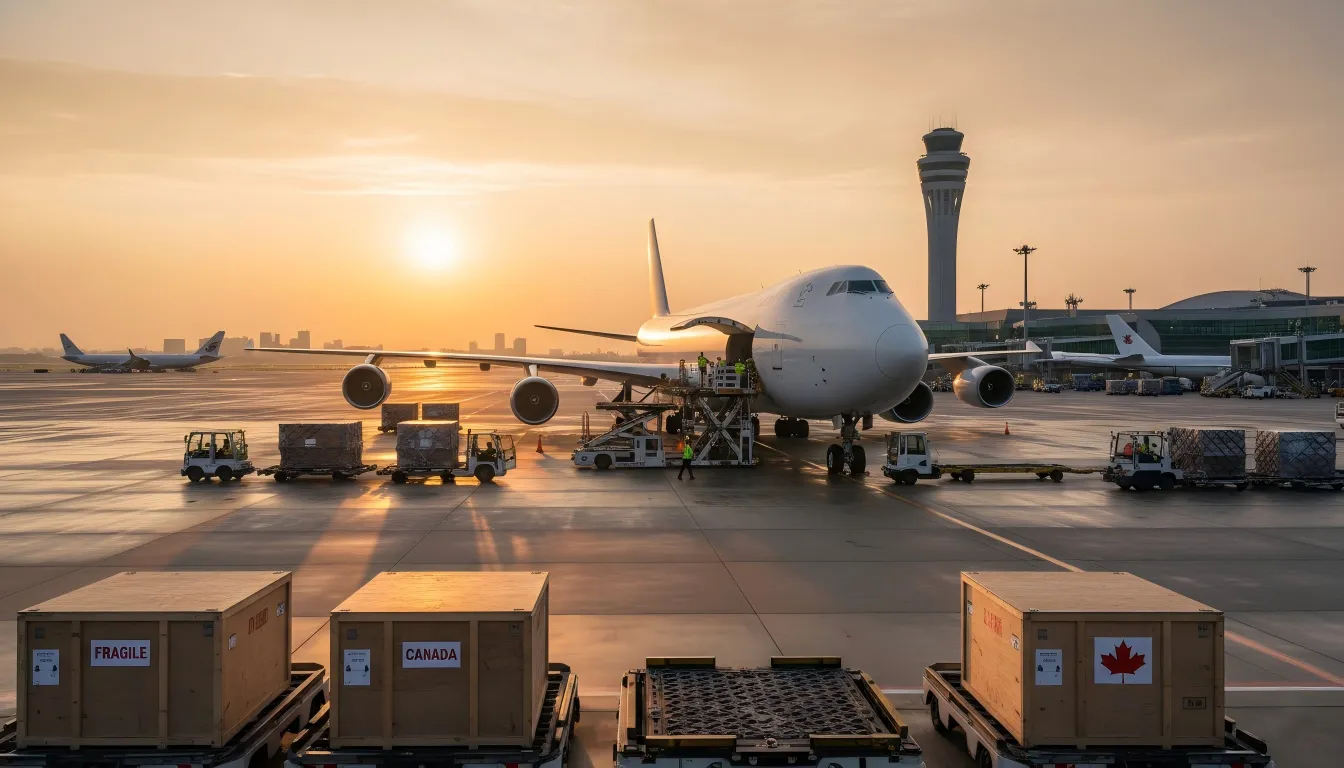
This comprehensive guide cuts through the noise. As freight forwarding experts who successfully managed over 5,000 tons of air cargo to North America last year, we will break down the real costs, exact transit times, and "insider" strategies to avoid customs delays in 2026. Whether you are an Amazon FBA seller, a Shopify store owner, or a B2B importer, this guide is your blueprint for efficient, cost-effective air transport.
When to Choose Air Freight? (Air vs. Sea vs. Express)
The decision between air freight, sea freight, and express courier services often comes down to a balance of three factors: Volume, Budget, and Urgency. To optimize your overall strategy for shipping from China to Canada, it is crucial to understand where air freight fits into the mix.
The "Golden Rule" of Weight
One of the most reliable metrics for choosing a shipping method is the chargeable weight of your shipment.
- < 150kg: Express (Courier) services like DHL, UPS, or FedEx are often the best choice. At this weight, the minimum charges for standard air freight make it less economical than the all-in rates of couriers.
- 150kg - 500kg: Standard Air Freight is the sweet spot. Here, the price per kilogram drops significantly compared to express, making it the most cost-efficient option for medium-sized urgent shipments.
- > 500kg: Sea Freight becomes significantly cheaper. Unless your goods are extremely urgent or high-value, ocean transport (LCL or FCL) will offer massive savings.
Urgency: Time to Market
If your "Time to Market" outweighs the shipping cost, air freight is the winner. For fashion retailers launching a seasonal collection or electronics brands releasing a new gadget, being late means missing the trend. Air freight ensures your goods are on the shelf in days, not weeks.
Commodity Type
Air freight is the standard for high-value, low-volume goods.
- Electronics: Phones, tablets, and components.
- Fashion: High-end apparel and samples.
- Perishables: Foods or pharmaceuticals requiring temperature control.
- Documents: Urgent contracts or samples.
Comparison Table: Air Freight vs. Sea Freight vs. Express
| Feature | Express (Courier) | Standard Air Freight | Sea Freight (LCL) |
|---|---|---|---|
| Speed (Door-to-Door) | 2-4 Days | 4-7 Days | 25-40 Days |
| Cost | High ($$$) | Medium ($$) | Low ($) |
| Customs Clearance | Automated/Fast | Requires Broker | Complex/Slower |
| Best For | Documents, Samples, <150kg | 150kg-500kg Shipments | Bulk Cargo, >500kg |
| Tracking | Real-time, Detailed | Milestone-based | Milestone-based |
Major Air Routes & Airports
Understanding the geography of air logistics can help you plan better. China has several key export hubs, each serving different regions and industries.
Key Chinese Gateways
- PVG (Shanghai Pudong International Airport): The busiest cargo airport in China. It is the main hub for general cargo from the Yangtze River Delta (Suzhou, Hangzhou, Ningbo).
- CAN (Guangzhou Baiyun International Airport): The primary gateway for Southern China. Best for exports from Guangzhou, Foshan, and surrounding manufacturing hubs.
- HKG (Hong Kong International Airport): A crucial hub for special cargo. Unlike mainland China, Hong Kong has looser restrictions on batteries and e-liquids. It is the "E-cigarette/Battery" gateway.
- SZX (Shenzhen Bao'an International Airport): Ideally located for tech exports from the "Silicon Valley of Hardware."
Key Canadian Entry Points
- YVR (Vancouver International Airport): The closest North American entry point from Asia. Flights to YVR are often the fastest and most cost-effective. It serves as a transshipment hub for the rest of Canada.
- YYZ (Toronto Pearson International Airport): Located in Canada's economic heart. It is the major distribution hub for the East Coast and the heavily populated Ontario region.
- YUL (Montreal-Trudeau International Airport): Key for Quebec and Eastern Canada.
- YYC (Calgary International Airport): Serving Western Canada and the prairies.
Route Types: Direct vs. Transshipment
- Direct Flights: Fastest (e.g., Air China direct from Beijing to Vancouver). More expensive but reliable.
- Transshipment: Flights may stop in Korea (Incheon), Japan (Narita), or the USA (Anchorage/Los Angeles) before reaching Canada. These are often cheaper but add 1-2 days to the transit time and increase the risk of delays.
Transit Time: How Long Does It Really Take?
"Air freight" sounds instant, but it involves more than just the flight time. If you are wondering How Long to Ship from China to Canada, here is the breakdown.
The Breakdown
Airport-to-Airport: The actual flight time is only 12-15 hours. However, including handling at both ends, this phase takes 1-3 days.
Door-to-Door: This includes pickup in China, export customs, the flight, import customs in Canada, and final delivery. For more details, check our guide on Door to Door Shipping from China to Canada.
- Standard Air Freight: 4-7 Days.
- Priority Air Freight: 2-4 Days.
- Economical Air Freight: 7-10 Days (often involves transshipment).
Factors Causing Delays
Even the fastest planes can be grounded by bureaucracy.
Pro Tip from Our Team: Avoid shipping sensitive electronics via mainland China during the "Two Sessions" political meetings in March, as security checks tighten significantly. We often reroute these via Hong Kong to maintain speed.
- Customs Inspections (CBSA): The Canada Border Services Agency may select shipments for random examinations. This can add 24-72 hours.
- Peak Season Congestion: In Q4 (October to December), cargo capacity is tight due to the holiday rush. Shipments can be "rolled" (bumped to the next flight), causing delays.
- Weather Events: Typhoons in Asia or snowstorms in Canada can disrupt flight schedules.
Estimated Transit Times for Major Routes
| Route (China to Canada) | Airport-to-Airport | Door-to-Door (Est.) |
|---|---|---|
| Shanghai (PVG) to Vancouver (YVR) | 1-2 Days | 3-5 Days |
| Shanghai (PVG) to Toronto (YYZ) | 2-3 Days | 4-6 Days |
| Shenzhen (SZX) to Toronto (YYZ) | 2-4 Days | 5-7 Days |
| Hong Kong (HKG) to Montreal (YUL) | 2-4 Days | 5-8 Days |
Air Freight Costs & Rates (2026 Update)
Air freight rates are volatile, changing weekly based on fuel prices and demand.
Market Alert (2026): Due to ongoing fluctuations in global oil prices, the Fuel Surcharge (FSC) can change monthly. Always request a valid-for-7-days quote before booking.
Rate Structure Explained
When you receive a quote, it typically includes:
- Base Rate: The cost per kilogram charged by the airline.
- FSC (Fuel Surcharge): Linked to oil prices, currently hovering around 15-25% of the base rate.
- SSC (Security Surcharge): A smaller fee for x-ray and screening.
- THC (Terminal Handling Charges): Fees for handling cargo at the airport terminals.
Current Market Estimates (2026)
General Cargo Rates: Currently ranging between
6.50 USD per kg. Weight Brackets: Air freight operates on a sliding scale. The more you ship, the less you pay per kilo.
- +45kg: Highest rate per kg.
- +100kg: Moderate discount.
- +300kg: Significant discount.
- +1000kg: Best "heavy cargo" rates.
Chargeable Weight: The "Silent Budget Killer"
This is the most common source of confusion for importers. Airlines charge based on whichever is greater: Gross Weight (actual scale weight) or Volumetric Weight.
- Volumetric Weight Formula:
(Note: Express couriers often use 5000 as the divisor, making it more expensive).
Real Example: Imagine you are shipping 10 cartons of cotton wool.
- Gross Weight: 50 kg (very light).
- Dimensions: 0.5m x 0.5m x 0.5m per carton. Total Volume = 1.25 CBM.
- Volumetric Calculation:
.
In this case, the airline will charge you for 208 kg, not 50 kg. This is why "light but bulky" goods are expensive to ship by air.
The Shipping Process: Step-by-Step
Understanding the workflow helps you monitor your shipment effectively.
- Booking: You or your supplier contact a freight forwarder (like AllBestShipping) to request a quote. Once accepted, space is booked on a flight.
- Pickup & Consolidation: The forwarder arranges a truck to pick up goods from the factory. If you have multiple suppliers, goods are consolidated at the forwarder's warehouse.
- Export Customs (China): Documents are submitted to Chinese Customs. Once cleared, the goods are released for loading.
- Air Transit: The cargo is loaded onto the aircraft and flown to Canada.
- Import Customs (Canada): Before arrival, your customs broker submits the manifest to CBSA. You pay the applicable Duties and Taxes (GST/HST).
- Final Delivery: Once released, the cargo is moved to a bonded warehouse, then trucked to your final destination (warehouse, office, or Amazon FBA center).
Customs Clearance & Documentation for Canada
Canada has strict import regulations. Missing documents can lead to expensive storage fees at the airport.
Essential Documents
- Air Waybill (AWB): The transport contract. A "Master AWB" covers the whole shipment, while a "House AWB" is issued to you by the forwarder.
- Commercial Invoice: Must detail the buyer, seller, description of goods, value, and country of origin.
- Packing List: Details the contents, weight, and dimensions of each package.
- Canada Customs Invoice (CCI): Required for shipments valued over $2,500 CAD. It provides specific data fields required by CBSA.
- Certificate of Origin: Necessary if you want to claim preferential tariff treatment under trade agreements.
Duties & Taxes
GST (Goods and Services Tax): A 5% federal tax applies to almost all commercial imports.
PST/HST: Depending on the province of destination, you may also pay Provincial Sales Tax (PST) or Harmonized Sales Tax (HST).
- Ontario: 13% HST.
- British Columbia: 5% GST + 7% PST.
- Alberta: 5% GST only.
De Minimis Threshold: The threshold for duty-free and tax-free imports is very low in Canada (around $20 CAD for most goods). Be prepared to pay taxes on almost everything.
- Expert Note: Unlike the USA's generous $800 de minimis, Canada collects taxes aggressively. Under-declaring value to avoid this is a red flag for CBSA and can lead to permanent blacklisting of your importer account.
DDP Shipping (Delivered Duty Paid): This is the hassle-free option. The freight forwarder includes all transport, duties, and taxes in one final price. You don't need to worry about paying CBSA directly. Learn more about DDP Shipping.
Prohibited & Restricted Items
Safety is paramount in air transport.
- Batteries: Lithium batteries (Power banks, laptops) are classified as Dangerous Goods (DG) under IATA DGR. They require MSDS (Material Safety Data Sheet) and UN38.3 test reports. Shipping them via Hong Kong is often easier than mainland China.
- Liquids & Powders: Hard to verify via x-ray, often requiring special chemical testing reports (DGM).
- Brand Name Goods: Shipping branded goods (Nike, Apple, etc.) without an official Letter of Authorization from the brand owner risks seizure by customs for trademark infringement.
Tips to Reduce Air Shipping Costs
- Optimize Packaging: "Ship air, pay for air." Work with your supplier to minimize packaging size. Vacuum-pack soft goods (like plush toys or clothes) to reduce volumetric weight.
- Consolidate Shipments: If you are buying from three different factories, don't ship three separate small parcels. Consolidate them into one larger shipment to hit the +100kg or +300kg rate brackets.
- Book in Advance: Spot rates (last-minute) are expensive. Booking 5-7 days in advance can secure better "contract rates."
- Mix Modes (Sea-Air): For a middle ground, consider Sea-Air via Dubai or Los Angeles. It's faster than pure sea freight and cheaper than pure air freight.
Why Choose AllBestShipping?
At AllBestShipping, we don't just move boxes; we optimize your supply chain.
- Competitive Rates: We hold direct contracts with major airlines like Air China (CA), Cathay Pacific (CX), and Air Canada (AC), allowing us to pass significant savings to you.
- Expertise with Complex Cargo: We specialize in handling batteries, electronics, and oversized cargo that other forwarders refuse.
- DDP Services: Our "Door-to-Door DDP" service means we handle the customs headache. You get a single invoice, and your goods show up at your door.
- 24/7 Support: Our team provides real-time tracking and is always available to answer your questions, bridging the time zone gap between China and Canada.
FAQ
How much is air freight from China to Canada per kg?
In 2026, standard air freight rates generally range from
Is DHL cheaper than air freight? For shipments under 150kg, DHL (or other couriers) is often cheaper and faster because the price is "all-inclusive" (excluding duties). For shipments over 150kg, standard air freight is usually 30-50% cheaper per kilo.
What is the difference between chargeable weight and gross weight? Gross weight is the actual weight on the scale. Chargeable weight is the greater of the gross weight or the volumetric weight (L x W x H / 6000). Airlines charge based on whichever is higher.
Can I ship directly to Amazon FBA in Canada by air? Yes! AllBestShipping offers direct air service to Amazon FBA fulfillment centers in Canada (e.g., YYZ4, YVR3). We handle the appointment booking and delivery according to Amazon's strict requirements.
Conclusion
Air shipping from China to Canada is the engine of rapid commerce. While it costs more than ocean freight, the speed and reliability it offers can be the difference between a stocked shelf and a lost sale. By understanding the rate structures, optimizing your packaging, and choosing the right partner, you can turn logistics from a cost center into a competitive advantage.
Ready to ship? Don't let logistics slow you down. Contact AllBestShipping today for a free, instant quote and experience the difference of working with true freight forwarding experts.