How Long to Ship from China to USA: The 2026 Definitive Guide
"How long does it take to ship from China to the USA?" This is the first question every importer asks us at AllBestShipping. Whether you are launching a new product line on Amazon or restocking critical inventory, knowing the exact transit time is the difference between a profitable quarter and a stockout disaster.
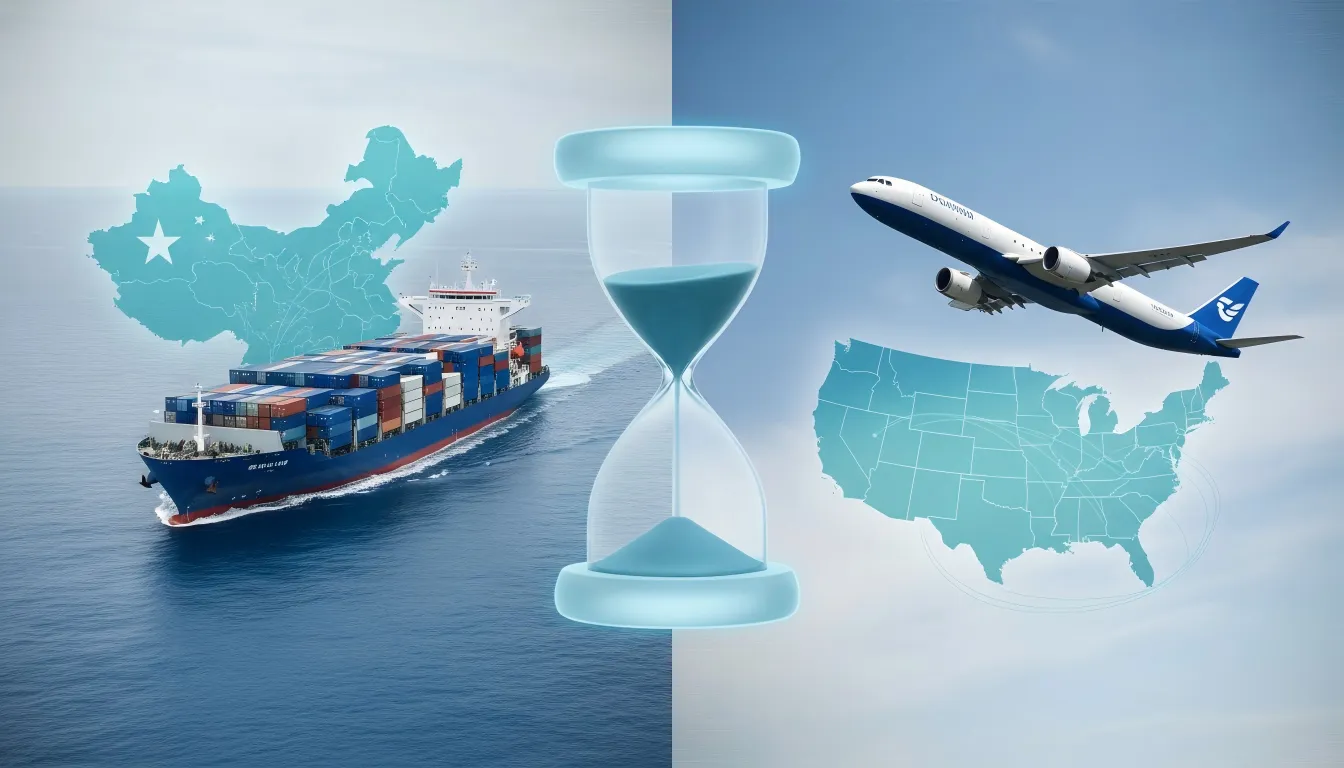
In 2026, the answer isn't a simple number. It depends heavily on your choice of logistics: Express shipping can take as little as 1–4 days, while standard ocean freight can range from 13 days (West Coast) to over 40 days (East Coast).
As freight forwarders with over a decade of experience navigating the trans-Pacific trade lane, we have seen it all—from the port congestion of Los Angeles to the rapid efficiency of air charters. In this comprehensive guide, we will break down the realistic timelines for every shipping method, explain the "hidden" delays that most forwarders won't tell you about, and share our insider strategies to get your goods delivered faster.
1. Quick Summary: China to USA Shipping Times (2026 Estimates)
If you are in a rush, here is the "cheat sheet" we use with our clients to set initial expectations.
| Shipping Mode | Transit Time (Door-to-Door) | Best For |
|---|---|---|
| Express (DHL/FedEx) | 2 – 5 Days | Urgent samples, documents, high-value small parcels (< 100kg). |
| Standard Air Freight | 5 – 10 Days | High-value goods, electronics, fashion (100kg - 1000kg). |
| Sea Freight (West Coast) | 20 – 30 Days | Bulk inventory to California, Nevada, Arizona. |
| Sea Freight (East Coast) | 30 – 45 Days | Bulk inventory to New York, Florida, Texas. |
| Sea Freight (LCL) | +7 – 10 Days extra | Smaller shipments sharing container space. |
Pro Tip: These are average times. In Q4 (Peak Season) or during the weeks leading up to Chinese New Year (February 17, 2026), you should add a buffer of at least 5–7 days.
2. Ocean Freight Transit Times: The Backbone of Trade
Sea Freight accounts for over 90% of cargo volume from China to the US. It is the most cost-effective option, but it requires patience and planning.
West Coast vs. East Coast: The Great Divide
The geography of the US plays a massive role in transit time.
West Coast (Los Angeles, Long Beach, Seattle, Oakland):
- Port-to-Port: 13 – 16 days. This is the fastest ocean route. Fast boats (like Matson) can even hit 11 days from Shanghai to Long Beach.
- Door-to-Door: 20 – 30 days. This accounts for customs clearance and final trucking.
- Our Experience: For clients needing speed but wanting to avoid air freight costs, we often recommend the "Matson Express" service. It costs a premium but guarantees faster unloading at a dedicated terminal in Long Beach, avoiding the worst of the congestion.
East Coast (New York, Savannah, Norfolk, Miami):
- Port-to-Port: 28 – 38 days. Most vessels route through the Panama Canal.
- Door-to-Door: 35 – 50 days.
- Real-World Context: With occasional drought restrictions in the Panama Canal or congestion at East Coast ports, this route can be unpredictable. For urgent East Coast shipments, we sometimes suggest shipping to LA and trucking across the country (Land Bridge), though this is more expensive.
FCL vs. LCL: Why Full Containers are Faster
FCL (Full Container Load): You rent the whole box. Once it's sealed at the factory, it stays sealed until it reaches you. Transit time is standard.
LCL (Less than Container Load): You share space. This adds 5–10 days to your timeline.
- Why? The cargo must be consolidated at a warehouse in China (wait time: 3-5 days) and deconsolidated at a warehouse in the US (wait time: 3-5 days). We often advise clients: if you have 15 CBM or more, just book a 20ft FCL. It might cost slightly more than LCL, but you save a week of time and reduce the risk of damage.
3. Air Freight and Express: When Speed is Non-Negotiable
For electronics, fashion, or "just-in-time" inventory, Air Freight is the king of speed.
Standard Air Freight (Airport-to-Airport)
- Transit Time: 3 – 7 days.
- Process: Goods are trucked to major hubs like Shanghai (PVG), Shenzhen (SZX), or Hong Kong (HKG). They fly to US hubs (LAX, JFK, ORD) and are then cleared.
- The "Direct" vs. "Indirect" Trap: Be careful. A "direct" flight takes 12-15 hours. But many cheaper air quotes use "indirect" flights that stop in Korea, Alaska, or Europe, adding 2-3 days to the journey. Always ask your forwarder: "Is this a direct flight?"
Express Courier (Door-to-Door)
- Transit Time: 2 – 5 days.
- Carriers: DHL, FedEx, UPS.
- Why it's faster: These carriers have their own customs networks and planes. Customs clearance is often done "in the air" (electronic pre-clearance), so the package starts moving to the final mile almost immediately upon landing.
- Use Case: We recently had a client needing prototype samples in New York for a Monday meeting. We shipped via DHL Express on Thursday from Shenzhen, and it arrived on Monday morning.
4. Key Factors That Delay Your Shipment (and How to Avoid Them)
Even the best plans can face delays. Here is what typically goes wrong and how we mitigate it.
1. Customs Clearance Holds
- The Delay: 2 – 10 days.
- The Cause: Incorrect HS Codes, missing paperwork (like the Toxic Substance Control Act form for chemicals), or undervaluation.
- Our Solution: We review all commercial invoices before the goods leave China. In 2026, US Customs (CBP) is stricter than ever on data accuracy regarding "forced labor" regulations. Ensure your supplier provides a complete paper trail.
2. The "Last Mile" Bottleneck
- The Delay: 3 – 7 days.
- The Cause: Once the ship arrives, it doesn't mean your goods are available. Containers must be unloaded, and chassis (trailers) must be available.
- Rail Delays: If you are shipping to inland cities like Chicago or Dallas via "IPI" (Interior Point Intermodal), expect delays at the rail ramp. We often see containers sit in LA for 5-7 days waiting for a train.
3. Seasonal Disruptions (CNY & Q4)
- Chinese New Year (CNY): In 2026, CNY falls on February 17. Factories stop production 2 weeks prior.
- The Impact: Space becomes fully booked, and prices skyrocket.
- Strategy: You MUST book your space by mid-January. If you wait until February 1st, your cargo will likely roll over to March.
5. Case Studies: Real Transit Times from Our Log
To give you a realistic picture, here are three actual shipments we managed in January 2026:
Case A: The Urgent Restock (Shenzhen to Amazon FBA Dallas)
- Method: Matson Fast Boat + Trucking (No Rail).
- Timeline: Departs Shanghai Day 0 -> Arrives Long Beach Day 11 -> Available Day 12 -> Truck to Dallas Day 14.
- Total: 14 Days. (Fastest ocean option).
Case B: The Bulk Furniture Order (Ningbo to New York)
- Method: Standard FCL via Panama Canal.
- Timeline: Departs Ningbo Day 0 -> Arrives NY/NJ Day 35 -> Unloaded & Cleared Day 38.
- Total: 38 Days. (Standard East Coast option).
Case C: The Small Electronics Batch (Hong Kong to Los Angeles)
- Method: Air Freight (Direct).
- Timeline: Departs HKG Day 0 -> Arrives LAX Day 1 -> Cleared & Delivered Day 3.
- Total: 3 Days.
6. How to Speed Up Your Shipping: Insider Tips
If you need to shave days off your supply chain, here is what we recommend:
- Split Your Shipment: Don't put all your eggs in one basket. Ship 10% via Air Freight to keep stock flowing, and send the remaining 90% via Sea Freight to save costs.
- Pre-Clear Customs: File your ISF (Importer Security Filing) and customs entry as early as possible. We can often file the entry 5 days before the ship arrives, so the cargo is "wheels up" the moment it hits the dock.
- Optimize Packaging: For air freight, volume weight kills your budget. Work with your supplier to minimize empty space in cartons.
- Use a Reliable Forwarder: A good forwarder doesn't just book space; they solve problems. We monitor port congestion daily and will reroute your cargo (e.g., to Seattle instead of LA) if we see a bottleneck forming.
7. FAQ: Common Questions on Transit Times
Q: Does "Shipping Time" include manufacturing time? A: No. "Shipping Time" usually refers to the transit from the port/airport to the destination. Always add the factory's "Lead Time" (usually 15-30 days) to your total planning.
Q: Why is my tracking showing "stuck" at the port? A: It's likely waiting for a customs exam or a chassis. "Closed" exams take 2-3 days; "Intensive" exams can take 7-14 days. This is random, but proper documentation reduces the risk.
Q: Is shipping to Amazon FBA slower? A: Yes, slightly. Amazon fulfillment centers have strict appointment slots. Even if your goods arrive in LA, getting a delivery slot at Amazon's warehouse (e.g., ONT8) can sometimes take an extra 3-5 days during peak season.