Door to Door Shipping from China to Iraq: The Complete 2026 Guide (Costs, Transit Times & DDP vs DDU)
Iraq imports over $30 billion in goods annually, and Chinese manufacturers supply a massive share of that demand. But here's the reality most importers discover too late: Door to Door Shipping from China to Iraq is not a simple A-to-B transaction. Without local expertise, your cargo can sit for weeks at Umm Qasr port or Baghdad International Airport, racking up demurrage fees while you scramble to understand Iraq's dual customs system.
We've spent years moving freight from Shenzhen factories to Baghdad warehouses, Basra construction sites, and Erbil distribution centers. In our experience managing China-to-Iraq shipments through peak seasons and political transitions, we have learned that the difference between a 30-day delivery and a 60-day nightmare usually comes down to three details: choosing the right Incoterms 2020 term, routing through the correct customs territory, and securing COSQC certification before the cargo leaves the factory. This guide fixes all of that. You'll get real 2026 pricing, transit times for every major China-Iraq corridor, a clear breakdown of DDP versus DDU, and the compliance steps your competitors probably don't know about.
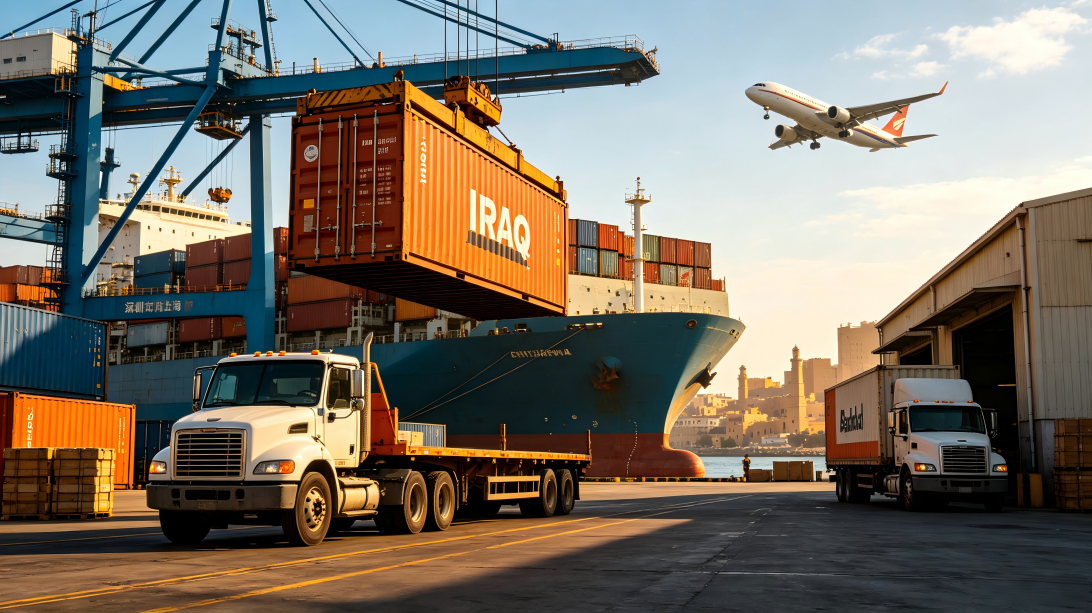
What Is Door-to-Door Shipping from China to Iraq?
Door-to-door shipping means one contract, one responsible party, and zero coordination headaches for you. Your freight forwarder handles everything from factory pickup in China to final delivery at your Iraqi facility. That includes export documentation, China customs clearance, international transport, Iraq import customs, duty and tax payment, and last-mile trucking.
Under the Incoterms 2020 framework, door-to-door services typically map to DDP (Delivered Duty Paid) or DDU (Delivered Duty Unpaid). These terms define exactly where the seller's responsibility ends and the buyer's begins — a distinction that matters enormously in Iraq's complex regulatory environment.
DDP vs DDU: The Decision That Changes Everything
The single most important choice you'll make is whether to ship under DDP (Delivered Duty Paid) or DDU (Delivered Duty Unpaid). Get this wrong, and your cargo stalls at the border while you figure out how to pay Iraqi customs in dinars.
| Feature | DDP (Delivered Duty Paid) | DDU (Delivered Duty Unpaid) |
|---|---|---|
| Seller/Forwarder Responsibility | All costs and risks until final delivery, including duties and taxes | All costs and risks until destination, excluding duties and taxes |
| Import Customs Clearance | Handled entirely by forwarder | Handled by forwarder, but buyer pays duties |
| Duty & Tax Payment | Included in quoted price | Buyer pays separately upon arrival |
| Price Predictability | Fixed total cost known upfront | Base freight known; duties are variable |
| Best For | First-time importers, SMEs without local Iraqi customs contacts | Experienced importers with local agents and dinar accounts |
| Risk Level | Low — forwarder assumes customs risk | Medium — buyer bears customs delay risk if payment lags |
| Typical Use Case | E-commerce sellers, retailers, project contractors | Large wholesalers with established Baghdad operations |
In our experience, roughly 70% of China-to-Iraq shipments move DDP. The Iraqi customs environment is complex enough that most importers prefer paying a predictable premium rather than navigating duty calculations, COSQC inspections, and potential storage penalties themselves.
Insider insight: We once had a client switch from DDU to DDP mid-shipment because their local Baghdad agent failed to arrange dinar payment in time. The cargo sat at Umm Qasr for 11 days, accumulating $340 in demurrage. That single delay wiped out the savings they expected from DDU. For most importers without a dedicated Iraqi treasury contact, DDP is the safer financial bet.
How It Differs from Port-to-Port
Port-to-port shipping ends when your container hits Umm Qasr or your air cargo lands at Baghdad International (BGW). From there, you're on your own for customs clearance, inland transport, and dealing with Iraqi bureaucracy. Door-to-door puts all of that on your forwarder's shoulders. For most importers, the small premium is worth avoiding the operational nightmare of coordinating Iraqi trucking, customs brokers, and duty payments from another time zone.
Door-to-Door Shipping Options: Sea vs Air vs Express
Not every shipment needs the same mode. Here's how the three main options break down for China-to-Iraq corridors.
Sea Freight (FCL and LCL)
Sea freight remains the dominant mode for China-to-Iraq cargo, especially for construction materials, machinery, consumer goods, and bulk inventory.
Typical routing:
- FCL (Full Container Load) and LCL (Less than Container Load) depart from Shanghai, Shenzhen, Ningbo, or Qingdao
- Transit via Jebel Ali (Dubai) or direct to Umm Qasr port
- Inland trucking to Baghdad, Basra, or north toward KRG territory
Most containers bound for central or northern Iraq clear at Umm Qasr, then move by truck. For southern destinations like Basra, some forwarders use transhipment through Dubai or Kuwait depending on carrier schedules and port congestion.
Real-world routing note: In our experience, the Jebel Ali transhipment hub often adds 3–5 days to the total transit time compared to direct Umm Qasr calls, but direct sailings from Chinese ports to Umm Qasr are limited. We typically book Jebel Ali transhipment for LCL cargo and reserve direct Umm Qasr vessel space for FCL clients with strict deadlines.
Air Freight
Air freight suits high-value, time-sensitive cargo: electronics, spare parts, medical equipment, and urgent project materials.
Typical routing:
- Origin: Shanghai Pudong (PVG), Guangzhou Baiyun (CAN), or Shenzhen (SZX)
- Direct or via Dubai (DXB) / Doha (DOH)
- Destination: Baghdad (BGW), Basra (BSR), or Erbil (EBL)
Air freight door-to-door includes pickup, export clearance, flight, import clearance, and delivery. Transit times range from 5 to 12 days depending on whether you book direct flights or consolidated service.
Express and Courier
For samples, documents, and small parcels under 100 kg, express couriers offer the simplest door-to-door solution. Major carriers operate China-to-Iraq express lanes, though remote areas outside Baghdad, Basra, and Erbil may incur extended delivery windows or additional fees.
Decision Framework: Which Mode Is Right for You?
| Factor | Sea Freight (FCL/LCL) | Air Freight | Express/Courier |
|---|---|---|---|
| Volume | 1 CBM+ (LCL) or full container | 50–500 kg sweet spot | Under 100 kg |
| Weight | Any weight | Cost-effective under 500 kg | Under 100 kg ideal |
| Urgency | Low — 25–45 days | Medium — 5–12 days | High — 3–7 days |
| Budget | Lowest cost per kg | 5–10x sea freight cost | Highest cost per kg |
| Cargo Type | Bulk goods, machinery, furniture | Electronics, pharma, urgent parts | Samples, documents, small parcels |
| Best For | Regular inventory replenishment | Time-sensitive project cargo | Quick prototypes or urgent documents |
Step-by-Step: How Door-to-Door Shipping from China to Iraq Works
Understanding the full chain helps you spot delays before they happen. Here's the seven-stage process we follow on every China-to-Iraq shipment.
Step 1: Factory Pickup in China
Your forwarder arranges collection from the supplier's facility — whether that's a Shenzhen electronics factory, a Ningbo furniture manufacturer, or a Shanghai machinery plant. At this stage, the forwarder verifies cargo condition, counts cartons or pallets, and confirms packing matches export requirements.
Pro tip from our operations team: We always request suppliers to mark each carton with the destination city in both English and Arabic (Baghdad, Basra, or Erbil). This simple step prevents misrouted cargo at Umm Qasr, where warehouse staff handle thousands of containers weekly. One mislabeled carton can delay an entire LCL shipment by 2–3 days.
Step 2: Export Documentation
The forwarder prepares the commercial invoice, packing list, Bill of Lading (B/L) or Airway Bill (AWB), and any certificates required for Iraqi import (notably COSQC certificates for regulated products). Accuracy here is non-negotiable. One mismatch between invoice and packing list can trigger a customs hold that costs you days.
Every document must reference the correct HS Codes (Harmonized System codes). Iraqi customs uses HS Codes to determine duty rates and whether COSQC certification applies. A mismatched HS Code is the single most common cause of customs delays we see on China-to-Iraq shipments.
Step 3: China Export Customs Clearance
Cargo clears Chinese customs at the port of departure. For sea freight, that's usually Shenzhen, Shanghai, or Ningbo. For air freight, it's the origin airport. Standard clearance takes 1–3 days if documentation is clean.
Step 4: International Transport
Sea freight moves via mainline vessel to Jebel Ali or direct to Umm Qasr. Air freight flies direct or via a Middle Eastern hub. During transit, your forwarder should provide tracking updates — vessel name, estimated arrival, and any transshipment events.
Step 5: Iraq Import Customs Clearance
This is where Iraq gets complicated. You don't have one customs regime. You have two.
Federal Iraq (Baghdad, Basra, and all territory south of the KRG border) uses the Arabic-language federal customs system. Clearance happens at Umm Qasr port for sea freight or Baghdad International Airport for air cargo.
Kurdistan Region of Iraq (KRG) (Erbil, Sulaymaniyah, Duhok) operates a separate customs administration. Cargo entering the KRG must clear at the Ibrahim Khalil border crossing or Erbil airport, and documentation often requires both Kurdish and Arabic versions.
The critical mistake we see: importers ship to Umm Qasr, clear federal customs, then try to truck cargo north into the KRG — only to face a second customs clearance and additional duties. If your final destination is Erbil, route the shipment directly into KRG territory from the start. It saves time, money, and paperwork.
Case example: In early 2025, a construction materials importer routed a 20-foot container to Umm Qasr for a Basra project, then decided to divert half the cargo to Erbil. The result: federal clearance at Umm Qasr, KRG clearance at Ibrahim Khalil, and two sets of trucking fees. Total cost overrun: 34%. The importer now splits shipments by destination before they leave Ningbo.
Step 6: Duty and Tax Payment
Under DDP, your forwarder calculates and pays all applicable duties, taxes, and customs fees on your behalf. Under DDU, you or your local agent must arrange payment. Iraqi customs accepts payment in Iraqi dinars, and processing delays are common if the payment mechanism isn't pre-arranged.
Step 7: Last-Mile Delivery
Once cleared, cargo trucks to the final destination. For Baghdad, that's typically a 6–8 hour drive from Umm Qasr. For Basra, it's shorter. For Erbil, routing depends on whether you cleared through federal Iraq or the KRG directly — another reason to get the corridor right at the planning stage.
Costs Breakdown: Door-to-Door Shipping from China to Iraq (2026)
Let's talk numbers. These are representative market rates for 2026 based on current fuel costs, carrier pricing, and Iraqi customs fee structures. Your actual quote will vary by cargo type, season, and forwarder relationship.
Pricing transparency note: The figures below are compiled from our own AllBestShipping rate cards and market intelligence gathered from weekly China-Iraq departures. They are estimates only. For an exact, itemized quote tailored to your cargo, contact us with your pickup city, delivery address, cargo dimensions, weight, and HS Codes.
Sea Freight DDP Pricing (Door-to-Door)
| Service Type | Volume / Size | Estimated DDP Rate (USD) | Notes |
|---|---|---|---|
| LCL | 1 CBM | $280–$380 | Shared container; rate per CBM |
| LCL | 5 CBM | $1,200–$1,600 | Consolidated; includes trucking to Baghdad |
| LCL | 10 CBM | $2,200–$2,900 | Economies of scale kick in |
| FCL 20ft | 28–30 CBM | $4,500–$6,200 | Full container; DDP to Baghdad |
| FCL 40ft | 58–60 CBM | $6,800–$9,500 | Standard or high-cube options |
| FCL 40ft HC | 68–70 CBM | $7,500–$10,200 | Best for light, bulky cargo |
Air Freight DDP Pricing (Door-to-Door)
| Weight Range | Estimated DDP Rate (USD) | Notes |
|---|---|---|
| 50–100 kg | $8.50–$12.00 / kg | Minimum charges apply |
| 100–300 kg | $7.00–$9.50 / kg | Consolidated air freight |
| 300–500 kg | $6.00–$8.00 / kg | Better rates at higher volumes |
| 500+ kg | $5.50–$7.50 / kg | Negotiable with forwarder contracts |
What's Included vs. What's Not
| Included in DDP Quote | Typically Excluded |
|---|---|
| China factory pickup | Supplier packing non-compliance |
| Export customs clearance | COSQC certificate fees (if required) |
| International freight | Cargo insurance (often separate) |
| Iraq import customs clearance | Storage after free time expires |
| Duty and tax payment | Re-inspection fees for non-compliant cargo |
| Last-mile delivery to named address | Delivery to remote areas outside major cities |
Hidden Costs to Watch For
- Port storage at Umm Qasr: Free time is typically 7–10 days. After that, daily charges escalate fast.
- COSQC inspection fees: If your cargo requires certification and arrives without it, inspection and testing fees at port can exceed $500 per batch.
- KRG double clearance: Routing through federal Iraq then trucking to the KRG triggers two separate customs processes. Budget an extra 15–25% in duties and fees.
- Currency conversion: Iraqi customs transactions happen in dinars. If your forwarder doesn't handle conversion efficiently, you eat exchange rate spreads.
DDP vs DDU vs FOB/CIF: Total Cost Comparison (5 CBM Scenario)
| Cost Component | DDP Door-to-Door | DDU Door-to-Door | FOB Port-to-Port | CIF Port-to-Port |
|---|---|---|---|---|
| China pickup | Included | Included | Buyer arranges | Buyer arranges |
| Export clearance | Included | Included | Seller handles | Seller handles |
| Ocean freight | Included | Included | Buyer pays | Included |
| Insurance | Often included | Often included | Buyer arranges | Included |
| Iraq import customs | Included | Included | Buyer handles | Buyer handles |
| Duty & tax | Included | Buyer pays | Buyer pays | Buyer pays |
| Inland delivery | Included | Included | Buyer arranges | Buyer arranges |
| Total Estimated Cost | $1,350–$1,750 | $1,100–$1,450 + duties | $800–$1,100 + all local costs | $950–$1,250 + all local costs |
| Predictability | High | Medium | Low | Low |
| Management Burden | Minimal | Medium | High | High |
For a 5 CBM shipment, DDP door-to-door typically costs 20–30% more than the base freight under FOB or CIF. But when you factor in the cost of your time, potential delays, and the risk of customs penalties, DDP usually wins for any importer without a dedicated Iraqi logistics team.
Fair assessment: While DDP is the most hassle-free option for most SMEs and first-time importers, if you have an established Baghdad customs broker and a local dinar account, DDU or even FOB/CIF can reduce your landed cost by 10–15%. The key is having the local infrastructure to manage what comes after the port.
Transit Times: How Long Does Door-to-Door Shipping Take?
Sea Freight Transit Times (Door-to-Door)
| Origin → Destination | Transit Time | Notes |
|---|---|---|
| Shanghai → Baghdad | 28–38 days | Via Jebel Ali or direct to Umm Qasr |
| Shenzhen → Basra | 25–35 days | Southern routing; often faster to Basra |
| Ningbo → Baghdad | 30–40 days | Similar to Shanghai corridor |
| Ningbo → Erbil | 35–48 days | KRG routing; border clearance adds time |
| Qingdao → Baghdad | 32–42 days | Northern China origin |
Air Freight Transit Times (Door-to-Door)
| Origin → Destination | Transit Time | Notes |
|---|---|---|
| Shanghai → Baghdad | 5–8 days | Direct or via DXB/DOH |
| Guangzhou → Baghdad | 6–10 days | Consolidated service common |
| Shenzhen → Erbil | 7–12 days | KRG clearance adds 1–3 days |
| Shanghai → Basra | 6–9 days | Limited direct flights; often via hub |
Common Delay Factors
Even with perfect planning, these issues can add days or weeks:
- COSQC inspection backlog: If your cargo category requires certification and the port inspector is backlogged, expect 3–10 day delays.
- KRG border congestion: The Ibrahim Khalil crossing sees periodic closures and long truck queues. During peak periods, waits of 2–5 days are not unusual.
- Umm Qasr port congestion: Iraq's primary seaport handles the majority of imports. Vessel bunching and yard congestion can delay discharge by 2–7 days.
- Incomplete documentation: A missing commercial invoice line item or mismatched HS Code triggers customs holds that cascade through the entire chain.
- Ramadan and Iraqi holidays: Customs operations slow significantly during religious holidays. Plan buffer time accordingly.
Operational insight: We build a 5-day buffer into every China-to-Iraq delivery estimate we give clients. Not because we're pessimistic, but because we've learned that the combination of Umm Qasr yard congestion and unpredictable COSQC inspection queues makes "best-case" timelines unreliable. Under-promise and over-deliver is our standard on this lane.
Critical Compliance: COSQC, KRG vs Federal Iraq, and Documentation
If there's one section that separates successful importers from those who lose money, it's this one. Iraq's compliance environment is stricter than many assume, and the dual customs system catches newcomers off guard.
COSQC: The Gatekeeper Certificate
The Central Organization for Standardization and Quality Control (COSQC) enforces mandatory conformity assessment on a wide range of products entering Iraq. If your cargo falls under a regulated category and arrives without a valid Certificate of Conformity (CoC), it will not clear customs.
According to the Iraqi Ministry of Planning and COSQC regulations, the following product categories typically require a COSQC CoC:
- Electronics and electrical appliances
- Vehicles and automotive parts
- Construction materials (steel, cement, tiles)
- Toys and children's products
- Food contact materials
- Cosmetics and personal care products
In our experience, the most common compliance failure is assuming that a Chinese factory's internal quality certificate satisfies COSQC. It doesn't. The CoC must be issued by a COSQC-authorized inspection body, typically based on a pre-shipment inspection at the Chinese factory or a document review.
How we handle this at AllBestShipping: Our in-house compliance team reviews every client's product catalog against the latest COSQC regulated-category list before the first shipment departs. For clients shipping electronics or construction materials, we coordinate pre-shipment inspections with authorized third-party bodies in Shenzhen or Shanghai. This single step has prevented dozens of port holds for our clients.
Penalties for non-compliance:
- Cargo held at port pending inspection
- Mandatory COSQC testing fees (often $300–$800 per shipment)
- Potential destruction or re-export of non-compliant goods
- Demurrage and storage charges accumulating daily
Our advice: confirm COSQC requirements before production begins, not after the cargo is on the water.
KRG vs Federal Iraq: Two Systems, One Country
This is the detail most guides gloss over. Iraq does not have a unified customs territory.
| Aspect | Federal Iraq | KRG (Kurdistan Region) |
|---|---|---|
| Primary entry points | Umm Qasr port, Baghdad International Airport | Ibrahim Khalil border, Erbil International Airport |
| Customs language | Arabic | Kurdish and Arabic |
| Duty rates | Federal tariff schedule | KRG tariff schedule (often similar but not identical) |
| Documentation | Arabic commercial invoices preferred | Bilingual (Kurdish/Arabic) often required |
| Clearance authority | Federal customs | KRG customs administration |
| Key risk | Routing KRG-bound cargo here triggers double clearance | Border congestion; limited cold chain infrastructure |
Strategic routing advice:
- If your final destination is Baghdad, Basra, Najaf, or any city south of the KRG border, clear through federal customs at Umm Qasr or Baghdad airport.
- If your final destination is Erbil, Sulaymaniyah, or Duhok, route directly into the KRG via Ibrahim Khalil or Erbil airport. Do not clear at Umm Qasr and then truck north.
- If you supply both federal Iraq and the KRG, consider splitting shipments by destination to avoid cross-border complications.
Complete Documentation Checklist
| Document | Required For | Notes |
|---|---|---|
| Commercial Invoice | All shipments | Must match packing list exactly; Arabic translation helpful |
| Packing List | All shipments | Detailed itemization by carton |
| Bill of Lading (B/L) | Sea freight | Original or telex release |
| Airway Bill (AWB) | Air freight | House or master AWB |
| COSQC Certificate of Conformity | Regulated products | Issued by authorized body before shipment |
| Certificate of Origin | All shipments | Often required for preferential duty treatment |
| Import License | Specific categories | Required for pharmaceuticals, weapons, certain chemicals |
| MSDS / Dangerous Goods Declaration | Hazardous cargo | Mandatory for chemicals, batteries, flammables |
| Power of Attorney | Customs clearance | Authorizes forwarder or broker to clear on your behalf |
| Insurance Certificate | Recommended | Especially for high-value or fragile cargo |
Insider tip: We always recommend clients obtain a Certificate of Origin from their local chamber of commerce in China, even when it seems optional. Iraqi customs officers sometimes apply preferential duty rates when a valid Certificate of Origin is presented, and the cost of obtaining one (usually under $50) is negligible compared to potential duty savings.
Special Scenarios: Beyond Standard Cargo
Not every shipment fits the standard container. Here's how we handle specialized cargo on China-to-Iraq lanes.
Amazon FBA to Iraq
Amazon FBA shipping infrastructure in Iraq is limited compared to the UAE or Saudi Arabia. Most sellers use third-party fulfillment centers in Baghdad or Erbil, or fulfill directly to customers via local courier networks. If you're sourcing from China for the Iraqi e-commerce market, door-to-door delivery to a local 3PL warehouse is usually more practical than attempting FBA-style inbounding.
Project Cargo and Heavy Machinery
Iraq's reconstruction and oil sector demand massive equipment imports from China. We've moved everything from excavators to complete production lines.
Case example: A Shanghai manufacturer shipped a 45-ton construction crane to a Basra oil field development. The move required:
- Out-of-gauge (OOG) flat rack container
- Special heavy-haul trucking permits from Umm Qasr to Basra
- Advance coordination with Iraqi port authorities for crane discharge
- Project-specific insurance coverage
Project cargo door-to-door demands a forwarder with heavy-lift experience and relationships with Iraqi port operators. Standard freight agents often lack the equipment and permits for oversized loads.
Hazardous Goods
Chemicals, batteries, paints, and certain industrial materials require MSDS documentation, UN-approved packaging, and often a permit from Iraq's Ministry of Environment. Not all forwarders handle hazmat door-to-door. Verify your forwarder's IATA / IMDG certifications before booking.
Temperature-Controlled Cargo
Refrigerated containers (reefer) are available on China-to-Iraq lanes, but capacity is limited at Umm Qasr and almost nonexistent in the KRG. If you're shipping pharmaceuticals, fresh produce, or temperature-sensitive chemicals, book reefer space well in advance and confirm your forwarder has contingency plans for reefer power connections during inland trucking.
How to Choose the Right Door-to-Door Freight Forwarder
The forwarder you choose matters more on the China-Iraq lane than on almost any other corridor. Here's what to look for — and what to run from.
5 Essential Capabilities
-
NVOCC license and China operational presence: Your forwarder should be a licensed NVOCC with offices or strong partners in Shenzhen, Shanghai, or Ningbo. They need to be able to visit your factory if problems arise.
-
Iraq destination network: A single agent in Baghdad isn't enough. Look for proven relationships in Baghdad, Basra, and Erbil — with the ability to handle both federal and KRG clearances.
-
DDP execution experience: Ask for references. How many DDP shipments to Iraq did they handle last month? What was their average customs clearance time?
-
COSQC compliance support: Can they arrange pre-shipment inspection? Do they know which product categories require CoC? This is not a nice-to-have. It's essential.
-
Real tracking and communication: You should know where your cargo is without sending three emails. Modern forwarders offer online tracking with milestone updates.
Red Flags
- Vague quotes: If a forwarder won't itemize what's included in their "DDP" rate, they're probably hiding costs.
- No Iraq-specific experience: A forwarder who handles general Middle East cargo but has never moved freight to Umm Qasr is a gamble.
- Promises that sound too good: "3-day clearance guaranteed at Umm Qasr" is a lie. No one guarantees Iraqi customs speed.
- No local Iraqi partner: If they can't name their Baghdad or Erbil agent, they don't have one.
Why AllBestShipping
At AllBestShipping, we've built our China-to-Iraq service around the exact pain points this guide describes. We're a licensed NVOCC based in Shenzhen, China, with weekly consolidated departures to Iraq. Our destination network covers Baghdad, Basra, and Erbil — with dedicated teams who understand both federal and KRG customs procedures.
We handle DDP and DDU door-to-door shipments every week, and our in-house compliance team manages COSQC pre-shipment inspections before your cargo ever reaches the port. You get online tracking, transparent pricing, and a single point of contact from factory pickup to final delivery. If you're moving freight from China to Iraq, we've already solved the problems you're worried about.
FAQ
How long does door-to-door shipping from China to Iraq take?
Sea freight typically takes 25–45 days door-to-door depending on the origin city and whether the destination is in federal Iraq or the KRG. Air freight ranges from 5–12 days. Express courier can deliver in 3–7 days for small parcels.
What is the difference between DDP and DDU for Iraq shipments?
Under DDP, your forwarder pays all duties and taxes, and you receive cargo with no additional charges. Under DDU, the forwarder delivers cargo to your facility, but you must pay Iraqi customs duties and taxes separately before or upon delivery. DDP is simpler; DDU requires local Iraqi payment capability.
Do I need a COSQC certificate for every shipment?
No. COSQC Certificate of Conformity is mandatory only for regulated product categories, including electronics, vehicles, construction materials, toys, and certain consumer goods. Your forwarder or inspection partner can confirm whether your specific products require certification.
Can I ship directly to Erbil without clearing customs in Baghdad?
Yes, and you should. If your final destination is in the KRG, route your shipment directly through Ibrahim Khalil border (for sea freight via truck) or Erbil International Airport. Clearing at Umm Qasr or Baghdad and then trucking north triggers a second KRG customs process, adding cost and delay.
What are the hidden costs of shipping to Iraq?
Common hidden costs include Umm Qasr port storage after free time expires, COSQC inspection fees for non-compliant cargo, KRG double-clearance charges, and currency conversion spreads on duty payments. A transparent DDP quote from an experienced forwarder should eliminate most of these surprises.
Is cargo insurance included in door-to-door quotes?
Sometimes, but not always. Ask explicitly. AllBestShipping offers all-risk cargo insurance as an optional add-on. For high-value shipments, we strongly recommend purchasing coverage — Iraqi inland trucking routes and port handling carry risks that standard carrier liability doesn't fully cover.
Can you ship Amazon FBA inventory to Iraq?
Direct Amazon FBA inbounding to Iraq is limited. Most sellers use door-to-door delivery to a third-party fulfillment center in Baghdad or Erbil, then distribute to customers via local couriers. We can arrange delivery to your designated 3PL warehouse.
What happens if my cargo is held at Iraqi customs?
If documentation is incomplete or COSQC certification is missing, customs will place a hold. You'll incur daily storage fees while the issue is resolved. The best prevention is working with a forwarder who verifies all documentation before the shipment departs China. If a hold occurs, your forwarder's local agent should work directly with customs to resolve it.
How do I get a quote for door-to-door shipping from China to Iraq?
Provide your forwarder with: pickup city in China, delivery city in Iraq, cargo description and HS Codes, dimensions and weight, value for customs, and preferred Incoterms 2020 term (DDP or DDU). With that information, AllBestShipping can return a detailed, itemized quote within 24 hours.
Conclusion
Door to Door Shipping from China to Iraq doesn't have to be the logistical nightmare many importers fear. Get three things right, and your shipments move smoothly: choose the correct Incoterm (usually DDP for most importers), route through the right customs territory (federal vs KRG), and secure COSQC certification before the cargo leaves China.
If you're new to the Iraq market, start with DDP door-to-door. The predictability is worth the premium. If you have an established Iraqi operation with local customs contacts and dinar liquidity, DDU can reduce your landed cost.
Either way, your choice of freight forwarder matters more on this lane than on almost any other. You need a partner who knows Umm Qasr port operations, understands the difference between Baghdad and Erbil customs, and can navigate COSQC requirements without drama.
At AllBestShipping, we move freight from Shenzhen, Shanghai, and Ningbo to Baghdad, Basra, and Erbil every single week. We handle the paperwork, the customs, the duties, and the delivery — so you don't have to. Get your free, itemized door-to-door quote within 24 hours. Just tell us what you're shipping, where it's going, and we'll handle the rest.
Disclaimer: The pricing, transit times, and regulatory information in this guide are estimates based on market conditions as of June 2026. Actual costs may vary depending on fuel surcharges, carrier rates, cargo specifications, and changes in Iraqi customs regulations. For legally binding quotes and compliance advice specific to your shipment, please contact AllBestShipping directly. This guide is for informational purposes only and does not constitute legal or financial advice.